What is AI-Powered Project Management?
AI-powered project management refers to the integration of artificial intelligence technologies into the planning, execution, and monitoring of engineering projects. By leveraging machine learning, natural language processing (NLP), predictive analytics, and intelligent automation, AI enhances traditional project management systems with data-driven decision-making and predictive insights.
These systems don’t just help manage tasks—they anticipate risks, automate repetitive operations, optimize schedules, and enhance team collaboration. For engineering firms, where complexity and precision are critical, AI can be the game-changer that boosts efficiency and profitability.
Why Engineering Projects Need AI Now More Than Ever
Engineering projects are becoming more complex, distributed, and data-intensive. Teams often face challenges like:
- Inefficient workflows
- Resource misallocation
- Cost overruns
- Schedule delays
- Lack of real-time insights
- Decision paralysis due to data overload
AI addresses these issues head-on. As digital transformation accelerates and client demands evolve, the engineering industry must move beyond spreadsheets and manual scheduling. AI helps engineering teams stay competitive by reducing errors, increasing agility, and enabling more informed decisions.
Top Benefits of AI in Engineering Project Management
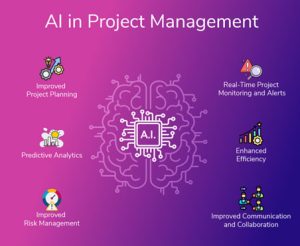
1. Predictive Analytics for Better Planning
AI systems analyze historical and real-time data to forecast timelines, resource needs, and budget requirements. This leads to more accurate project planning and reduced uncertainty.
2. Risk Identification and Mitigation
AI can flag potential risks—like supplier delays, budget overruns, or design inconsistencies—early in the process. Machine learning models continuously improve risk prediction over time.
3. Improved Resource Allocation
AI helps optimize workforce deployment, equipment usage, and materials allocation. This reduces idle time and ensures that the right resources are available at the right time.
4. Automation of Repetitive Tasks
Routine processes like scheduling, documentation, and reporting can be automated, freeing up human capital for higher-level problem-solving.
5. Enhanced Team Collaboration
AI tools with NLP can convert meeting notes into action items or summarize communications. Integrated systems keep everyone on the same page in real time.
6. Real-Time Performance Monitoring
AI dashboards track KPIs continuously, offering insights into project health. This allows managers to make proactive adjustments rather than reactive corrections.
Key Use Cases of AI in Engineering Projects
Construction and Civil Engineering
AI predicts delays due to weather, labor shortages, or permitting issues. Drones and sensors feed data into AI systems that optimize site operations.
Mechanical and Industrial Engineering
Predictive maintenance powered by AI avoids costly downtime. AI also helps in design validation by simulating mechanical stress and fluid dynamics.
Chemical and Process Engineering
AI manages quality control in real-time by analyzing sensor data. It also optimizes supply chain logistics and resource usage.
Software and Systems Engineering
AI enhances Agile/Scrum methodologies by analyzing sprints, identifying bottlenecks, and improving sprint predictions.
Electrical and Electronics Engineering
AI ensures design efficiency by simulating circuits and predicting power consumption. It also automates testing processes and identifies anomalies.
Tools Leading the AI Revolution in Project Management
Here are some of the top AI tools and platforms transforming engineering project workflows:
Procore + Avata Intelligence
Used in construction, Procore integrates AI modules from Avata to optimize workflows, detect conflicts, and predict cost overruns.
Autodesk Construction Cloud + AI Insights
Offers AI-powered design automation and clash detection, crucial in civil and architectural projects.
ClickUp + AI Assistant
Helps manage engineering sprints with automated suggestions, schedule optimization, and intelligent reporting.
Microsoft Project with AI Capabilities
Microsoft’s suite now includes AI that identifies project risks, recommends task prioritization, and integrates with Power BI for smarter visualization.
Asana + Smart Workflows
Utilizes AI to prioritize tasks and predict deadlines based on workload history and dependencies.
IBM Engineering Lifecycle Management
Tailored for complex systems engineering, this suite uses AI to track requirements, detect errors, and align teams across the development lifecycle.
SEO Tip – Why “AI in Project Management” Is a High-Ranking Keyword
“AI in project management” and related terms like “AI for engineering workflows” are rising in search volume due to growing awareness across industries. Here’s why it matters:
- High commercial intent – Users searching this are often decision-makers looking to invest.
- Topical relevance – Combines two booming niches: AI and project management.
- Evergreen value – As AI evolves, demand for updated content on the topic will persist.
- Opportunity for backlinks – Educational and technical content in this niche attracts academic and corporate references.
Future Trends in AI for Engineering Projects
- AI-Driven Digital Twins
Digital replicas of engineering systems that simulate performance under real-world conditions. - Generative Design
AI that produces multiple design alternatives based on input constraints, allowing engineers to evaluate optimal designs instantly. - Human-AI Collaboration Platforms
Systems where AI handles routine project management tasks while humans focus on creativity and problem-solving. - Natural Language Interfaces
AI will soon interpret voice commands or typed input to schedule meetings, update project status, and create reports. - Hyper-Personalization of Workflows
AI will adjust project dashboards, notifications, and reports to match individual team member preferences and responsibilities.
How to Implement AI in Your Project Workflow
Here’s a step-by-step approach:
Step 1: Audit Your Current Workflow
Understand where inefficiencies lie—whether in planning, communication, or tracking.
Step 2: Choose the Right Tools
Start with AI features built into tools you already use (e.g., Microsoft Project, Asana, Jira). Gradually layer more sophisticated solutions.
Step 3: Train Your Team
Invest in training to ensure adoption. Even the best tools fail if users don’t know how to use them.
Step 4: Set AI-Enhanced KPIs
Identify measurable goals: reduced project duration, fewer change orders, lower costs, higher quality.
Step 5: Start Small and Scale
Run a pilot project before a full rollout. Assess AI’s impact and refine integration strategies.
Step 6: Ensure Data Quality
AI is only as good as the data it receives. Establish protocols for clean, accurate, and timely data entry.
Common Challenges and How to Overcome Them
Challenge 1: Resistance to Change
Solution: Involve teams early. Show quick wins from AI tools to build trust.
Challenge 2: Integration Issues
Solution: Choose AI tools with APIs and compatibility with your existing tech stack.
Challenge 3: Data Privacy Concerns
Solution: Work with vendors who comply with GDPR, HIPAA, and other industry standards. Use on-premise AI if needed.
Challenge 4: Misunderstanding AI Capabilities
Solution: Clarify what AI can and can’t do. It’s a collaborator, not a manager.
Challenge 5: Cost of Implementation
Solution: Focus on ROI. AI might seem expensive, but reducing delays and rework pays off quickly.
Conclusion: Engineering a Smarter Future with AI
AI-powered project management is not a luxury—it’s a necessity for modern engineering teams. From anticipating project risks to automating workflows and enhancing design processes, AI is transforming how engineering projects are conceived, managed, and delivered.
For consulting firms like Avesta Consulting, offering AI implementation guidance adds strategic value to clients. It’s time to lead the engineering industry into a smarter, faster, and more adaptive future.
Looking to integrate AI into your engineering project workflows?
???? Contact Avesta Consulting today for a personalized consultation.
????️ ALT Text for Images (You can use these for different types of visuals)
- Image: AI Dashboard for Project Monitoring
ALT Text: “AI-powered project dashboard displaying real-time engineering KPIs and performance metrics” - Image: Engineering Team Collaborating with AI Assistant
ALT Text: “Engineering team using AI assistant tool for project planning and task allocation”