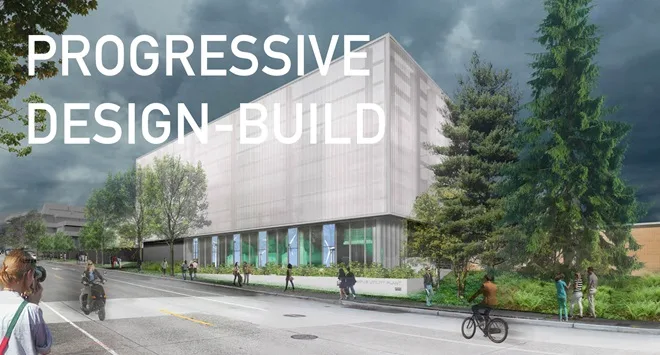
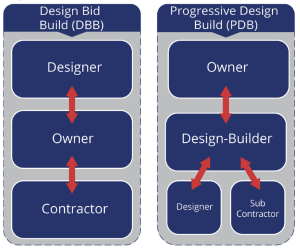
Progressive Design-Build (PDB) is a project delivery method that brings the owner, designer, and builder into close collaboration from the earliest stages of a construction project. Unlike traditional design-bid-build or fixed-price design-build models, PDB is structured around early engagement, transparent pricing, and shared decision-making.
In this model, the owner selects a design-builder based on qualifications, not price, and then works collaboratively through the preliminary design phase. Only after reaching an agreed design and budget does the team proceed to the final contract phase (known as “Phase 2”).
Key Features of Progressive Design-Build:
- Early selection of the design-build team
- Two-phase contract: initial services (design + preconstruction) and final construction
- Emphasis on collaboration and trust
- Flexible and adaptive to complex or undefined project scopes
Why Progressive Design-Build Is Gaining Traction
Progressive Design-Build is increasingly popular in both public and private sectors, especially for infrastructure, water, healthcare, and large-scale institutional projects. The growing complexity of projects and demand for faster delivery with fewer surprises has led many owners to adopt PDB over more traditional models.
Key drivers include:
- Complex projects with evolving scopes
- Need for speed and agility
- Desire for collaborative relationships
- Mitigation of change orders and disputes
How Progressive Design-Build Works (Phase by Phase)
Phase 1: Preliminary Services
- Team Selection: Based on qualifications, not price.
- Early Design Development: Conceptual and schematic design created collaboratively.
- Open-Book Budgeting: The contractor provides transparent cost estimates.
- Risk Identification: Potential design and construction risks are assessed together.
- Validation of Scope, Schedule, and Budget
Phase 2: Final Design and Construction
- GMP Agreement (Guaranteed Maximum Price): The team agrees on a target price.
- Full Construction Drawings: Final design development and documentation.
- Construction Begins: With full continuity from the early collaboration phase.
- Shared Accountability: Ongoing coordination ensures alignment with goals.
Top Benefits of Progressive Design-Build
1. Early Collaboration = Better Outcomes
Owners, designers, and builders collaborate from day one. This prevents design rework, improves constructability, and encourages innovation.
2. Cost and Scope Transparency
PDB uses open-book estimating, where the owner can review labor, materials, and markup costs, building trust and accountability.
3. Flexible Decision-Making
As designs evolve, teams can make informed decisions without rigid contractual constraints, especially helpful when project details are not fully known at the outset.
4. Faster Delivery
With early engagement, teams can parallel-track design and permitting or even begin construction before final designs are complete.
5. Reduced Risk of Disputes
PDB’s collaborative structure naturally reduces the “blame game.” Risks are shared, and disputes are often resolved during planning, not litigation.
6. Better Project Quality
Because teams collaborate and align incentives, PDB tends to produce higher-quality outcomes with fewer surprises or rework.
When to Use Progressive Design-Build
Progressive Design-Build is ideal for:
- Projects with undefined or evolving scopes
- Projects requiring tight collaboration across disciplines
- Projects with aggressive timelines
- Complex infrastructure like water/wastewater plants, hospitals, or airports
- Public sector projects seeking transparency and value-based procurement
Traditional vs. Progressive Design-Build
| Feature | Traditional Design-Build | Progressive Design-Build |
| Selection Criteria | Price + Qualifications | Qualifications |
| Design Completion at Award | 30–100% | 0–10% |
| Pricing Method | Lump Sum | Open-book, then GMP |
| Owner Involvement | Limited | High |
| Flexibility for Scope Changes | Low | High |
| Typical Use Case | Simple, well-defined projects | Complex, evolving projects |
Case Studies: Real-World Applications of PDB
Water Treatment Plant Expansion – Oregon
A $75M upgrade of a municipal water treatment facility used the PDB model. The evolving regulatory requirements made it ideal for PDB’s flexible framework. Collaborative early design helped integrate advanced filtration systems without project delays.
Hospital Expansion – Texas
An urban medical center used PDB to expand its ER and surgical wings. With many unknowns (underground utilities, structural tie-ins), early builder input prevented costly missteps and improved constructability.
Highway Infrastructure – California
A regional transportation agency applied PDB for a $200M interchange project. Open-book costing and shared risk allowed the team to manage inflation and schedule volatility.
The term “progressive design-build” is becoming a high-intent keyword with growing search volume. Owners, agencies, and even design firms are researching this model to improve project outcomes.
- Low competition, high relevance in AEC sectors
- Growing use in public sector RFPs
- Appears in industry reports by DBIA, ENR, FMI
Common Challenges in PDB (and How to Overcome Them)
1. Owner Must Stay Engaged
Unlike traditional models, the owner plays a central role in Phase 1. Lack of involvement can slow decision-making or cause scope creep.
Solution: Assign a dedicated owner’s rep or project manager who understands both design and construction.
2. Trust and Transparency Are Required
PDB depends on open-book cost sharing and shared responsibility. If trust breaks down, collaboration suffers.
Solution: Clearly define communication protocols, and document decisions throughout Phase 1.
3. Limited Awareness or Misconceptions
Some organizations confuse PDB with traditional design-build or CMAR (Construction Manager at Risk).
Solution: Educate stakeholders early, emphasizing how PDB is different—especially in selection, pricing, and collaboration.
How to Get Started with Progressive Design-Build
- Educate Stakeholders
Introduce the model internally through webinars, case studies, or workshops. - Choose the Right Partners
Select experienced design-builders who have completed PDB projects before. - Develop Clear Criteria
Use best-value procurement based on qualifications, experience, and approach to collaboration—not just cost. - Align Legal Contracts to PDB
Avoid standard DB templates. Work with attorneys familiar with collaborative models and risk-sharing frameworks. - Create a Phase 1 Agreement
Establish scope, schedule, deliverables, and budgets for the preconstruction phase. - Foster a Collaborative Culture
Invest in early workshops, joint risk registers, and shared performance KPIs.
The Future of Progressive Design-Build
As projects become more complex and delivery expectations rise, Progressive Design-Build is poised to become the default model for collaborative, high-performance project delivery.
The Design-Build Institute of America (DBIA) reports a 20–30% increase in PDB adoption annually, particularly in water, transportation, and civic infrastructure.
Innovations to watch:
- Integration with AI tools for preconstruction planning
- Digital twins and BIM integration from early stages
- Increased use of PDB in federal and military procurement
Conclusion: Is Progressive Design-Build Right for You?
If you’re seeking a flexible, transparent, and highly collaborative way to deliver complex projects—Progressive Design-Build is likely your best option. It aligns teams, improves outcomes, and reduces surprises.
At Avesta Consulting, we specialize in helping organizations transition to modern delivery models like PDB. From procurement strategy to team alignment, we ensure your PDB journey starts on the right foot.
???? Call to Action
Ready to explore Progressive Design-Build for your next project?
???? Contact Avesta Consulting today for a tailored consultation.
- Image: Design-Build Team Meeting
- ALT Text: “Progressive Design-Build team collaborating during early design phase”
- Image: Phase 1 and Phase 2 Process Chart
- ALT Text: “Two-phase Progressive Design-Build process: design and construction”