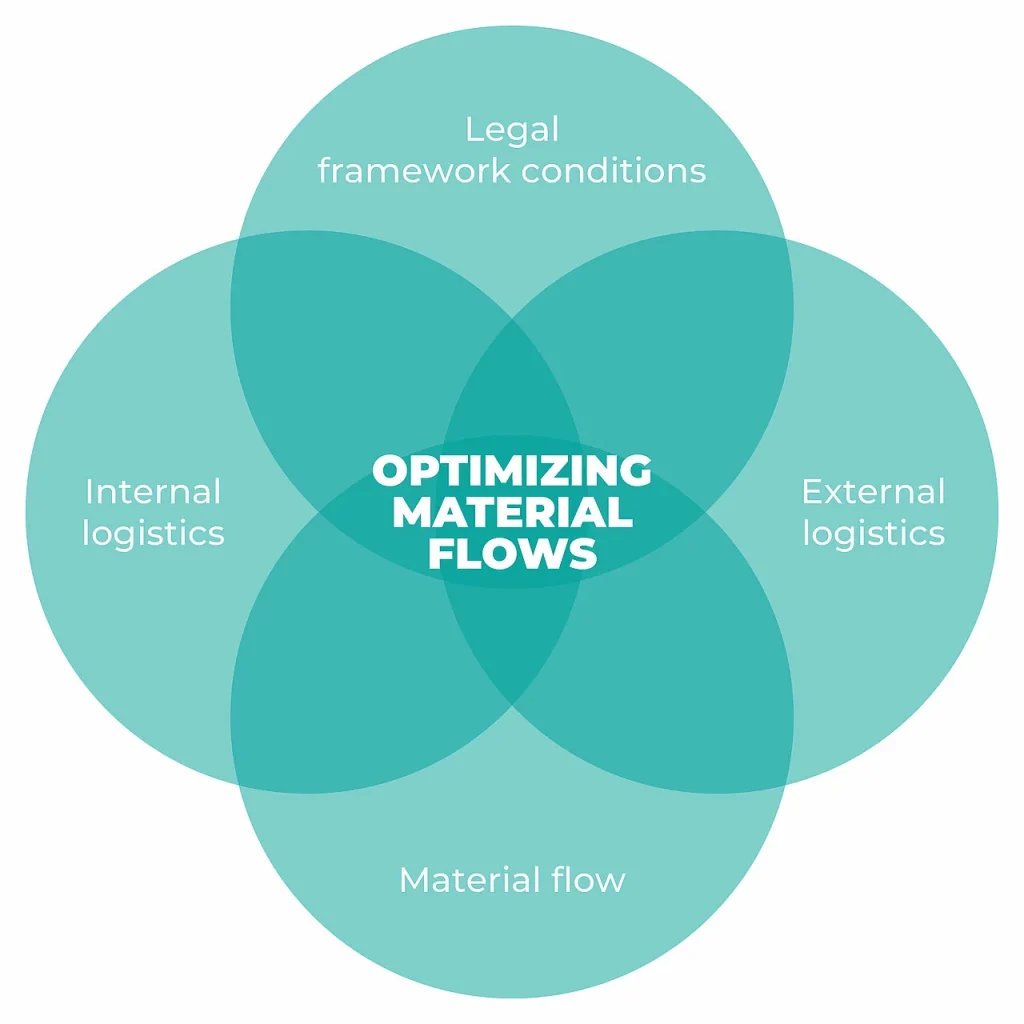
Efficient material movement is the backbone of any high-performing manufacturing or supply chain system. When materials move smoothly, production becomes faster, costs drop, and businesses can maintain consistent quality. Material Flow optimization (MFO) has therefore become one of the most critical improvement disciplines in modern manufacturing, logistics, and warehousing environments.
What Is Material Flow optimization ?
Definition of Material Flow optimization
Material Flow optimization refers to the process of analyzing, improving, and managing the movement of materials throughout production, supply chain, or warehousing operations.
It includes every stage—from raw material receipt and storage to in-process handling, movement between workstations, and final product dispatch.
The primary goal is to reduce waste, eliminate bottlenecks, and ensure materials flow smoothly without delays or excess inventory.
Importance for Manufacturing and Supply Chain Efficiency
Material flow is directly linked to operational performance. Poor flow means longer lead times, higher inventory, machine downtime, and customer delays. Optimizing flow leads to:
- Faster throughput
- Lower operating costs
- Better resource utilisation
- Reduced lead times
- Higher customer satisfaction
When materials flow seamlessly, everything else—production, logistics, planning—becomes more predictable and controlled.
Difference Between Material Flow and Product Flow
Although often confused, the two concepts are different:
| Material Flow | Product Flow |
|---|---|
| Movement of raw materials, components, WIP (work-in-progress), and packaging inside operations. | Movement of finished goods to customers or distribution points. |
| Focuses on internal movement. | Focuses on outbound movement. |
| Includes storage, handling, transport, and in-process transfers. | Includes shipping, distribution, and logistics networks. |
Material flow optimization focuses more on internal efficiency, while product flow is about external supply chain performance.
Key Principles of Material Flow optimization
Minimising Bottlenecks and Delays
A bottleneck is any point where materials build up due to slower processing rates.
Optimisation identifies:
- Overworked machines
- Long queues
- Excessive waiting
- Poor workstation layout
By reducing these delays, overall flow becomes faster and smoother.
Reducing Waste and Idle Time
Material waste includes unnecessary movement, damaged goods, excess handling, or long idle periods.
Lean principles classify these wastes as:
- Transportation waste
- Motion waste
- Waiting
- Overprocessing
- Overproduction
Eliminating these helps improve flow dramatically.
Streamlining Material Movement Through Processes
Materials should flow in a logical, linear, and efficient sequence.
Key strategies include:
- Minimising backtracking
- Designing U-shaped or linear layouts
- Reducing transport distances
- Automating flows with conveyors or AGVs
The smoother the material movement, the faster the production cycle.
Aligning Flow With Production Demand
Material flow must match customer and production needs.
If materials arrive too early → excess inventory.
If materials arrive too late → downtime and delays.
Tools like Kanban and demand-driven MRP help ensure accurate timing and quantity
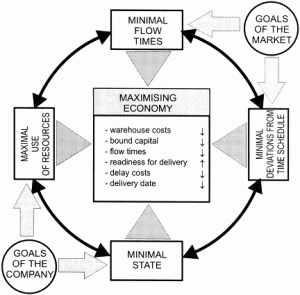 Steps to Optimise Material Flow
Step 1: Map Current Material Flows
Start with a detailed understanding of how materials move today.
Use:
- Value Stream Mapping (VSM)
- Process flow charts
- Spaghetti diagrams
- Material flow diagrams
Mapping reveals inefficiencies, detours, unnecessary steps, and wastes.
Step 2: Collect Process and Operational Data
Data validates the real conditions of your process.
Gather:
- Cycle times
- Lead times
- Handling times
- Inventory counts
- Machine utilisation
- Transport distances
This data is essential for defining bottlenecks and forecasting improvements.
Step 3: Identify Inefficiencies and Bottlenecks
Analyze the mapped flow and data to locate:
- High waiting times
- Build-ups of WIP
- Overloaded machines
- Underutilised resources
- Transportation waste
- Poor layout causing long movement paths
This is the diagnostic stage that shapes the improvement plan.
Step 4: Develop Improvement Strategies
Strategies may include:
- Redesigning plant layout
- Adding automation (AGVs, conveyors, sensors)
- Implementing Kanban systems
- Introducing FIFO lanes
- Reducing batch sizes
- Rebalancing workloads
- Improving scheduling algorithms
The strategy must be realistic, cost-effective, and aligned with production targets.
Step 5: Implement Changes and Monitor Results
Once improvement plans are executed, measure:
- Throughput rate
- Lead time reduction
- Inventory changes
- Operator movement reductions
- Machine utilisation impact
Monitoring ensures the flow does not revert back to old patterns.
Step 6: Continuous Improvement and Feedback
Material flow is not a one-time project.
Changes in products, demand, layout, and technology continuously impact flow.
Companies must:
- Review performance regularly
- Update their VSM and process maps
- Gather operator feedback
- Keep improving cycle times
Sustained improvements come from consistent feedback and evaluation.
Tools and Techniques for Material Flow optimization
Process Mapping Software
Digital flow mapping allows teams to visualise complex material movement.
Common software includes:
- Lucidchart
- Visio
- Minitab Workspace
- Siemens Tecnomatix
- AutoCAD for layout mapping
These tools help model different scenarios and validate improvements.
Lean Manufacturing Tools (Kanban, 5S, Kaizen)
Lean tools are essential for improving flow:
- Kanban: controls material flow through pull-based demand.
- 5S: keeps work areas organised for fast material movement.
- Kaizen: promotes continuous small improvements.
- SMED: reduces setup times to keep flow fast.
- Poka-Yoke: prevents errors that slow down processes.
Lean thinking is the foundation of most material flow strategies.
Simulation and Modeling Software
Simulation allows testing improvement strategies before implementation.
You can simulate:
- Machine loads
- Layout changes
- Inventory changes
- Flow variations
- Shifts in demand
Tools include FlexSim, AnyLogic, Arena, and Simio.
Real-Time Monitoring and Dashboards
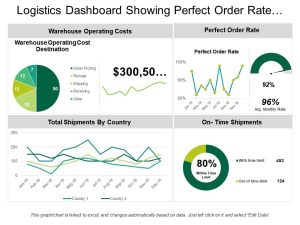
IoT sensors, RFID, and digital dashboards allow businesses to track material movement in real-time.
Managers can detect delays, shortages, or inefficiencies immediately.
This supports predictive decision-making and proactive intervention.
Applications of Material Flow optimization
Manufacturing Production Lines
Production lines benefit the most from optimised flow.
Benefits include:
- Reduced downtime
- Fewer material shortages
- Faster cycle times
- Balanced workstations
- Higher productivity
MFO is especially important in automotive, electronics, food processing, and heavy industry.
Warehousing and Inventory Management
Improving material flow in warehouses leads to:
- Faster order picking
- Reduced walking time
- Lower inventory holding cost
- Optimised storage layouts
- Better replenishment strategies
Automation like AS/RS and WMS tools are often used.
Logistics and Distribution Networks
Smooth material flow results in:
- Better shipment scheduling
- Lower transport costs
- Enhanced route planning
- Reduced loading/unloading times
Material flow ensures all logistics elements run at their best.
New Product Introduction Planning
When introducing new products:
- Workstation layouts may change
- Material requirements differ
- Inventory behaviour shifts
- Suppliers may be new
MFO helps companies redesign flows to support the new product efficiently from day one.
Benefits of Material Flow optimization
Improved Throughput and Efficiency
By reducing bottlenecks and delays, companies produce more in less time.
Reduced Operational Costs and Waste
Optimised flow eliminates:
- Overhandling
- Rework
- Inventory waste
- Energy waste
- Excess labor movement
Lower waste = higher profitability.
Better Inventory Management
Material flow improves both raw material and WIP inventory.
Companies can shift from “just-in-case” to “just-in-time”.
Enhanced Decision-Making and Planning
When flow is predictable, planning accuracy improves.
Companies can better forecast:
- Production
- Inventory needs
- Lead times
- Staff allocation
- Machine usage
This leads to stronger strategic and operational decisions.
Common Challenges in Material Flow optimization
Complex or Dynamic Processes
Large-scale operations with complex layouts or high product mix make flow optimisation difficult.
Processes often change quickly, requiring constant updates.
Incomplete or Inaccurate Data
Poor data leads to poor decisions.
Flow optimisation depends heavily on:
- Real-time data
- Accurate cycle time measurements
- Updated layouts
Without reliable data, optimisation is guesswork.
Resistance to Process Change
Employees may resist new layouts, new tools, or new flow strategies.
Effective training and communication are essential.
Best Practices for Effective Material Flow Optimization
Engage Cross-Functional Teams
Material flow affects production, logistics, planning, quality, and purchasing.
Teams across all departments must collaborate.
Validate Improvements With Real Data
Always test improvements using:
- Simulation
- Time studies
- Pilot implementation
- KPI-based analysis
Data-driven decisions ensure long-term success.
Continuously Monitor and Update Flows
Material flow must evolve with:
- Customer demand
- New equipment
- New products
- Layout changes
- Resource availability
Constant review ensures stability.
Integrate MFO Into Continuous Improvement Programs
Material flow optimization should be part of:
- Lean programs
- Six Sigma projects
- Digital transformation initiatives
- Industry 4.0 strategies
Companies that embrace ongoing improvement see long-term competitive advantage.
Conclusion
Material Flow Optimisation is one of the most impactful ways to improve manufacturing and supply chain efficiency. By understanding current flows, reducing waste, and implementing data-driven improvements, companies can significantly enhance productivity, reduce costs, and improve responsiveness.
With continuous monitoring and the right tools, a business can build a resilient, efficient, and scalable operational system.