Designing a bridge is one of the most fascinating and complex challenges in civil and structural engineering. It requires a balance between creativity, safety, efficiency, and cost-effectiveness. Whether you are an engineer, a project manager, or a client exploring infrastructure development, understanding the bridge design process gives you a powerful advantage in decision-making.
In this comprehensive guide, we will walk through everything you need to know about bridge design—from fundamental concepts to practical considerations—while keeping the explanation accessible for both technical and non-technical audiences.
What is the Best Design for Bridges?
There is no single “best” bridge design. The ideal design depends entirely on the project’s specific requirements, including location, load, span length, environmental conditions, and budget.
However, a good bridge design always achieves the following:
- Structural safety and stability
- Cost efficiency (construction and maintenance)
- Durability over time
- Suitability for environmental conditions
- Aesthetic integration with surroundings
For example:
- A beam bridge may be the best choice for short spans due to its simplicity and cost-effectiveness.
- A suspension bridge is ideal for very long spans where minimal support in the middle is required.
- A cable-stayed bridge offers a balance between aesthetics and structural performance for medium to long spans.
In modern engineering, determining the best design increasingly relies on advanced simulation and modeling tools. These tools allow engineers to test multiple design scenarios before construction begins. If you’re exploring this further, understanding bridge simulation software can provide deeper insight into how engineers validate performance under real-world conditions.
What are the 6 Main Factors to Consider When Designing a Bridge?
Designing a bridge is not just about structure—it’s about context. Engineers must consider multiple factors simultaneously:
1. Load and Traffic Requirements
Bridges must safely carry:
- Vehicles
- Pedestrians
- Trains (if applicable)
Engineers calculate:
- Dead loads (structure weight)
- Live loads (traffic)
- Dynamic loads (movement, vibration)
2. Span Length
The distance between supports determines the type of bridge:
- Short spans → Beam bridges
- Medium spans → Arch or truss bridges
- Long spans → Suspension or cable-stayed bridges
3. Environmental Conditions
Climate and surroundings heavily influence design:
- Wind forces
- Earthquakes
- Temperature variations
- Flood levels
This is where simulation plays a key role. Using advanced modeling techniques (like those explored in bridge modeling software help predict environmental impacts before construction.) helps predict environmental impacts before construction.
4. Material Selection
Common materials include:
- Steel
- Reinforced concrete
- Prestressed concrete
- Composite materials
Each material affects:
- Strength
- Durability
- Maintenance cost
5. Foundation and Soil Conditions
The ground beneath the bridge determines:
- Type of foundation
- Depth of supports
- Stability of the entire structure
Poor soil conditions can significantly increase project complexity and cost.
6. Budget and Lifecycle Cost
A bridge is a long-term investment. Engineers must consider:
- Initial construction cost
- Maintenance expenses
- Expected lifespan
A cheaper design upfront may become expensive over time if maintenance is high.
What are the 7 Types of Bridges?
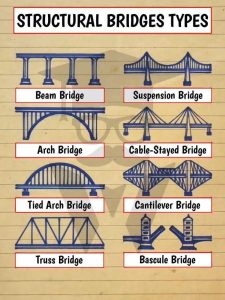
Understanding bridge types is essential to selecting the right structure. Here are the seven primary types:
1. Beam Bridge
The simplest type:
- Horizontal beam supported by piers
- Best for short distances
- Cost-effective but limited in span
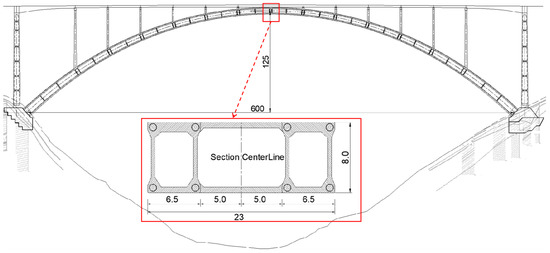
2. Arch Bridge
Uses a curved structure to distribute loads:
- Strong and durable
- Ideal for medium spans
- Often used in valleys or over rivers
3. Truss Bridge
Made of interconnected triangular units:
- High strength-to-weight ratio
- Efficient for heavy loads
- Common in railway bridges
4. Suspension Bridge
Features cables suspended between towers:
- Suitable for very long spans
- Flexible and visually striking
- Requires advanced engineering analysis
5. Cable-Stayed Bridge
Cables connect directly from deck to towers:
- Modern and efficient
- Less cable material than suspension bridges
- Popular for medium-to-long spans
6. Cantilever Bridge
Built using projecting beams:
- Ideal for situations where support from below is limited
- Strong but complex to design
7. Movable Bridge
Includes:
- Drawbridges
- Swing bridges
Used where ships need to pass through.
Each type has unique design challenges, which is why engineers often rely on structural analysis tools such as bridge design in STAAD Pro to validate load distribution and performance.
What are the 5 Components of a Bridge?
Every bridge, regardless of type, consists of five key components:
1. Deck
The surface where traffic moves:
- Must be strong and durable
- Designed to handle wear and environmental exposure
2. Superstructure
The part above the supports:
- Includes beams, trusses, or cables
- Carries the load of the deck
3. Substructure
Includes piers and abutments:
- Transfers load from superstructure to foundation
4. Foundation
The base of the bridge:
- Transfers loads to the ground
- Critical for stability
5. Bearings
Located between deck and supports:
- Allow controlled movement
- Handle thermal expansion and load shifts
Understanding these components helps both engineers and clients visualize how the structure functions as a whole system.
What are 5 Tools Used to Build a Bridge?
Bridge construction combines physical tools and digital technologies. Here are five essential tools used in modern bridge projects:
1. Structural Analysis Software
Used to calculate loads, stresses, and structural behavior.
2. Simulation Tools
Help engineers predict:
- Wind effects
- Seismic response
- Traffic impact
These are critical in reducing design risks.
3. Modeling Software
Creates detailed 3D representations of the bridge. These models help in:
- Visualization
- Clash detection
- Construction planning
4. Surveying Equipment
Includes:
- Total stations
- GPS systems
Used for accurate site measurements and alignment.
5. Construction Machinery
Such as:
- Cranes
- Excavators
- Concrete pumps
While physical tools build the structure, digital tools ensure it is built correctly. For example, combining simulation and modeling (as explained in Bridge Simulation Software and Bridge Modeling Software) significantly improves project outcomes.
In modern projects, combining bridge simulation software and bridge modeling software significantly improves design accuracy and reduces risks.
What are the Four General Stages of Bridge Design?
Bridge design is a structured process that moves from concept to execution. The four main stages are:
1. Conceptual Design
This is the idea phase:
- Selecting bridge type
- Estimating span and layout
- Initial cost evaluation
At this stage, multiple alternatives are explored.
2. Preliminary Design
Refinement begins:
- Basic dimensions are defined
- Material selection starts
- Initial structural calculations are performed
This phase often includes early modeling and simulation.
3. Detailed Design
This is the most technical stage:
- Full structural analysis
- Precise calculations
- Design of every component
Engineers use advanced tools like Bridge Design in STAAD Pro to ensure accuracy and safety.
4. Construction and Implementation
The design becomes reality:
- Construction drawings are executed
- Engineers monitor progress
- Adjustments are made if needed
Close coordination between designers and contractors is essential at this stage.
Step-by-Step Overview: How a Bridge Structure is Designed
To bring everything together, here is a simplified step-by-step process:
- Site analysis and data collection
- Selection of bridge type
- Load and environmental analysis
- Preliminary structural design
- Modeling and simulation validation
- Detailed engineering design
- Construction planning and execution
Each step builds on the previous one, ensuring that the final structure is safe, efficient, and durable.
The Role of Modern Engineering in Bridge Design
Today, bridge design is no longer based solely on manual calculations. Advanced technologies have transformed the field:
- Simulation tools reduce uncertainty
- 3D modeling improves accuracy
- Optimization algorithms enhance efficiency
This shift allows engineering firms to deliver:
- Faster project timelines
- Reduced costs
- Higher safety standards
For companies offering engineering consulting services, integrating these technologies is no longer optional—it is a competitive necessity.
Conclusion
Designing a bridge structure is a multidisciplinary process that combines engineering principles, environmental awareness, and advanced technology. From choosing the right bridge type to analyzing loads and finalizing construction details, every step plays a crucial role in ensuring the structure’s success.
For both engineers and clients, understanding the fundamentals of bridge design leads to better decisions, improved collaboration, and more successful projects.
As infrastructure demands continue to grow worldwide, the importance of efficient, safe, and innovative bridge design will only increase. By combining foundational engineering knowledge with modern tools such as simulation and modeling, it is possible to create structures that stand the test of time—both functionally and aesthetically.