In today’s engineering and industrial world, simulation software has become one of the most important digital tools for reducing risk, improving design accuracy, and accelerating project delivery. From bridge construction and manufacturing plants to oil & gas systems and urban infrastructure, simulation technologies allow engineers and businesses to test ideas virtually before implementing them in reality.
Instead of relying only on physical prototypes, trial-and-error processes, or expensive field testing, companies now use simulation software to create virtual models that replicate real-world behavior. These models help predict how systems, structures, machines, or processes will perform under different conditions.
Whether you are an engineering consultant, project owner, industrial manager, or technical student, understanding simulation software and its applications is essential in modern engineering environments.
This article explains:
- What simulation software is
- Examples of simulation software
- Different types of simulation
- The stages of simulation studies
- What 4D simulations are
- Real-world engineering applications
- Benefits and limitations of simulation technologies
What Is Simulation Software?
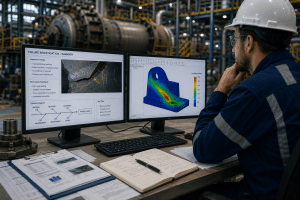
Simulation software is a digital tool used to create virtual models of real-world systems, processes, machines, structures, or environments in order to analyze their behavior under different conditions.
The main goal of simulation software is to predict outcomes before physical implementation. Engineers and consultants use these tools to test designs, improve efficiency, identify risks, and optimize performance.
Simulation software works by using mathematical models, physics equations, engineering principles, and computational algorithms to imitate real-life operations.
For example:
- A structural engineer can simulate how a bridge reacts during earthquakes.
- A factory manager can simulate production flow to reduce bottlenecks.
- A transportation planner can simulate traffic movement in a city.
- An oil & gas consultant can simulate fluid flow in pipelines.
- A construction company can simulate project scheduling and construction sequencing.
In many industries, simulation reduces project costs, improves safety, and shortens development time.
Why Simulation Software Is Important
Modern engineering projects are becoming increasingly complex. Without simulation tools, companies would need to depend heavily on physical testing, which is often expensive, slow, and risky.
Simulation software provides several advantages:
1. Risk Reduction
Potential failures can be identified before construction or manufacturing begins.
2. Cost Savings
Virtual testing reduces the need for physical prototypes and repeated redesigns.
3. Faster Project Delivery
Engineers can analyze multiple scenarios quickly and make faster decisions.
4. Improved Accuracy
Simulation tools allow highly detailed analysis of structures, systems, and processes.
5. Better Decision-Making
Project managers and stakeholders can visualize outcomes before implementation.
What Are Some Simulation Software?
There are many types of simulation software used across industries. Each software focuses on specific engineering or operational applications.
Below are some widely used simulation software examples.
1. ANSYS
ANSYS is one of the most popular engineering simulation platforms used worldwide.
It is commonly used for:
- Finite Element Analysis (FEA)
- Structural simulation
- Fluid dynamics
- Thermal analysis
- Electromagnetic simulations
Industries using ANSYS include aerospace, automotive, civil engineering, and energy.
Example Application
Engineers may use ANSYS to simulate stress distribution in steel structures under heavy loads.
2. MATLAB & Simulink
MATLAB and Simulink are widely used for mathematical modeling and system simulation.
Applications include:
- Control systems
- Signal processing
- Robotics
- Electrical systems
- Mechanical systems
Simulink allows engineers to visually model dynamic systems using block diagrams.
3. STAAD.Pro
STAAD.Pro is commonly used in civil and structural engineering.
It helps engineers simulate:
- Building structures
- Bridges
- Towers
- Industrial facilities
- Load analysis
Structural consultants frequently use STAAD.Pro for seismic and wind load simulations.
4. Aspen HYSYS
Aspen HYSYS is widely used in process engineering industries such as oil & gas, petrochemical, and energy.
It helps simulate:
- Fluid flow
- Heat exchangers
- Chemical processes
- Refinery operations
- Gas processing systems
5. Arena Simulation
Arena Simulation is commonly used for industrial and operational simulations.
Applications include:
- Manufacturing systems
- Supply chain analysis
- Hospital operations
- Production line optimization
6. COMSOL Multiphysics
COMSOL Multiphysics enables multi-physics simulations where several physical effects interact simultaneously.
Examples include:
- Heat transfer
- Structural mechanics
- Electromagnetics
- Acoustics
- Fluid flow
7. AnyLogic
AnyLogic is used for advanced simulation modeling.
It supports:
- Agent-based simulation
- Discrete-event simulation
- System dynamics simulation
Industries include logistics, healthcare, transportation, and manufacturing.
What Are Examples of Simulation?
Simulation can be found in almost every engineering and industrial sector. Below are some practical examples.
Structural Simulation
Structural engineers simulate how buildings, bridges, and towers respond to loads, earthquakes, wind, and vibration.
Example
A bridge model is tested virtually under traffic and seismic conditions before construction begins.
Manufacturing Simulation
Factories simulate production lines to improve efficiency and reduce downtime.
Example
A manufacturing plant simulates worker movement and machine operations to optimize production speed.
Traffic Simulation
Transportation engineers simulate road traffic and transportation networks.
Example
A city authority simulates traffic congestion during peak hours before redesigning road infrastructure.
Fluid Flow Simulation
Oil & gas industries simulate the movement of liquids and gases through pipelines.
Example
Engineers test pressure changes inside pipelines under varying temperatures.
Construction Simulation
Construction companies simulate project schedules and sequencing.
Example
A contractor simulates crane operations and material movement before starting construction.
Healthcare Simulation
Hospitals use simulation to optimize patient flow and emergency response systems.
Example
Emergency departments simulate patient admission rates to reduce waiting times.
What Are the 4 Types of Simulation?
Simulation methods are generally divided into four major categories.
1. Discrete Event Simulation
Discrete event simulation models systems where events occur at specific times.
Examples include:
- Manufacturing lines
- Warehouse systems
- Airport operations
- Customer service systems
This type focuses on events such as machine breakdowns, customer arrivals, or inventory changes.
2. Continuous Simulation
Continuous simulation analyzes systems that change continuously over time.
Examples include:
- Fluid dynamics
- Temperature variation
- Chemical processing
- Hydraulic systems
This type is common in process engineering.
3. Agent-Based Simulation
Agent-based simulation models interactions between individual entities or agents.
Examples include:
- Traffic systems
- Crowd movement
- Market behavior
- Social systems
Each agent behaves independently based on predefined rules.
4. Monte Carlo Simulation
Monte Carlo simulation uses probability and random variables to predict outcomes.
It is commonly used in:
- Risk analysis
- Financial forecasting
- Project management
- Reliability engineering
For example, project managers may simulate multiple schedule outcomes to estimate project completion risk.
What Are the 5 Stages of Simulation?
Simulation projects typically follow a structured workflow to ensure accuracy and reliability.
1. Problem Definition
The first stage identifies the system, challenge, or objective.
Questions include:
- What needs to be analyzed?
- What are the project goals?
- What outputs are required?
Example:
A company wants to reduce traffic congestion inside an industrial facility.
2. Model Development
Engineers create the mathematical or digital model representing the system.
This stage involves:
- Geometry creation
- Data collection
- Parameter definition
- System assumptions
3. Verification and Validation
The model is tested to ensure it behaves correctly and accurately represents real-world conditions.
Verification checks:
- Is the model built correctly?
Validation checks:
- Does the model reflect reality?
4. Simulation Execution
The simulation runs under different scenarios and operating conditions.
Engineers may analyze:
- Maximum loads
- Failure conditions
- Operational efficiency
- Safety margins
5. Result Analysis and Optimization
The final stage interprets results and improves the system.
Possible outcomes include:
- Design modifications
- Process optimization
- Cost reduction
- Improved safety
- Better scheduling
What Are 4D Simulations?
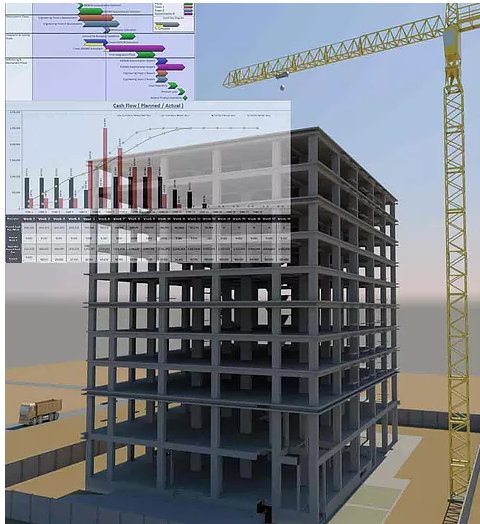
4D simulation combines 3D modeling with time-based scheduling information.
The “fourth dimension” refers to time.
In construction and infrastructure projects, 4D simulations help visualize how projects progress over time.
How 4D Simulation Works
A 3D model of a structure is connected to the project schedule.
This allows teams to visualize:
- Construction sequencing
- Equipment movement
- Material installation
- Project timelines
- Worksite logistics
Benefits of 4D Simulation
Improved Planning
Construction teams can identify scheduling conflicts before work begins.
Better Communication
Project stakeholders can visualize construction phases clearly.
Reduced Delays
Potential clashes and inefficiencies become visible early.
Enhanced Safety
Site risks can be identified during planning stages.
Industries Using 4D Simulations
4D simulation is widely used in:
- Construction
- Infrastructure
- Transportation
- Industrial plants
- Large-scale engineering projects
Simulation Software in Civil Engineering
Civil engineering is one of the industries most dependent on simulation technologies.
Applications include:
- Structural analysis
- Earthquake simulation
- Wind analysis
- Foundation settlement analysis
- Bridge modeling
- Traffic analysis
- Construction sequencing
Simulation enables engineers to evaluate performance before actual construction begins.
Simulation Software in Industrial Engineering
Industrial engineers use simulation tools to optimize operational systems.
Common applications:
- Production planning
- Supply chain analysis
- Inventory optimization
- Factory layout simulation
- Resource allocation
These simulations help improve efficiency and reduce operational costs.
Simulation Software in Oil and Gas
The oil & gas sector uses simulation extensively for process optimization and safety analysis.
Applications include:
- Pipeline flow simulation
- Reservoir modeling
- Heat exchanger analysis
- Gas processing
- Process safety evaluation
Simulation reduces operational risks and improves system performance.
Challenges and Limitations of Simulation Software
Although simulation software offers major advantages, it also has limitations.
High Initial Cost
Advanced simulation tools can be expensive.
Complex Learning Curve
Professional engineering simulation requires technical expertise.
Dependence on Accurate Data
Incorrect input data can lead to unreliable results.
Computational Requirements
Large simulations may require high-performance computing systems.
Future of Simulation Software
Simulation technology is evolving rapidly with advances in:
- Artificial intelligence
- Cloud computing
- Digital twins
- Real-time data integration
- Virtual reality
- Machine learning
Modern industries increasingly use “digital twin” technology, where real systems are continuously connected to virtual simulation models.
This allows ongoing monitoring and predictive maintenance.
Conclusion
Simulation software has transformed modern engineering, industrial operations, and project management. By creating virtual models of real-world systems, organizations can reduce costs, improve safety, optimize performance, and accelerate project delivery.
From structural analysis and manufacturing optimization to 4D construction simulations and fluid dynamics modeling, simulation technologies are now essential across multiple industries.
Understanding the different types of simulation, the stages of simulation studies, and the most widely used software platforms helps businesses and engineers make smarter technical decisions.
As engineering projects become more complex, simulation software will continue playing a critical role in innovation, sustainability, and operational efficiency.