What Is Material Flow Planning?
Definition of Material Flow Planning
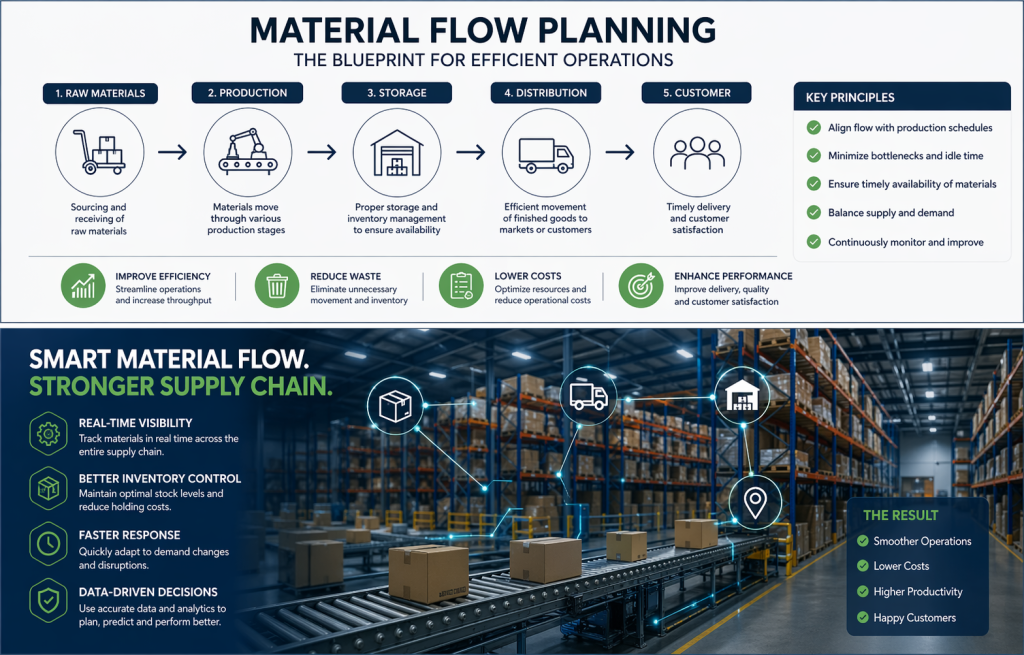
Material Flow Planning is the strategic process of designing, organizing, and managing the movement of raw materials, components, and finished goods throughout a production or supply chain system. It ensures that materials are available at the right place, at the right time, and in the right quantity to support uninterrupted operations.
Unlike reactive approaches, material flow planning is proactive. It involves forecasting demand, mapping processes, and coordinating supply chain activities to minimize inefficiencies and ensure smooth production.
In industrial environments, material flow planning acts as the backbone of operational performance. Without it, even the most advanced production systems can suffer from delays, overstocking, or costly interruptions.
Importance for Manufacturing and Supply Chain Efficiency
Material flow planning plays a critical role in improving both manufacturing efficiency and overall supply chain performance. In modern industries where competition is intense and margins are tight, even minor inefficiencies can lead to significant financial losses.
Effective material flow planning helps organizations:
- Reduce production downtime caused by material shortages
- Avoid excessive inventory and storage costs
- Improve coordination between departments
- Enhance responsiveness to market demand changes
- Increase throughput and operational speed
For manufacturing companies, this means smoother production cycles. For supply chains, it ensures seamless coordination between suppliers, warehouses, and distribution centers.
Difference Between Planning, Tracking, and Optimization
Although often used interchangeably, planning, tracking, and optimization are distinct concepts:
- Material Flow Planning focuses on designing how materials should move
- Material Flow Tracking monitors how materials actually move in real time
- Material Flow Optimization improves and refines processes based on performance data
Planning is the foundation. Without a well-structured plan, tracking becomes reactive and optimization becomes guesswork.
Key Principles of Material Flow Planning
Aligning Material Flow with Production Schedules
One of the most important principles is synchronizing material flow with production requirements. Materials must arrive exactly when needed—not too early (which increases storage costs) and not too late (which causes delays).
This alignment ensures:
- Continuous production flow
- Reduced work-in-progress inventory
- Better utilization of resources
Minimizing Bottlenecks and Idle Time
Bottlenecks are one of the biggest threats to operational efficiency. They occur when one stage of production cannot keep up with the rest.
Material flow planning identifies these constraints early and ensures that materials are distributed evenly across processes. This reduces idle time and prevents accumulation of materials in certain areas.
Ensuring Timely Availability of Materials
Timely availability is not just about having materials—it’s about having the right materials in the right quantities at the right moment.
This requires:
- Accurate demand forecasting
- Reliable supplier coordination
- Efficient internal logistics
Balancing Supply and Demand
Overproduction and underproduction both lead to inefficiencies. Material flow planning ensures a balance between supply and demand by coordinating procurement, production, and distribution activities.
This balance is especially critical in industries with fluctuating demand or seasonal variations.
Steps in Material Flow Planning
Step 1: Map All Material Flows in the Process
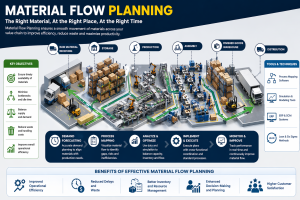
The first step is to create a complete visual representation of how materials move through the system.
This includes:
- Raw material entry points
- Production stages
- Storage areas
- Final product dispatch
Process mapping helps identify inefficiencies, redundancies, and unnecessary movements.
Step 2: Collect and Analyse Operational Data
Data is the foundation of effective planning. Key data points include:
- Production rates
- Lead times
- Inventory levels
- Supplier performance
- Transportation times
By analyzing this data, companies gain insights into current performance and identify improvement opportunities.
Step 3: Identify Inefficiencies and Risks
Once data is collected, the next step is to detect inefficiencies such as:
- Delays in material delivery
- Excess inventory accumulation
- Repetitive handling or transport
- Equipment underutilization
Risk analysis is also crucial, especially for supply chain disruptions or demand variability.
Step 4: Develop Flow Plans and Strategies
Based on insights, companies develop optimized flow strategies. These may include:
- Just-in-Time (JIT) delivery systems
- Optimized routing and layout changes
- Improved supplier coordination
- Buffer stock strategies for critical materials
Step 5: Implement and Monitor Plans
Implementation requires coordination across departments. Once deployed, performance must be continuously monitored to ensure the plan is working as intended.
KPIs may include:
- Lead time reduction
- Inventory turnover
- Production efficiency
- On-time delivery rates
Step 6: Integrate with ERP and Logistics Systems
Modern material flow planning is deeply integrated with digital systems such as ERP platforms and logistics software.
Integration enables:
- Real-time visibility
- Automated planning updates
- Improved communication across departments
Tools and Techniques for Material Flow Planning
Process Mapping Software
Tools like flowcharts and digital mapping software help visualize material movement and identify inefficiencies.
They provide clarity and make complex systems easier to understand and optimize.
Simulation and Modeling Tools
Simulation tools allow companies to test different scenarios without disrupting actual operations.
These tools help answer questions like:
- What happens if demand increases by 20%?
- How will delays impact production?
Simulation reduces risk and improves decision-making.
ERP and Supply Chain Management Systems
ERP systems play a crucial role in managing material flow. They integrate data from procurement, production, inventory, and distribution.
This ensures:
- Data consistency
- Better planning accuracy
- Faster decision-making
Lean and Six Sigma Methods
Lean focuses on eliminating waste, while Six Sigma aims to reduce variability and defects.
When applied to material flow planning, these methodologies:
- Improve efficiency
- Reduce costs
- Enhance quality
Applications of Material Flow Planning
Manufacturing Production Lines
Material flow planning ensures that production lines operate smoothly without interruptions.
It helps in:
- Reducing downtime
- Improving throughput
- Enhancing productivity
Warehousing and Distribution Networks
In warehouses, efficient material flow reduces handling time and improves storage utilization.
In distribution networks, it ensures faster and more reliable deliveries.
Supply Chain and Logistics Planning
Material flow planning connects all supply chain elements, ensuring seamless coordination between suppliers, manufacturers, and distributors.
New Product Introduction and Ramp-Up
When launching new products, material flow planning ensures a smooth transition from development to full-scale production.
It minimizes risks associated with demand uncertainty and process inefficiencies.
Benefits of Material Flow Planning
Improved Operational Efficiency
Well-planned material flow reduces delays and ensures smooth operations, leading to higher productivity.
Reduced Delays and Waste
By eliminating unnecessary movements and inefficiencies, companies can significantly reduce waste and operational delays.
Better Inventory and Resource Management
Material flow planning helps maintain optimal inventory levels, reducing both shortages and excess stock.
Enhanced Decision-Making and Planning
With accurate data and structured planning, decision-makers can respond quickly to changes and make informed choices.
Common Challenges in Material Flow Planning
Complex and Dynamic Processes
Modern manufacturing systems are complex and constantly changing. This makes planning more challenging and requires continuous updates.
Data Accuracy and Integration Issues
Poor data quality can lead to incorrect planning decisions. Integrating data from multiple systems is often a major challenge.
Resistance to Operational Changes
Employees and management may resist changes to established processes, even when improvements are needed.
Overcoming this requires strong leadership and clear communication.
Best Practices for Effective Material Flow Planning
Engage Cross-Functional Teams
Material flow planning should involve multiple departments, including production, logistics, procurement, and IT.
Collaboration ensures better alignment and more effective solutions.
Continuously Monitor and Adjust Plans
Material flow planning is not a one-time activity. Continuous monitoring and improvement are essential for long-term success.
Validate Improvements with Real Data
All changes should be tested and validated using actual performance data to ensure effectiveness.
Integrate Material Flow Planning into Overall Supply Chain Strategy
For maximum impact, material flow planning must be aligned with the broader supply chain strategy.
This ensures consistency, efficiency, and long-term sustainability.
Conclusion
Material Flow Planning is no longer optional—it is a critical component of modern manufacturing and supply chain success. Companies that invest in structured planning, data-driven decision-making, and continuous improvement gain a significant competitive advantage.
By implementing the principles, tools, and best practices outlined in this guide, businesses can achieve higher efficiency, lower costs, and better operational performance.
For organizations aiming to stay ahead in today’s competitive landscape, mastering material flow planning is a strategic necessity.