Day: December 27, 2025

Visual diagram showing product flow from manufacturing to delivery with bottlenecks highlighted

Product Flow Analysis: Optimizing Movement from Production to Delivery

In today’s competitive manufacturing and supply chain environment, efficiency is more than just reducing costs—it’s about ensuring smooth product movement, minimizing delays, and maximizing throughput across the entire value chain. Product Flow Analysis (PFA) is a structured methodology that allows organizations to track, evaluate, and optimize the movement of products
Read More
1. Diagram illustrating dynamic flow analysis workflow from data collection to optimization recommendations

Dynamic Flow Analysis: Optimizing Systems and Processes in Real Time

In modern industries, achieving operational efficiency requires more than just static planning. Systems and processes often behave differently under real operating conditions, and static analysis may fail to capture transient behaviors, bottlenecks, or inefficiencies. Dynamic Flow Analysis (DFA) addresses this challenge by studying real-time system behavior and providing actionable insights

Read More
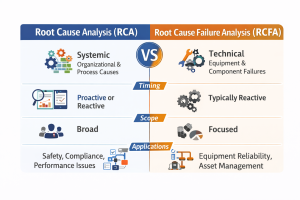
1. Comparison diagram showing differences between root cause analysis and root cause failure analysis

RCA vs RCFA: Understanding the Key Differences and Choosing the Right Approach

In today’s complex operational environments, failures rarely occur in isolation. Equipment breakdowns, safety incidents, quality deviations, and organizational underperformance are often symptoms of deeper issues embedded within systems, processes, and decision-making structures. To prevent recurrence and improve performance, organizations rely on structured problem-solving methodologies—two of the most commonly used are

Read More
Transformation root cause analysis framework showing systemic, human, and process-level factors influencing organizational change

Transformation Root Cause Analysis: A Strategic Approach to Sustainable Organizational Change

Organizational transformation is one of the most challenging initiatives any business can undertake. Whether driven by digital transformation, operational excellence programs, cultural change, or large-scale restructuring, many transformation efforts fail to deliver their intended outcomes. Missed deadlines, low adoption rates, resistance from employees, and underwhelming performance improvements are common symptoms.

Read More
Comparison diagram showing differences between root cause analysis and FMEA methodologies.

Difference Between Root Cause Analysis and FMEA: A Complete Practical Guide

Organizations that operate complex systems—whether in manufacturing, oil and gas, utilities, healthcare, or infrastructure—must constantly manage risk, failure, and uncertainty. Two of the most widely used methodologies for this purpose are Root Cause Analysis (RCA) and Failure Mode and Effects Analysis (FMEA). Although both methods aim to improve reliability and

Read More