Ensuring Safety, Efficiency, and Compliance in Pressure Vessel Engineering
Pressure vessels are critical components in industries ranging from chemical processing and oil & gas to power generation and pharmaceuticals. The design of a pressure vessel must account for extreme pressures, temperatures, and operational conditions to ensure safety, performance, and longevity. Proven vessel design combines engineering principles, material science, stress analysis, and simulation software to meet stringent industry standards.
This blog explores key aspects of pressure vessel design, including ASME Section VIII requirements, material and thickness calculations, stress and buckling analysis, and modern software tools used for vessel simulation. By understanding these elements, engineering firms can achieve optimal vessel performance and regulatory compliance.
Why Proven Vessel Design Matters
Pressure vessels operate under demanding conditions and can pose significant safety risks if not designed correctly. Potential hazards include:
- Explosions due to overpressure
- Material failure from fatigue or corrosion
- Leakage of hazardous substances
- Reduced service life due to improper design
A proven vessel design ensures:
- Safety: Protecting personnel, equipment, and the environment.
- Compliance: Meeting local and international codes, such as ASME, PED, or ISO standards.
- Efficiency: Optimizing material use and operational costs.
- Reliability: Extending vessel service life and reducing maintenance costs.
Engineering consulting firms, like Avesta Consulting, rely on established methodologies and simulation tools to verify vessel performance before fabrication.
ASME Section VIII Requirements
ASME Section VIII of the Boiler and Pressure Vessel Code provides mandatory requirements for designing, fabricating, and inspecting pressure vessels. It covers three divisions:
Division 1
- Provides rules for pressure vessels operating at pressures up to 3,000 psi.
- Focuses on stress analysis, material selection, and welding requirements.
- Emphasizes allowable stress values, corrosion allowances, and joint efficiencies.
Division 2
- Allows higher design stress levels using advanced analysis methods.
- Encourages finite element analysis for complex geometries and higher pressures.
- Includes requirements for fatigue analysis, post-weld heat treatment, and detailed inspection protocols.
Division 3
- Applies to very high-pressure vessels exceeding 10,000 psi.
- Requires advanced material characterization and rigorous design verification.
- Used in specialized applications such as hydrogen storage, gas compressors, and high-pressure reactors.
Key ASME Requirements for Vessel Design:
- Material properties must meet the specifications of the intended service.
- Maximum allowable working pressures must be calculated.
- Weld design and inspection procedures must ensure structural integrity.
- Corrosion allowances must be incorporated.
- Vessels must undergo hydrostatic testing to verify safety.
By adhering to ASME Section VIII, engineers can produce vessels that are both safe and code-compliant.
Material & Thickness Calculations
Choosing the right material and calculating the appropriate thickness are critical steps in pressure vessel design.
Material Selection
Factors to consider when selecting vessel material include:
- Pressure and temperature conditions
- Corrosion resistance
- Fatigue and creep properties
- Weldability and machinability
- Cost and availability
Common materials for pressure vessels:
- Carbon steel: Cost-effective, suitable for moderate pressure and temperature.
- Stainless steel: High corrosion resistance for chemical and food processing applications.
- Alloy steels: For high-temperature and high-pressure applications.
- Aluminum or nickel alloys: Lightweight, corrosion-resistant, for specialized applications.
Thickness Calculations
The vessel wall thickness is determined by balancing internal pressure, allowable stress, and material properties.
Cylindrical Shells:
[ t = \frac{P , R}{S , E – 0.6 P} ]
Where:
- t = required wall thickness
- P = internal design pressure
- R = inner radius of the cylinder
- S = allowable stress of the material
- E = joint efficiency (weld quality factor)
Spherical Heads:
[ t = \frac{P , R}{2 S , E – 0.2 P} ]
- Provides better pressure distribution compared to flat or cylindrical heads.
- Commonly used for storage tanks, chemical reactors, and high-pressure vessels.
Corrosion Allowance:
- A safety margin added to the calculated thickness to compensate for material loss over time.
- Typically ranges from 1 mm to 6 mm depending on fluid corrosivity.
Proper material and thickness selection ensure the vessel can withstand operational loads safely and efficiently.
Stress & Buckling Analysis
Stress and buckling analysis verify that a vessel can withstand operational and external loads without failure.
Stress Analysis
Stress analysis involves calculating hoop, longitudinal, and radial stresses in cylindrical and spherical vessels.
- Hoop Stress: Circumferential stress around the vessel, usually the highest stress.
- Longitudinal Stress: Stress along the axis of the cylinder.
- Radial Stress: Stress through the vessel wall thickness, usually small compared to hoop and longitudinal stresses.
Equations for cylindrical shells under internal pressure:
- Hoop Stress: [ \sigma_h = \frac{P , R}{t} ]
- Longitudinal Stress: [ \sigma_l = \frac{P , R}{2 t} ]
Additional stresses from nozzles, attachments, and external loads must also be considered. Advanced analysis often uses finite element modeling (FEM) to evaluate stress concentration areas.
Buckling Analysis
Thin-walled vessels may fail due to buckling under external pressure or axial loads.
- Critical buckling pressure can be calculated for cylindrical shells:
[ P_{cr} = \frac{2 E (t/R)^3}{\sqrt{3 (1 – \nu^2)}} ]
Where: - E = Young’s modulus
- t = wall thickness
- R = cylinder radius
- ν = Poisson’s ratio
Buckling analysis ensures that vessels under vacuum or external loads remain stable.
Fatigue Considerations:
- Vessels exposed to cyclic pressures require fatigue analysis.
- Helps predict service life and schedule inspections or maintenance.
Software Tools for Vessel Simulation
Modern pressure vessel design relies heavily on simulation software to enhance accuracy, safety, and efficiency.
1. ANSYS
Overview: ANSYS offers advanced finite element analysis for stress, thermal, and dynamic analysis.
- Supports pressure, thermal, and fatigue analysis.
- Enables visualization of stress distribution, deformation, and potential failure zones.
- Useful for both static and transient load scenarios.
2. SolidWorks Simulation
Overview: Integrated with SolidWorks CAD, it provides structural analysis capabilities for pressure vessels.
- Stress and deformation simulation
- Thermal analysis
- Buckling and fatigue assessment
- Parametric design integration
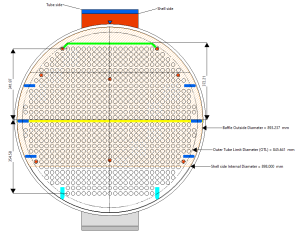
3. PVElite
Overview: Specialized software for pressure vessel and heat exchanger design.
- ASME Section VIII compliance verification
- Material selection and thickness calculations
- Stress and nozzle analysis
- Generates detailed design reports
4. AutoPIPE Vessel
Overview: Focused on pressure vessels and piping systems.
- Stress, load, and pressure calculations
- Integration with piping systems for combined load analysis
- Design code compliance checks
5. CAESAR II
Overview: Although primarily for piping, it supports vessel-load interaction analysis.
- Combined loading effects
- Fatigue and seismic load evaluation
- Works well with vessel and pipe systems
Benefits of Using Software:
- Rapid and accurate calculations
- Reduced risk of human error
- Simulation of extreme operational conditions
- Optimization of material usage and design parameters
- Facilitates documentation and regulatory compliance
Conclusion
Proven vessel design is essential for ensuring safety, compliance, and operational efficiency. By adhering to ASME Section VIII requirements, selecting appropriate materials and wall thickness, conducting thorough stress and buckling analysis, and utilizing advanced software tools, engineers can deliver pressure vessels that are reliable, durable, and optimized for their intended service.
For engineering consulting firms like Avesta Consulting, leveraging these principles and tools allows for efficient project delivery, regulatory compliance, and enhanced client confidence. Investing in modern design techniques and software not only mitigates risk but also improves the cost-effectiveness and longevity of pressure vessels across industries.
Avesta Consulting provides expert guidance on pressure vessel design, material selection, analysis, and software implementation to deliver safe, compliant, and optimized solutions for industrial applications.