A Technical Guide to FEA Verification, Benchmarks, and Best Practices
Introduction
Finite Element Analysis (FEA) has become a cornerstone of modern engineering design, enabling accurate prediction of structural behavior, thermal performance, and multi-physics interactions. However, as simulation results increasingly replace physical testing, a critical question arises: how reliable are the results?
Validating numerical simulations is essential to ensure engineering decisions are based on credible, traceable, and defensible data. This is where NAFEMS standards play a vital role. NAFEMS provides globally recognized guidelines, benchmarks, and training programs that support FEA verification and validation (V&V) across industries.
This article explores how NAFEMS standards are used to validate FEA results, explains NAFEMS FEA verification methods, reviews NAFEMS benchmarks, and highlights the importance of NAFEMS training in building trustworthy simulation workflows.
What Is NAFEMS?
NAFEMS (National Agency for Finite Element Methods and Standards) is an international, non-profit organization dedicated to the effective use of engineering simulation. Although the acronym originated in the UK, NAFEMS now operates globally, supporting industries such as aerospace, automotive, energy, marine, and manufacturing.
NAFEMS develops:
-
Best-practice guidelines
-
Verification and validation frameworks
-
Benchmark problems
-
Training and certification programs
Its mission is to ensure that simulation results are accurate, robust, and fit for purpose.

Why FEA Validation Is Critical
FEA results can be affected by:
-
Modeling assumptions
-
Mesh quality
-
Boundary condition definition
-
Material data accuracy
-
Solver settings
Without proper validation, even sophisticated simulations may produce misleading or unsafe conclusions.
Consequences of Unvalidated FEA
-
Under-designed or over-designed components
-
Unexpected failures
-
Regulatory non-compliance
-
Increased development costs
-
Loss of stakeholder confidence
NAFEMS provides structured methodologies to mitigate these risks.
FEA Verification vs Validation: Key Differences
Understanding the difference between verification and validation is essential before applying NAFEMS standards.
FEA Verification
Verification answers the question:
“Is the mathematical model solved correctly?”
It focuses on:
-
Numerical accuracy
-
Solver correctness
-
Mesh convergence
NAFEMS FEA verification ensures the simulation correctly implements the intended equations.
FEA Validation
Validation answers the question:
“Does the model represent physical reality accurately?”
It involves:
-
Comparison with experimental data
-
Physical testing correlation
-
Real-world behavior assessment
Both steps are required for simulation credibility.
NAFEMS FEA Verification Framework
NAFEMS promotes a structured approach to FEA verification based on systematic testing and benchmarking.
Key Elements of NAFEMS FEA Verification
-
Problem definition and assumptions
-
Mesh refinement studies
-
Boundary condition sensitivity analysis
-
Solver verification
-
Comparison with analytical or reference solutions
Verification is not a one-time activity but an iterative process throughout the simulation lifecycle.
NAFEMS Benchmarks Explained
What Are NAFEMS Benchmarks?
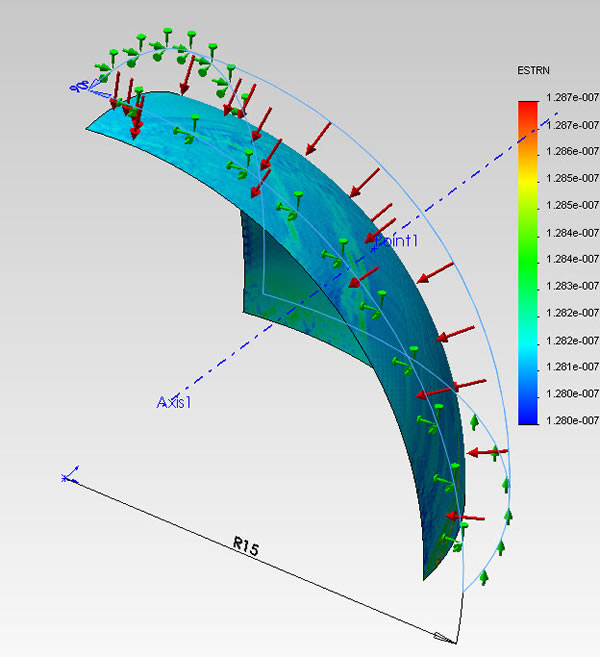
NAFEMS benchmarks are standardized test problems with known solutions, used to evaluate:
-
Software accuracy
-
Modeling techniques
-
Analyst competence
They cover a wide range of physics, including:
-
Linear and nonlinear structural analysis
-
Thermal analysis
-
Fatigue and fracture
-
Dynamics and vibration
Purpose of NAFEMS Benchmarks
NAFEMS benchmarks allow engineers to:
-
Verify solver performance
-
Compare different FEA tools
-
Assess modeling strategies
-
Identify numerical weaknesses
Benchmarks act as a reference baseline for simulation reliability.
Common Benchmark Categories
-
Analytical solution benchmarks
-
Experimental correlation benchmarks
-
Highly sensitive numerical problems
-
Industrial representative models
Applying these benchmarks helps ensure simulation tools behave as expected under controlled conditions.
FEA Validation Methods Recommended by NAFEMS
NAFEMS emphasizes a risk-based approach to FEA validation, where the level of validation effort is proportional to the consequence of failure.
Common Validation Methods
-
Physical testing correlation
-
Load-deflection comparison
-
Stress and strain measurement comparison
-
Modal and frequency correlation
-
Fatigue life comparison
Validation often involves multiple levels of comparison, rather than a single pass/fail check.
Managing Uncertainty in FEA Validation
NAFEMS recognizes that uncertainty exists in:
-
Material properties
-
Boundary conditions
-
Manufacturing tolerances
-
Measurement systems
To address this, NAFEMS promotes:
-
Sensitivity analysis
-
Uncertainty quantification
-
Probabilistic simulation methods
Understanding uncertainty improves confidence in engineering decisions.
Role of Mesh Convergence in NAFEMS Verification
Mesh convergence studies are central to NAFEMS verification practice.
Key Principles
-
Results should converge toward a stable solution
-
Stress singularities must be identified
-
Local refinement should be justified
NAFEMS discourages blind mesh refinement and instead promotes engineering-driven mesh strategies.
Documentation and Traceability
NAFEMS standards emphasize the importance of clear documentation, including:
-
Assumptions and limitations
-
Model setup details
-
Verification and validation results
-
Decision rationale
Traceability is essential for:
-
Audits
-
Certification
-
Regulatory approval
NAFEMS Training and Professional Development
Importance of NAFEMS Training
Simulation accuracy depends heavily on analyst competence. NAFEMS training programs help engineers:
-
Understand numerical methods
-
Apply best practices
-
Avoid common modeling errors
-
Stay aligned with industry standards
Types of NAFEMS Training
-
FEA fundamentals and advanced courses
-
Verification and validation workshops
-
Industry-specific simulation training
-
Professional certification programs
NAFEMS training ensures consistent and reliable simulation quality across organizations.
Integrating NAFEMS Standards into Industrial Workflows
To effectively use NAFEMS standards, organizations should:
-
Establish internal simulation guidelines
-
Use NAFEMS benchmarks for tool verification
-
Apply risk-based validation strategies
-
Invest in analyst training
-
Maintain traceable documentation
Engineering consulting support can accelerate this integration.
The Role of Engineering Consulting in NAFEMS-Based Validation
Engineering consulting firms help organizations:
-
Implement NAFEMS frameworks
-
Develop verification and validation plans
-
Perform benchmark studies
-
Train internal teams
-
Reduce simulation risk
At Avesta Consulting, NAFEMS-aligned practices are applied to ensure credible, defensible, and industry-compliant FEA results.
Conclusion
Using NAFEMS standards to validate FEA results is essential for trustworthy engineering simulation. Through structured FEA verification, standardized NAFEMS benchmarks, robust validation methods, and continuous NAFEMS training, organizations can significantly improve the reliability of their numerical analyses.
As simulation continues to replace physical testing, adopting NAFEMS best practices is no longer optional—it is a critical requirement for engineering excellence, safety, and innovation.