Material Flow Management (MFM) has become one of the most crucial drivers of operational excellence for modern industries. As manufacturing systems grow more complex and global supply chains face increasingly unpredictable disruptions, organizations are aggressively prioritizing how materials move through their operations. Smooth, predictable, and well-controlled material flow is not optional anymore—it is a strategic requirement for achieving efficiency, resilience, competitiveness, and long-term growth.
This comprehensive guide explores the full spectrum of Material Flow Management, including its definitions, principles, steps, tools, engineering concepts, logistics integration, digital transformation, real-world applications, and best practices. It blends technical engineering analysis, supply chain strategy, Lean thinking, and business decision-making to give you a complete view suitable for an engineering consulting website or industrial audience.
What Is Material Flow Management?
Definition of Material Flow Management
Material Flow Management refers to the organized planning, control, execution, and continuous improvement of how materials move throughout a system—from suppliers to warehouses, through production lines, and all the way to final customers.
It includes:
- Transportation of raw materials, components, intermediates, and finished goods
- Material storage and retrieval
- Handling operations
- Inventory positioning
- Synchronising material arrival with production schedules
- Avoiding congestion, delays, or shortages
- Maintaining a balanced and predictable flow
The purpose of MFM is to ensure that material movement supports production efficiency, minimizes waste, and aligns with operational demand.
Importance for Efficient Supply Chain and Production
Material flow is the backbone of manufacturing and supply chain performance. When it is poorly managed, companies face costly issues such as stockouts, delayed orders, bottlenecks, excess inventory, or even full production shutdowns.
The importance of MFM includes:
- Higher production efficiency through continuous material availability
- Reduced lead times across the supply chain
- Lower operational costs by eliminating unnecessary movement or storage
- Better inventory turnover
- More reliable production planning
- Stronger customer satisfaction due to on-time delivery
- Enhanced visibility and control over physical processes
In short: material flow determines how fast, how efficiently, and how reliably a company operates.
Difference Between Material Flow Management and Material Flow Optimization
Material Flow Management (MFM) is the overall framework, while Material Flow Optimization (MFO) is a sub-component focused on improvement.
| Material Flow Management | Material Flow Optimization |
|---|---|
| Ongoing planning, control, and monitoring of material movement | Specific improvements to remove waste and inefficiencies |
| Strategic + operational focus | Tactical + improvement-focused |
| Involves forecasting, scheduling, handling rules, inventory planning | Involves reducing bottlenecks, redesigning layouts, automation |
| Ensures materials are available | Makes availability faster, smoother, cheaper |
Think of MFM as the full discipline, and MFO as the engine tuned for peak performance.
Key Principles of Material Flow Management
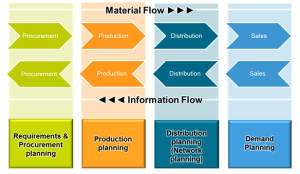
1. Planning and Controlling Material Movement
Solid planning determines how materials move across different stages. It includes:
- Material routing inside the plant
- Deciding between manual, automated, or hybrid handling
- Storage and staging point identification
- Defining buffer levels
- Coordinating suppliers with production schedules
Control ensures the movement follows the plan with minimal disruptions.
2. Synchronizing Supply and Demand
This principle ensures materials arrive at the exact moment they are needed—no earlier, no later.
Methods include:
- Demand forecasting
- Materials Requirement Planning (MRP)
- Supplier collaboration
- Just-in-Time (JIT) systems
- Pull-based replenishment (Kanban)
Proper synchronization eliminates stockouts and prevents excessive inventory.
3. Minimizing Bottlenecks and Waste
Waste in material flow appears as:
- Excess movement
- Long transportation routes
- Waiting time
- Over-storage
- Redundant handling steps
Addressing these wastes leads to leaner, faster, and more predictable flow.
4. Ensuring Timely Availability of Materials
A core function of MFM is to guarantee materials are exactly where they should be at the right moment.
Methods include:
- Real-time material tracking
- Efficient supermarket systems
- FIFO lanes
- Digital alerts for shortages
- Controlled material release
Timely availability reduces downtime and supports continuous operations.
Steps in Material Flow Management
Step 1: Map All Material Flows
Begin with a complete mapping using:
- Value Stream Mapping (VSM)
- Spaghetti diagrams
- Flowcharts
- Layout-based flow diagrams
This mapping reveals actual movement distances, handling points, queues, and overly complex routes.
Step 2: Collect and Analyse Operational Data
Data is essential for understanding current performance.
Useful data points include:
- Travel times
- Cycle times
- Inventory levels
- Loading/unloading durations
- Handling equipment utilisation
- Demand patterns
- Supplier delivery performance
Strong data leads to smart decisions instead of guesses.
Step 3: Identify Inefficiencies and Risks
Typical inefficiencies include:
- Unbalanced workflows
- Too many handling steps
- Long material routes
- Congested warehouse zones
- High inventory variance
- Excessive forklift usage
- Poor workstation layout
Identifying these issues guides improvement strategies.
Step 4: Implement Flow Management Strategies
Depending on the findings, improvements can include:
- Layout redesign
- Reducing manual movements
- Introducing conveyors or AGVs
- Creating flow lanes
- Implementing Kanban
- Adjusting buffer sizes
- Improving material release systems
- Introducing digital flow tracking
Changes should maximise throughput and minimize waste.
Step 5: Monitor Performance Continuously
Continuous monitoring ensures improvements remain consistent.
KPIs include:
- Throughput rate
- Material delivery accuracy
- Internal transport efficiency
- Inventory turnover
- Lead time per batch
These KPIs help identify new problems early.
Step 6: Integrate With ERP and Logistics Systems
Digital integration strengthens MFM through:
- Real-time inventory visibility
- Automatic material requests
- Supplier delivery tracking
- Barcode and RFID scanning
- Workflow automation
ERP + WMS + MES = full supply chain and production synchronization.
Tools and Techniques for Material Flow Management
Inventory Management Systems
These systems track stock levels, automate replenishment, and help forecast demand.
Examples:
- SAP
- Oracle NetSuite
- Odoo
- Infor
- Microsoft Dynamics
They reduce stockouts and prevent overstock.
Process Mapping and Workflow Analysis
Visualisation tools help teams understand current flow:
- VSM
- Swimlane diagrams
- SIPOC models
- Spaghetti diagrams
- Flowcharts
This visibility makes hidden inefficiencies more obvious.
Lean and Six Sigma Tools
Key Lean tools for MFM include:
- 5S (Sort, Set in Order, Shine, Standardise, Sustain)
- Kanban
- Kaizen
- SMED (quick changeovers)
- Root Cause Analysis (5 Whys, Fishbone)
- TPM (Total Productive Maintenance)
These tools systematically reduce waste and variability.
Simulation and Predictive Modeling
Simulation software allows companies to test hypothetical scenarios before implementing them physically.
Simulation can evaluate:
- New plant layouts
- Automated equipment (AGVs, robots)
- Buffer adjustments
- Workforce scheduling
- Peak demand conditions
Tools: FlexSim, AnyLogic, Simio, Arena.
Applications of Material Flow Management
Manufacturing and Assembly Lines
MFM ensures:
- Balanced workstations
- Continuous material availability
- Less downtime
- Reduced transport waste
- Stable manufacturing cycle times
Industries like automotive, electronics, packaging, textiles, and pharmaceuticals rely heavily on MFM.
Warehousing and Distribution Centers
Benefits include:
- Faster picking times
- Improved slotting strategies
- Better replenishment cycles
- Reduced congestion
- Higher throughput
MFM is essential for e-commerce fulfilment.
Supply Chain and Logistics Networks
Across the supply chain, MFM:
- Improves inbound material scheduling
- Enhances freight consolidation
- Reduces transport cost variance
- Improves traceability
- Strengthens supplier relationships
Strong flow = resilient supply chain.
New Product Introduction and Ramp-Up
New products require:
- Updated material routes
- Revised handling instructions
- Adjusted buffer levels
- Supplier changes
- Revised equipment utilisation
MFM ensures the ramp-up is smooth and predictable.
Expanded Technical Section: Engineering Principles of Material Flow
Material Flow Rate Calculations
Engineers often calculate flow using:
Flow Rate (units/hour) = Total units moved ÷ Time
To eliminate bottlenecks, engineers compare:
- Flow rate vs equipment capacity
- Flow rate vs demand rate
- Flow rate vs available working hours
Using Little’s Law
Little’s Law is essential for material flow:
Inventory = Throughput × Lead Time
This allows engineers to calculate:
- How much material should be in the system
- How long material stays in the workflow
- How to reduce WIP without slowing production
Applying Queue Theory
Queue theory predicts congestion and helps:
- Right-size buffers
- Adjust transportation frequency
- Determine ideal batch sizes
- Predict handling delays
Layout Engineering
Layout design supports optimal flow through:
- U-shaped layouts
- Linear flows
- Ergonomic workstations
- Clear material lanes
- Minimal crossing routes
Engineering-focused MFM reduces cost and increases speed.
Digital Transformation in Material Flow Management
Modern digital tools have revolutionised material flow:
IoT Sensors
Track:
- Material location
- Equipment utilisation
- Real-time movement
- Environmental conditions (temperature, humidity)
RFID & Barcode Systems
Provide:
- Faster scanning
- Real-time traceability
- Reduced manual errors
AGVs and AMRs
Automate movement while reducing:
- Labour cost
- Accident risk
- Transportation time
AI and Predictive Analytics
AI forecasts:
- Demand
- Stockouts
- Maintenance needs
- Optimal routes for material movement
Digital Twins
Simulate entire factories digitally to test:
- Layout changes
- Scheduling strategies
- Material handling choices
Digital transformation makes MFM far more efficient and predictive.
Benefits of Material Flow Management
Improved Operational Efficiency
Materials move smoother, machines stay active, and workers waste less time.
Reduced Delays and Waste
Waste such as excessive movement, waiting, and overproduction is eliminated.
Better Inventory and Resource Management
Controlled inventory prevents both shortages and surplus.
Enhanced Decision-Making and Planning
Real-time data supports accurate forecasting and strategic planning.
Higher Customer Satisfaction
Reliable material flow ensures on-time, high-quality deliveries.
Common Challenges in Material Flow Management
Complex and Dynamic Supply Chains
Global disruptions make material flow unpredictable.
Data Quality and Integration Issues
Incorrect or incomplete data causes planning errors.
Resistance to Change
Operators may resist new tools, automation, or layout changes.
High Variability in Production Demand
Demand fluctuations make synchronisation difficult.
Skill Gaps in Digital Tools
Teams need training to use ERP, MES, WMS, IoT, and dashboards.
Best Practices for Effective Material Flow Management
Engage Cross-Functional Teams
Involve production, warehouse, procurement, logistics, and quality.
Monitor and Optimise Continuously
Use KPIs and real-time dashboards.
Validate Improvements With Real Data
Pilot tests before full implementation.
Integrate With Overall Supply Chain Strategy
Link MFM with lean programs, automation strategy, and sustainability goals.
Use Simulation Before Making Changes
Reduces cost and risk of poor decisions.
Adopt Digital Tracking
IoT, RFID, and MES dramatically improve visibility.
Conclusion
Material Flow Management is one of the most powerful disciplines for improving efficiency, reducing costs, and enhancing resilience across manufacturing and supply chain operations. Whether applied to a factory, warehouse, distribution network, or complex logistics system, MFM ensures materials move with purpose, speed, and accuracy.
Companies that embrace engineering principles, digital tools, continuous improvement, and strategic alignment can dramatically improve throughput, reduce waste, and build world-class operations.
This comprehensive understanding of MFM enables organisations to design smarter, operate smoother, and compete stronger in today’s demanding industrial landscape.