Heat transfer in solids is one of the most important concepts in engineering, manufacturing, energy systems, and industrial design. Whether engineers are designing a furnace lining, evaluating a pressure vessel, improving electronic cooling, or optimizing thermal insulation, understanding how heat moves through solid materials is critical to safety, efficiency, and performance.
In industrial operations, heat transfer directly affects energy consumption, equipment reliability, production quality, and maintenance costs. Solid materials can either conduct heat efficiently, such as metals used in heat exchangers, or resist heat flow, such as refractory insulation in furnaces. Selecting the right material and understanding thermal behavior allows engineers to design systems that operate reliably under demanding conditions.
For businesses and industrial clients, poor heat transfer management can result in overheating, thermal fatigue, reduced equipment life, energy waste, and unplanned shutdowns. This is why thermal engineering and simulation tools such as finite element analysis (FEA) and computational fluid dynamics (CFD) are widely used in modern engineering design.
What Is Heat Transfer in Solids?
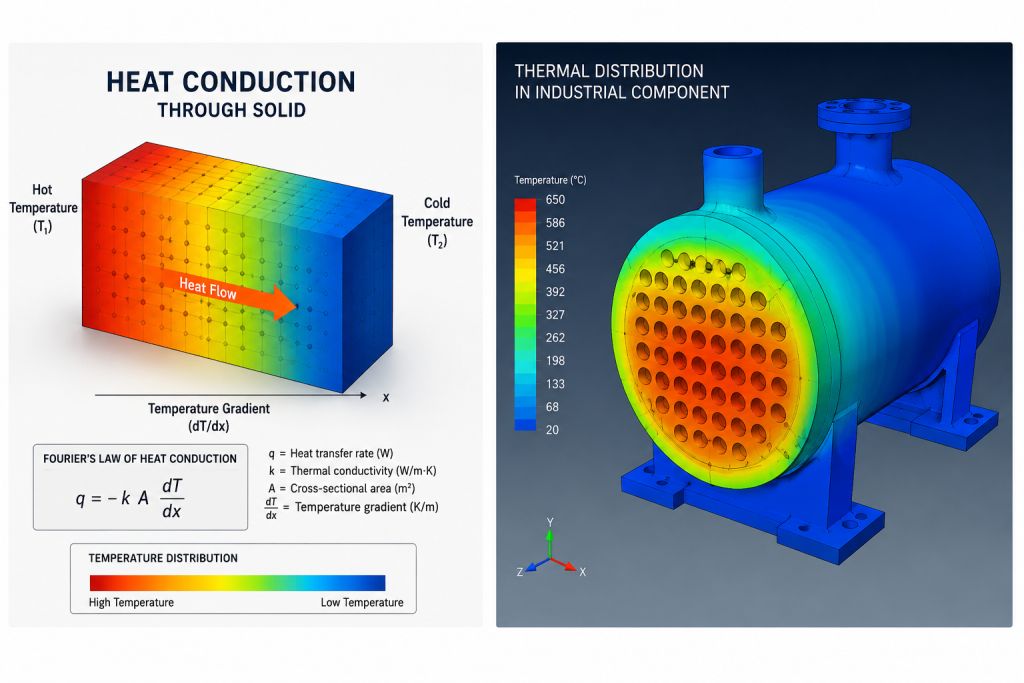
Heat transfer in solids refers to the movement of thermal energy through a solid material due to a temperature difference. Heat naturally flows from a region of higher temperature to a region of lower temperature until thermal equilibrium is reached.
In solid materials, heat transfer primarily occurs through conduction. Unlike fluids, where heat can move through fluid motion, solids transfer heat internally through molecular vibration and electron movement.
Metals are generally excellent thermal conductors because free electrons move energy rapidly through the material structure. Materials such as copper and aluminum are therefore commonly used in cooling systems, heat exchangers, and industrial thermal equipment.
On the other hand, insulating materials such as ceramics, mineral wool, refractory bricks, and polymers resist heat flow and are used to reduce energy losses and protect equipment from extreme temperatures.
In practical engineering systems, heat transfer in solids is rarely isolated. It is usually combined with convection and radiation, particularly in high-temperature industrial environments such as boilers, furnaces, kilns, turbines, and process plants.
How Is Heat Transferred in Solid Materials?

At the microscopic level, atoms inside a solid vibrate continuously. When one side of a material becomes hotter, atomic vibrations increase. These vibrations transfer energy to neighboring atoms, gradually moving heat through the material.
In metals, an additional mechanism exists: free electron transport. Since metals contain mobile electrons, thermal energy moves much faster than in non-metallic solids.
The rate at which heat moves depends on several important factors:
1. Temperature Difference
Heat transfer increases when the temperature difference between two regions becomes larger. A greater temperature gradient creates a stronger driving force for thermal conduction.
2. Thermal Conductivity
Thermal conductivity measures how easily a material conducts heat.
Examples include:
- Copper: very high conductivity
- Aluminum: high conductivity
- Stainless steel: moderate conductivity
- Ceramics: low conductivity
- Insulation materials: very low conductivity
Materials with high conductivity are used when rapid heat transfer is required, while low-conductivity materials are used for insulation and thermal protection.
Fourier’s Law of Heat Conduction
The basic engineering relationship governing heat conduction is Fourier’s Law:
Where:
- = heat transfer rate
- k = thermal conductivity
- A= cross-sectional area
- dT/dx = temperature gradient
This equation shows that heat transfer increases when:
- Thermal conductivity is higher
- Surface area is larger
- Temperature gradient is steeper
Fourier’s Law forms the foundation of thermal engineering calculations and is widely applied in industrial equipment design, electronics cooling, energy systems, and structural thermal analysis.
What Are the Three Methods of Heat Transfer in Solids?
Although conduction dominates in solids, all three heat transfer mechanisms can influence solid materials.
1. Conduction
Conduction is the direct transfer of heat through a material without bulk movement.
Examples include:
- Heat moving through a steel pipe
- Heat flow across a furnace wall
- Thermal transfer through electronic components
Conduction is the primary mode of heat transfer inside solids and is critical in thermal stress analysis and equipment design.
2. Convection
Convection occurs when heat transfers between a solid surface and a moving fluid such as air or water.
Examples include:
- Cooling of metal components by airflow
- Heat removal from radiators
- Water cooling in industrial systems
Although convection itself occurs in fluids, it strongly affects solid temperatures because the solid exchanges heat with the surrounding fluid.
3. Radiation
Radiation transfers heat through electromagnetic waves and does not require physical contact.
Examples include:
- Heat emitted from furnace walls
- Solar heating of structures
- Thermal radiation from high-temperature equipment
At elevated temperatures, radiation becomes extremely important in industrial applications such as power generation, metallurgy, and refractory systems.
Which Mode of Heat Transfer Is Used in Solids?
The dominant heat transfer mode in solids is conduction.
This occurs because atoms and electrons inside the solid transfer energy directly between neighboring particles. Unlike liquids and gases, solids generally do not experience large-scale bulk motion internally.
However, in real engineering systems, solids frequently interact with fluids and surrounding environments. As a result:
- Conduction governs internal heat movement
- Convection governs heat exchange with fluids
- Radiation governs thermal emission at surfaces
Engineers must often analyze all three simultaneously to accurately predict equipment performance.
Which Type of Heat Transfer Works Best in Solids?
The most effective heat transfer mechanism in solids depends on the application and material.
Metals
Metals conduct heat extremely well because of their free electrons. Copper and aluminum are among the best thermal conductors used in engineering.
Applications include:
- Heat exchangers
- Cooling plates
- Electronic heat sinks
- Thermal piping systems
Insulating Materials
Insulators work best when minimizing heat transfer is the goal.
Applications include:
- Furnace linings
- Refractory systems
- Thermal barriers
- Building insulation
The “best” heat transfer type therefore depends on whether the engineering objective is:
- Maximizing heat movement
- Controlling heat flow
- Minimizing energy loss
Heat Transfer in Industrial Engineering Applications
Heat transfer in solids is essential across multiple industries.
Power Generation
Power plants rely heavily on thermal conduction through:
- Boilers
- Heat exchangers
- Steam systems
- Turbines
- HRSG systems
Efficient heat transfer improves energy conversion efficiency while reducing operational costs.
Refractory and Furnace Engineering
Refractory systems must withstand extreme temperatures while minimizing heat loss.
Engineers analyze:
- Thermal gradients
- Expansion behavior
- Thermal stress
- Shell-refractory interaction
- Heat retention performance
Advanced simulation allows optimization of refractory lining design and thermal protection systems.
Electronics Cooling
Modern electronics generate significant heat in compact spaces.
Thermal management solutions include:
- Heat sinks
- Cooling plates
- Thermal interface materials
- Liquid cooling systems
- Forced air cooling
Poor thermal design can lead to overheating, reduced efficiency, and premature failure.
Aerospace Engineering
Aircraft and spacecraft experience severe thermal loading.
Applications include:
- Thermal protection systems
- High-temperature alloys
- Re-entry shielding
- Engine cooling
Heat transfer modeling is essential for safety and reliability.
Manufacturing and Process Industries
Industrial processes such as welding, casting, heat treatment, and chemical processing rely on accurate thermal control.
Heat transfer directly affects:
- Product quality
- Material properties
- Process efficiency
- Equipment lifespan
Thermal Resistance in Solids
Thermal resistance describes how strongly a material resists heat flow.
The concept is similar to electrical resistance.
Materials with:
- High thermal conductivity → low thermal resistance
- Low thermal conductivity → high thermal resistance
Engineers use thermal resistance calculations to:
- Design insulation systems
- Reduce energy loss
- Control equipment temperatures
- Improve efficiency
In multilayer systems, total thermal resistance includes:
- Solid conduction resistance
- Convection resistance
- Contact resistance
Steady-State vs Transient Heat Transfer
Steady-State Heat Transfer
In steady-state conditions, temperatures remain constant over time.
Examples:
- Stable furnace operation
- Continuous pipeline operation
- Constant equipment loading
Transient Heat Transfer
In transient conditions, temperatures change with time.
Examples:
- Equipment startup and shutdown
- Thermal shock events
- Rapid heating or cooling
- Fire exposure analysis
Transient thermal analysis is often more complex and requires advanced numerical simulation methods.
Heat Transfer Simulation and Engineering Analysis
Modern engineering increasingly relies on simulation to analyze thermal performance before manufacturing or construction.
Finite Element Analysis (FEA)
FEA is used to:
- Predict temperature distribution
- Evaluate thermal stresses
- Analyze thermal expansion
- Prevent failure mechanisms
Computational Fluid Dynamics (CFD)
CFD evaluates:
- Fluid flow behavior
- Convection effects
- Cooling performance
- Heat exchanger efficiency
Simulation reduces development costs while improving design reliability and operational efficiency.
Challenges in Heat Transfer Design
Engineers must address several thermal challenges:
Thermal Stress
Uneven heating causes expansion differences, which may produce cracking or structural failure.
Thermal Fatigue
Repeated heating and cooling cycles weaken materials over time.
Heat Loss
Excessive heat loss reduces energy efficiency and increases operating costs.
Material Degradation
High temperatures can weaken materials through:
- Oxidation
- Creep
- Corrosion
- Structural degradation
Proper material selection and thermal analysis are therefore essential.
Emerging Technologies in Heat Transfer Engineering
Modern research is advancing thermal engineering significantly.
Advanced Heat Exchangers
New geometries and additive manufacturing methods improve heat transfer efficiency while reducing size and weight.
Smart Thermal Materials
Engineered materials can dynamically control heat transfer properties.
AI and Machine Learning
Artificial intelligence is increasingly used to predict thermal performance and optimize designs.
Surface Engineering
Surface modification technologies improve boiling, condensation, and phase-change heat transfer performance.
Conclusion
Heat transfer in solids is a fundamental engineering principle that influences nearly every industrial system. From power plants and process equipment to electronics and aerospace applications, controlling thermal energy is essential for safety, reliability, efficiency, and long-term performance.
Conduction remains the dominant heat transfer mechanism in solids, but engineers must also consider convection and radiation in real-world applications. Understanding thermal conductivity, temperature gradients, thermal resistance, and material behavior enables better engineering decisions and optimized system performance.
Modern simulation technologies such as CFD and FEA have transformed the way thermal systems are designed and analyzed. By accurately predicting heat flow and temperature distribution, engineers can reduce failures, improve energy efficiency, and extend equipment life.
As industries continue pushing toward higher efficiency, sustainability, and advanced manufacturing, heat transfer engineering will remain a critical component of industrial innovation and engineering design.