Thermal conduction is one of the most fundamental physical phenomena in engineering, governing how heat moves through solid materials. In industrial applications—especially in metals, composites, electronics, energy systems, and manufacturing processes—understanding conduction alone is not enough. Engineers need to simulate, predict, and optimize heat transfer behavior before physical prototypes are built.
This is where thermal conduction simulation becomes a critical engineering tool.
Modern industries rely heavily on numerical simulation methods such as Finite Element Method (FEM) and advanced multiphysics modeling to evaluate temperature distribution, thermal stresses, and energy efficiency. Whether designing a heat exchanger, evaluating metal cooling behavior, or optimizing industrial components, simulation enables engineers to move from intuition-based design to data-driven thermal engineering.
This article explains thermal conduction simulation in a structured, semi-technical way—bridging the gap between engineering theory and real-world industrial use.
What is Thermal Conduction Simulation?
Thermal conduction simulation is a numerical modeling process used to predict how heat flows inside solid materials over time or under steady conditions.
In simple terms, it answers questions like:
- How fast does heat travel through a metal component?
- Where do hot spots form inside a system?
- How does geometry affect heat distribution?
- What happens when multiple materials interact thermally?
Unlike analytical solutions, which are limited to simple shapes and boundary conditions, simulation allows engineers to study complex geometries, composite materials, and real operating conditions.
At the core of most simulations is Fourier’s Law of Heat Conduction:
- Heat flows from high temperature to low temperature regions
- Rate of heat transfer depends on material thermal conductivity
But real engineering systems are rarely simple. That is why numerical simulation is essential.
Governing Physics Behind Conduction Modeling
Thermal conduction in solids is governed by the heat diffusion equation, which describes how temperature changes in space and time:
In general form:
- Temperature field varies with:
- Thermal conductivity of material
- Density and heat capacity
- Internal heat generation
- Boundary conditions (heat flux, convection, radiation)
In engineering simulation tools, this equation is solved numerically rather than analytically.
Key assumptions often used:
- Material properties may be temperature-dependent (nonlinear analysis)
- Heat transfer is continuous within solid domains
- Boundary conditions define interaction with environment
This forms the foundation of finite element thermal analysis frameworks used in industrial software environments.
Why Thermal Conduction Simulation is Important in Industry
Thermal conduction simulation is not just an academic exercise—it directly impacts product reliability, safety, and efficiency.
Key industrial motivations:
Preventing Thermal Failure
Overheating is one of the leading causes of failure in:
- Electronic circuits
- Mechanical assemblies
- Battery systems
- Industrial furnaces
Simulation helps identify thermal bottlenecks before manufacturing.
Improving Energy Efficiency
In energy systems, even small thermal losses can significantly impact performance. Simulation helps reduce:
- Heat leakage
- Unnecessary thermal gradients
- Energy consumption in heating/cooling systems
Material Selection and Optimization
Different materials behave differently under heat:
- Metals: high conductivity
- Polymers: insulating behavior
- Composites: anisotropic conduction
Simulation allows engineers to test multiple material configurations virtually.
Manufacturing Process Control
Processes such as welding, casting, and additive manufacturing depend heavily on controlled heat flow. Studies show that FEM-based thermal models are widely used for predicting temperature fields and solidification behavior in such processes .
Numerical Methods Used in Thermal Conduction Simulation
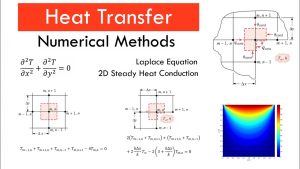
The most widely used method in engineering is the Finite Element Method (FEM).
Finite Element Method (FEM)
FEM divides a complex geometry into smaller elements (mesh) and solves heat transfer equations locally.
Advantages:
- Handles complex geometries
- Supports multi-material systems
- Works with nonlinear temperature-dependent properties
This method is widely used in industrial thermal modeling frameworks and engineering software systems .
Finite Difference Method (FDM)
Used mostly in simpler geometries like rods or plates.
- Discretizes space using grid points
- Easier to implement but less flexible than FEM
Finite Volume Method (FVM)
Common in CFD tools:
- Focuses on energy conservation in control volumes
- Strong in coupling fluid flow and heat transfer
Advanced Hybrid Methods
Modern simulations increasingly combine FEM with:
- Phase-field models (for microstructure evolution)
- Lattice methods (for heterogeneous materials)
- Reduced-order models for faster computation
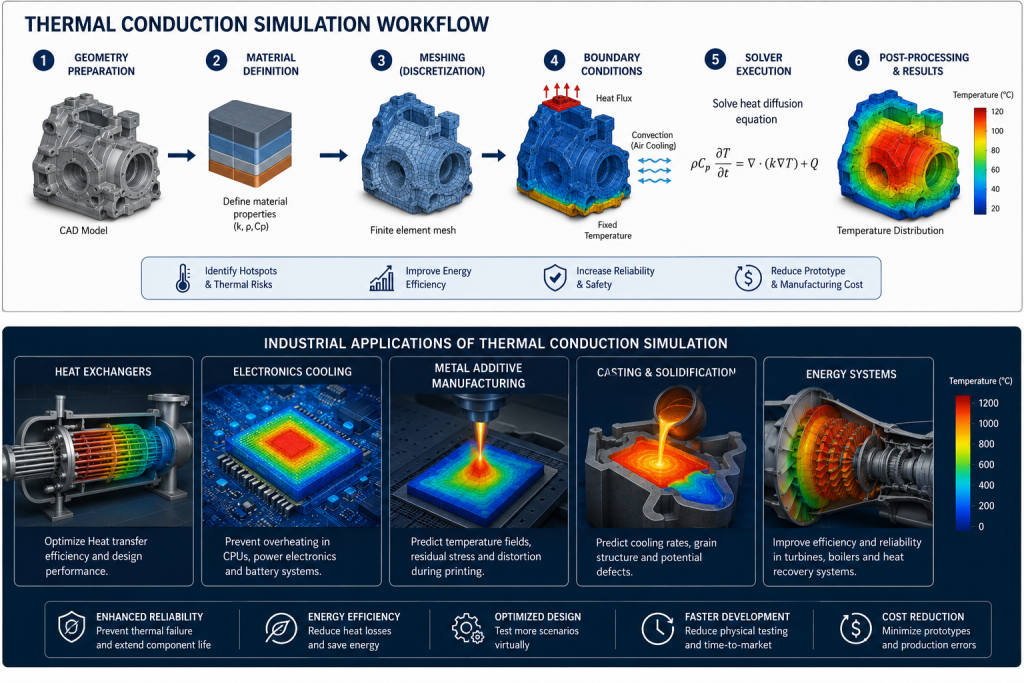
How Thermal Conduction Simulation Works (Engineering Workflow)
A realistic simulation process typically includes the following steps:
Step 1: Geometry Preparation
The component is imported or designed in CAD software.
Important considerations:
- Remove unnecessary small features
- Ensure watertight geometry
- Define contact surfaces
Step 2: Material Definition
Each domain is assigned material properties:
- Thermal conductivity (k)
- Density (ρ)
- Specific heat capacity (Cp)
In advanced cases, these properties are temperature-dependent.
Step 3: Meshing (Discretization)
The geometry is divided into finite elements:
- Fine mesh in high-gradient regions
- Coarser mesh in stable regions
In thermal simulations of metal processes, adaptive meshing is often required due to steep gradients .
Step 4: Boundary Conditions
These define how heat enters or leaves the system:
- Prescribed temperature
- Heat flux
- Convection (air cooling)
- Radiation
Step 5: Solver Execution
The numerical solver computes:
- Temperature distribution
- Heat flux vectors
- Time-dependent thermal evolution (transient analysis)
Step 6: Post-Processing
Engineers analyze:
- Hotspot locations
- Thermal gradients
- Energy losses
- Maximum temperature limits
Types of Thermal Conduction Simulation
Steady-State Simulation
Assumes temperature does not change over time.
Used for:
- Electronic cooling systems
- Insulated walls
- Constant operating machinery
Transient Simulation
Temperature varies over time.
Used for:
- Heating/cooling cycles
- Welding and casting processes
- Start-up/shutdown analysis
Nonlinear Thermal Simulation
Includes temperature-dependent material properties.
Important in:
- Metals at high temperatures
- Phase-change materials
- Industrial furnaces
Thermal Conduction in Metals: Special Engineering Considerations
Metals behave differently from other materials due to:
- High free electron mobility
- Strong lattice vibration coupling
- Temperature-dependent conductivity
This leads to:
Rapid Heat Distribution
Metals quickly equalize temperature, but localized heating still creates gradients.
Anisotropic Behavior in Some Alloys
Some engineered metals show directional conductivity.
Coupled Thermal-Stress Effects
Thermal gradients generate mechanical stress:
- Expansion mismatch
- Residual stress formation
- Deformation in manufacturing processes
This is why thermal simulation is often coupled with structural FEM analysis.
Industrial Applications of Thermal Conduction Simulation
Heat Exchangers
Used to optimize:
- Tube arrangement
- Flow efficiency
- Thermal exchange rate
Electronics Cooling
Critical for:
- CPUs and GPUs
- Power electronics
- Battery thermal management
Metal Additive Manufacturing
Laser-based processes generate steep thermal gradients requiring advanced simulation methods .
Casting and Solidification
Used to predict:
- Cooling rates
- Grain formation
- Defect formation
Energy Systems
Includes:
- Boilers
- Turbines
- Heat recovery systems
Challenges in Thermal Conduction Simulation
Despite advances, simulation still faces challenges:
Computational Cost
High-resolution FEM models are expensive.
Complex Boundary Conditions
Real environments involve mixed:
- Convection
- Radiation
- Contact resistance
Multiscale Effects
Heat transfer may vary from:
- Atomic scale (materials science)
- Macro scale (engineering systems)
Material Uncertainty
Thermal properties vary with:
- Temperature
- Manufacturing process
- Material impurities
Advanced Trends in Thermal Simulation
Modern engineering is moving toward:
AI-Assisted Thermal Prediction
Machine learning reduces computation time while maintaining accuracy.
Reduced-Order Modeling
Simplifies FEM results into fast predictive models.
Multiphysics Coupling
Thermal simulation is increasingly combined with:
- Structural mechanics
- Fluid dynamics
- Electromagnetics
Real-Time Digital Twins
Industrial systems are now monitored using live thermal simulation models.
Conclusion
Thermal conduction simulation is a cornerstone of modern engineering design. It allows engineers to predict temperature behavior, optimize performance, and prevent failure in complex systems.
From metals and electronics to large-scale industrial machinery, simulation transforms thermal engineering from a reactive process into a predictive and optimized design discipline.
As computational tools continue to evolve, thermal conduction modeling will become even more accurate, faster, and more integrated into real-time industrial decision-making.