Introduction
Thermal conductivity is one of the most important material properties considered in engineering, manufacturing, construction, and industrial design. Whether engineers are designing heat exchangers, industrial furnaces, pressure vessels, structural components, or manufacturing equipment, understanding how efficiently a material transfers heat is essential for ensuring safety, energy efficiency, and long-term reliability.
Among engineering metals, iron has played a fundamental role for centuries. Although modern industries often rely on steel alloys, cast iron, and stainless steel, pure iron and iron-based materials continue to be widely used in industrial equipment, automotive components, machinery, piping systems, and heavy construction. Their thermal performance directly influences operating temperatures, heat loss, thermal stress, and overall system efficiency.
One of the most frequently asked questions in engineering is, “What is the thermal conductivity of iron?” The answer depends on the type of iron, its chemical composition, temperature, and manufacturing process. Understanding these variables helps engineers select the right material for heat transfer applications while improving equipment performance and reducing energy consumption.
In this guide, we explore the thermal conductivity of iron, explain its k-value, compare it with other engineering materials, discuss factors that influence heat transfer, and demonstrate why thermal conductivity is a critical consideration in engineering analysis and industrial design.
What Is Thermal Conductivity?
Thermal conductivity is a material’s ability to transfer heat through conduction. It describes how efficiently thermal energy moves from a hotter region to a cooler one when a temperature difference exists.
The symbol used for thermal conductivity is k, and its SI unit is:
Watts per meter-Kelvin (W/m·K)
Materials with high thermal conductivity transfer heat quickly, while materials with low thermal conductivity resist heat flow and function as thermal insulators.
For example:
| Material | Thermal Conductivity (W/m·K) |
|---|---|
| Copper | 385–400 |
| Aluminum | 205–235 |
| Pure Iron | 75–80 |
| Carbon Steel | 45–60 |
| Stainless Steel | 14–16 |
| Concrete | 1.5–2.0 |
| Mineral Wool | 0.035–0.045 |
Although iron is not as conductive as copper or aluminum, it offers an excellent balance of heat transfer capability, mechanical strength, durability, and affordability, making it suitable for a wide range of engineering applications.
What Is the Thermal Conductivity of Iron?
The thermal conductivity of iron varies depending on its purity and microstructure.
Typical engineering values include:
| Iron Type | Thermal Conductivity (W/m·K) |
|---|---|
| Pure Iron | 75–80 |
| Wrought Iron | 70–80 |
| Grey Cast Iron | 45–55 |
| Ductile Cast Iron | 30–45 |
| White Cast Iron | 20–35 |
For many engineering calculations, 80 W/m·K is commonly used for pure iron under standard conditions.
Unlike insulation materials, which are designed to minimize heat transfer, iron readily conducts thermal energy. This property makes it suitable for applications requiring efficient heat distribution, such as engine blocks, industrial machinery, cookware, and heating equipment.
Understanding the K-Value of Iron
The k-value simply refers to the thermal conductivity of a material. In engineering calculations, the higher the k-value, the faster heat moves through the material.
A higher thermal conductivity means:
- Faster heat transfer
- Reduced temperature gradients
- More uniform temperature distribution
Conversely, a lower thermal conductivity results in:
- Better insulation
- Slower heat flow
- Greater thermal resistance
Iron’s moderate-to-high k-value provides a balance between structural performance and heat transfer, making it particularly valuable in mechanical engineering.
Factors Affecting the Thermal Conductivity of Iron
Thermal conductivity is not a fixed value. Several factors influence how efficiently iron transfers heat.
1. Carbon Content
The addition of carbon significantly affects thermal conductivity.
Pure iron has relatively high thermal conductivity, while increasing carbon content generally reduces heat transfer. This is why cast iron often exhibits lower conductivity than wrought iron.
2. Temperature
As temperature increases, thermal conductivity generally decreases because atomic vibrations interfere with electron movement, reducing heat transfer efficiency.
This temperature dependence is important when designing furnaces, boilers, and high-temperature industrial equipment.
3. Alloying Elements
Adding chromium, nickel, manganese, or silicon changes the crystal structure of iron and usually lowers thermal conductivity.
For example, stainless steel has much lower thermal conductivity than pure iron due to its alloy composition.
4. Microstructure
Grain size, porosity, and phase composition also influence thermal conductivity. Different heat treatment processes create different microstructures, affecting heat transfer characteristics.
5. Manufacturing Process
Casting, forging, rolling, and heat treatment alter the internal structure of iron. As a result, two components made from the same chemical composition may have slightly different thermal conductivity values.
Thermal Conductivity of Iron Compared with Other Materials
Material selection often involves balancing thermal performance with mechanical properties.
| Material | Thermal Conductivity (W/m·K) | Relative Heat Transfer |
|---|---|---|
| Copper | 400 | Excellent |
| Aluminum | 235 | Very High |
| Pure Iron | 80 | High |
| Carbon Steel | 50 | Moderate |
| Stainless Steel | 15 | Low |
| Glass | 1.0 | Very Low |
| Mineral Wool | 0.040 | Insulation |
This comparison illustrates that while iron is not the best conductor among metals, it offers considerably higher thermal conductivity than stainless steel and far exceeds most building materials.
Why Thermal Conductivity Matters in Engineering
Thermal conductivity directly influences equipment performance, product reliability, and energy efficiency.
Engineers use thermal conductivity data to:
- Calculate heat transfer rates
- Design cooling systems
- Select insulation thickness
- Predict thermal expansion
- Evaluate thermal stresses
- Improve manufacturing processes
- Optimize energy consumption
Without accurate thermal conductivity values, engineering calculations can become unreliable, leading to inefficient designs or premature equipment failure.
Engineering Applications of Iron
Iron’s thermal properties make it suitable for numerous industrial applications.
Industrial Furnaces
Iron structures are commonly used in furnace frames and support systems. Engineers must account for heat conduction when designing insulation systems to reduce energy loss.
Automotive Industry
Engine blocks, brake discs, and exhaust manifolds rely on iron because of its ability to distribute heat evenly while maintaining structural integrity.
Manufacturing Equipment
Heavy machinery often includes cast iron bases due to their dimensional stability and ability to dissipate heat during continuous operation.
Heat Exchangers
Although copper is generally preferred for maximum efficiency, iron components remain common in industrial heat exchangers where mechanical strength and durability are equally important.
Structural Engineering
Steel structures are largely iron-based. Understanding the thermal conductivity of iron helps engineers evaluate thermal bridges, fire performance, and expansion behavior.
Fourier’s Law of Heat Conduction
Heat transfer through iron follows Fourier’s Law:
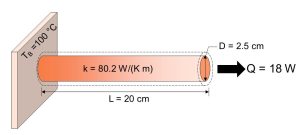
Q = (k × A × ΔT) ÷ L
Where:
- Q = Heat transfer rate (W)
- k = Thermal conductivity (W/m·K)
- A = Cross-sectional area (m²)
- ΔT = Temperature difference (K)
- L = Material thickness (m)
The equation demonstrates that increasing thermal conductivity results in greater heat transfer through the material.
Example Calculation
Consider an iron plate with:
- Thickness = 0.02 m
- Area = 1 m²
- Temperature difference = 100°C
- Thermal conductivity = 80 W/m·K
Heat transfer becomes:
Q = (80 × 1 × 100) ÷ 0.02
Q = 400,000 W
This example illustrates how efficiently iron conducts heat compared with insulating materials.
Thermal Conductivity in Finite Element Analysis (FEA)
Modern engineering projects frequently rely on Finite Element Analysis (FEA) to simulate heat transfer and thermal stresses.
Using accurate thermal conductivity values allows engineers to:
- Predict temperature distribution
- Identify thermal hotspots
- Evaluate thermal expansion
- Reduce thermal fatigue
- Improve product reliability
Thermal simulations help engineers optimize industrial equipment before manufacturing, reducing both development time and project costs.
Thermal Conductivity in Computational Fluid Dynamics (CFD)
Heat transfer rarely occurs through conduction alone. Industrial systems also involve convection and radiation.
Computational Fluid Dynamics (CFD) enables engineers to simulate:
- Cooling airflow
- Temperature distribution
- Heat exchanger performance
- Furnace airflow
- Ventilation efficiency
Combining CFD with accurate thermal conductivity data produces highly realistic thermal models for industrial equipment.
Advantages of Iron in Thermal Applications
Iron remains widely used because it offers several engineering advantages:
- Good thermal conductivity
- High mechanical strength
- Excellent durability
- Cost-effectiveness
- Ease of manufacturing
- Good wear resistance
- High availability
These characteristics explain why iron continues to play an important role despite the availability of newer engineering materials.
Limitations of Iron
Despite its advantages, iron also has some limitations.
These include:
- Lower thermal conductivity than copper or aluminum
- Susceptibility to corrosion
- Higher weight
- Thermal expansion at elevated temperatures
- Reduced conductivity when alloyed
Engineers must evaluate these limitations when selecting materials for high-performance thermal systems.
Best Practices for Engineers
When working with iron in thermal applications, engineers should:
- Use temperature-dependent material properties for simulations.
- Verify conductivity values from material datasheets.
- Consider the effects of alloy composition.
- Evaluate thermal stresses during design.
- Combine thermal analysis with structural analysis.
- Apply appropriate insulation where heat loss is undesirable.
Following these practices improves safety, energy efficiency, and equipment reliability.
Frequently Asked Questions
Is iron a good conductor of heat?
Yes. Iron is considered a good conductor of heat, although it is less conductive than copper and aluminum.
What is the thermal conductivity of pure iron?
Pure iron typically has a thermal conductivity between 75 and 80 W/m·K under standard conditions.
Is cast iron less conductive than pure iron?
Yes. Cast iron generally has lower thermal conductivity because its higher carbon content and graphite structure reduce heat transfer.
Why is thermal conductivity important?
Thermal conductivity determines how efficiently heat moves through a material, affecting equipment performance, thermal stresses, insulation design, and energy efficiency.
Does thermal conductivity change with temperature?
Yes. Thermal conductivity generally decreases as temperature increases, making temperature-dependent data important for high-temperature engineering applications.
Conclusion
Thermal conductivity is one of the most significant material properties engineers consider when designing industrial equipment, buildings, manufacturing systems, and energy infrastructure. Iron offers a valuable combination of thermal performance, mechanical strength, durability, and affordability, making it one of the world’s most widely used engineering materials.
With a thermal conductivity ranging from approximately 75 to 80 W/m·K for pure iron, the material efficiently transfers heat while maintaining the structural characteristics required for demanding industrial applications. Cast iron and wrought iron exhibit different thermal conductivities due to their composition and microstructure, emphasizing the importance of selecting the correct material for each engineering project.
From heat exchangers and automotive components to structural systems and industrial furnaces, understanding the thermal conductivity of iron enables engineers to make informed decisions about material selection, insulation design, thermal analysis, and energy efficiency. When combined with modern engineering tools such as Finite Element Analysis (FEA) and Computational Fluid Dynamics (CFD), accurate thermal conductivity data helps optimize designs, reduce operational costs, and improve equipment reliability.
As industries continue to demand higher efficiency and more sustainable engineering solutions, the thermal properties of iron will remain a fundamental consideration in industrial design, manufacturing, and thermal engineering.