Introduction
Thermal conduction is one of the most fundamental mechanisms of heat transfer and plays a critical role in almost every engineering system—from microelectronics and building insulation to industrial heat exchangers and manufacturing processes. Despite being a basic concept in physics, thermal conduction becomes highly complex when applied to real-world materials, especially in metals, composites, and multi-layered systems.
In this article, we will explore thermal conduction in a practical, semi-technical way suitable for both engineers and decision-makers. We will answer key questions such as:
- What are examples of thermal conduction?
- What is a thermal conductor and how does it transfer heat?
- What is thermal conductivity and how is heat transferred through materials?
We will also connect theory with industrial applications and provide internal linking opportunities for deeper exploration of heat transfer engineering topics.
What is Thermal Conduction?
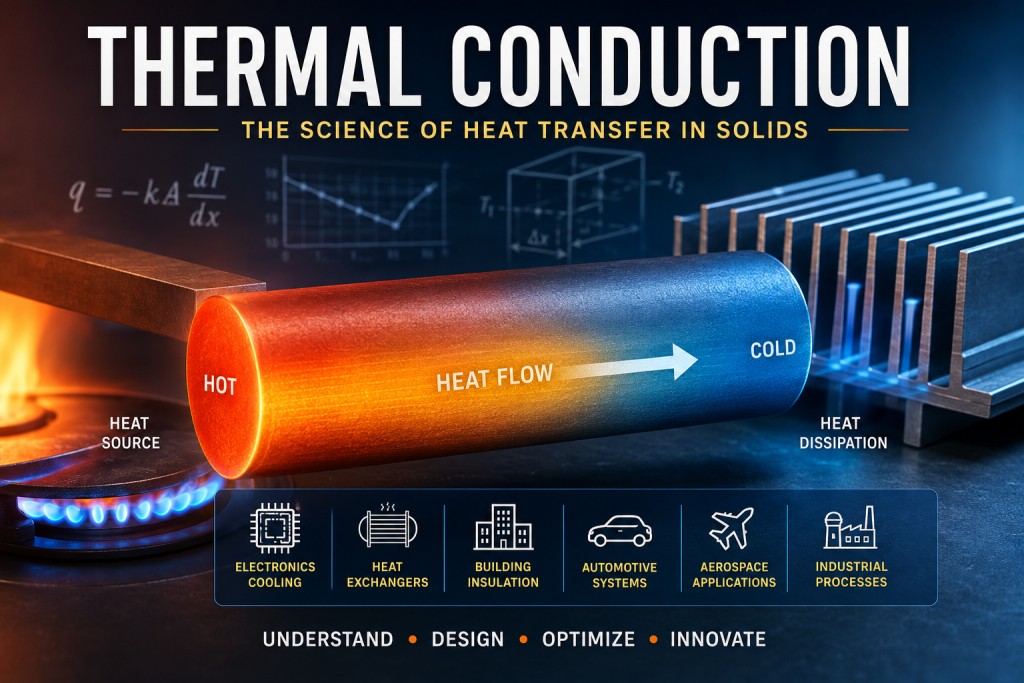
Thermal conduction is the process by which heat energy is transferred through a material without any visible movement of the material itself. Instead, energy is transferred through molecular vibration and free electron movement.
In simpler terms:
- Heat flows from a hotter region to a colder region
- No bulk movement of matter is involved
- Energy is passed molecule-to-molecule or electron-to-electron
This process is governed by temperature gradients and material properties.
Fundamental Concept
Heat always flows in the direction of decreasing temperature. When one part of a solid is heated, its particles gain kinetic energy and start vibrating more intensely. These vibrations are transferred to neighboring particles, creating a chain reaction of energy transfer.
Mechanism of Thermal Conduction
Thermal conduction occurs through two main mechanisms depending on the material type:
Lattice Vibration (Phonon Transfer)
In non-metallic solids such as ceramics, glass, and polymers:
- Atoms are tightly bound in a lattice structure
- Heat is transferred through vibrations of atoms
- These vibrations are called phonons
Electron Movement
In metals such as copper, aluminum, and steel:
- Free electrons are abundant
- Electrons carry energy rapidly through the structure
- This makes metals excellent thermal conductors
This is why metals feel cold to touch—they rapidly draw heat from your skin.
What are Examples of Thermal Conduction?
Thermal conduction occurs everywhere in daily life and industrial systems. Below are some clear examples:
Metal Spoon in Hot Tea
When a metal spoon is placed in hot tea:
- Heat travels from the liquid into the spoon
- Then it moves from the immersed part to the handle
- Eventually, the handle becomes hot
Cooking Pan on Stove
A frying pan conducts heat from:
- Burner → base of pan → food surface
This is essential for even cooking.
Building Walls and Windows
Heat transfer through walls and glass:
- In winter: heat escapes from inside to outside
- In summer: heat enters from outside
This is why insulation materials are critical in construction.
Electronic Devices
In CPUs and processors:
- Heat is generated in silicon chips
- Conducted into heat sinks (usually aluminum or copper)
- Then dissipated into the air
Underground Pipelines
Oil and gas pipelines experience heat conduction between:
- Fluid inside the pipe
- Surrounding soil
This affects viscosity and flow efficiency.
What is a Thermal Conductor and How Does it Transfer Heat?
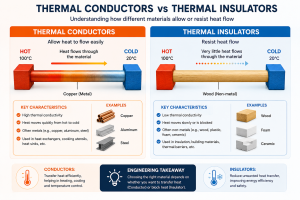
A thermal conductor is a material that allows heat to pass through it easily due to its atomic structure and electron availability.
Key Characteristics of Thermal Conductors:
- High thermal conductivity
- Low thermal resistance
- Presence of free electrons (in metals)
- Dense atomic structure
How Heat is Transferred
The transfer process occurs in three stages:
Step 1: Energy Absorption
Heat is introduced to one part of the material (e.g., one end of a metal rod).
Step 2: Energy Transfer
- Atoms vibrate more intensely
- Free electrons move faster
- Energy is passed to adjacent atoms
Step 3: Energy Distribution
Heat spreads throughout the material until thermal equilibrium is reached.
Common Thermal Conductors:
- Copper (excellent conductor)
- Aluminum (lightweight and efficient)
- Silver (highest conductivity but expensive)
- Steel (moderate conductor)
What is Thermal Conductivity?
Thermal conductivity is a material property that defines how easily heat flows through a substance.
It is represented by k and measured in:
W/m·K (Watts per meter Kelvin)
Interpretation:
- High k value → fast heat transfer
- Low k value → slow heat transfer (insulation)
Fourier’s Law of Heat Conduction
Thermal conduction is mathematically described by Fourier’s Law:
Heat transfer rate is proportional to:
- Temperature gradient
- Cross-sectional area
- Thermal conductivity
This principle is widely used in engineering simulations and thermal design systems.
Thermal Conductivity Transfer in Engineering Systems
Thermal conductivity transfer is not just a material property—it is a system-level behavior influenced by:
Material Selection
Engineers select materials based on:
- Heat transfer efficiency
- Weight constraints
- Cost considerations
Geometry and Thickness
- Thicker materials reduce heat transfer
- Thin layers increase conduction speed
Contact Resistance
Even two conductive materials may resist heat flow at interfaces due to:
- Surface roughness
- Air gaps
- Imperfect contact
Temperature Dependency
Thermal conductivity changes with temperature in many materials.
Applications of Thermal Conduction in Industry
Heat Exchangers
Used in:
- Chemical plants
- Oil refineries
- HVAC systems
Heat is transferred between fluids without mixing.
Electronics Cooling
Thermal conduction is critical in:
- CPUs
- Power electronics
- LED systems
Building Engineering
Heat loss prevention through:
- Insulation panels
- Double-glazed windows
- Composite wall systems
Automotive Industry
- Engine heat transfer
- Brake system heating
- Battery thermal management in EVs
Aerospace Applications
- Aircraft skin heating
- Re-entry thermal protection systems
- Satellite thermal control
Factors Affecting Thermal Conduction
Several variables influence heat conduction efficiency:
Material Type
Metals > liquids > gases in conduction ability
Density
Higher density often increases conduction efficiency
Temperature Gradient
Greater difference → faster heat transfer
Impurities
Impurities disrupt atomic structure and reduce conductivity
Phase of Matter
Thermal Conductors vs Thermal Insulators
| Property | Conductors | Insulators |
|---|---|---|
| Heat flow | Fast | Slow |
| Electron movement | High | Low |
| Examples | Copper, aluminum | Wood, foam, air |
Insulators are just as important as conductors in engineering design.
Engineering Importance of Thermal Conduction
Understanding thermal conduction is essential for:
- Preventing overheating in machinery
- Designing energy-efficient buildings
- Improving industrial process efficiency
- Enhancing electronic device lifespan
- Reducing energy loss in systems
Without proper thermal design, systems can fail due to overheating or inefficiency.
Advanced Perspective: Micro and Nano Scale Conduction
At micro and nano scales:
- Classical heat transfer laws become less accurate
- Quantum effects influence phonon behavior
- Heat transfer becomes size-dependent
This is particularly important in:
- Microchips
- Nanomaterials
- Thin-film coatings
Common Misconceptions About Thermal Conduction
Misconception 1: Heat rises because of conduction
Heat rising is actually convection, not conduction.
Misconception 2: All metals conduct heat equally
Different metals have different conductivity values.
Misconception 3: Insulators block heat completely
They only slow down heat transfer; they do not stop it entirely.
Future Trends in Thermal Conductivity Research
Modern engineering research focuses on:
- Graphene-based thermal conductors
- Nano-engineered heat sinks
- Phase-change materials
- AI-based thermal modeling systems
These innovations aim to improve efficiency in electronics, energy systems, and manufacturing.
Conclusion
Thermal conduction is a foundational heat transfer mechanism that influences nearly every engineering discipline. From simple daily-life examples like heating a spoon in tea to advanced applications in aerospace and microelectronics, understanding how heat moves through materials is essential for efficient and safe system design.
By mastering concepts like thermal conductivity, material selection, and conduction mechanisms, engineers and designers can significantly improve performance and energy efficiency across industries.