Thermal conduction affects nearly every industrial sector. In manufacturing plants, heat conduction determines how quickly equipment heats up or cools down. In buildings, it influences insulation performance and energy consumption. In electronics, controlling thermal conduction prevents overheating and equipment failure. Even everyday activities such as cooking with a metal pan or touching a hot cup involve conduction.
This article explains thermal conduction in a semi-technical way suitable for both engineers and business-oriented readers who want a practical understanding of how conductive heat transfer works and why it matters in real-world engineering applications.
According to engineering heat transfer references, conduction occurs due to energy movement from high-temperature regions to low-temperature regions without bulk movement of matter.
What Is Meant by Thermal Conduction?
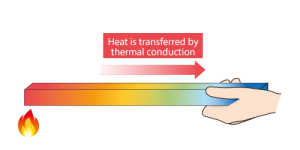
Thermal conduction is the transfer of heat through a material caused by a temperature difference between two regions. Heat naturally flows from hotter areas toward colder areas until thermal equilibrium is reached.
In solids, conduction occurs because molecules and atoms vibrate and transfer energy to neighboring particles. In metals, free electrons also help transport heat very efficiently, which is why metals are excellent thermal conductors.
For example:
- A metal spoon placed in hot tea becomes hot after a few minutes.
- Heat moves through the wall of a furnace.
- Electronics transfer heat from processors to heat sinks.
These are all examples of thermal conduction.
How Does Thermal Conduction Work?
At the microscopic level, thermal conduction occurs through particle interaction.
When one part of a material becomes hotter:
- The particles in that region gain kinetic energy.
- These particles vibrate faster.
- They collide with neighboring particles.
- Energy transfers through the material.
In conductive materials such as copper or aluminum, electrons move freely and transport thermal energy rapidly. In insulating materials such as fiberglass or foam, molecular movement is less efficient, reducing heat transfer.
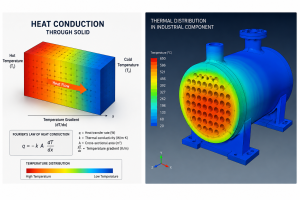
Fourier’s Law of Thermal Conduction
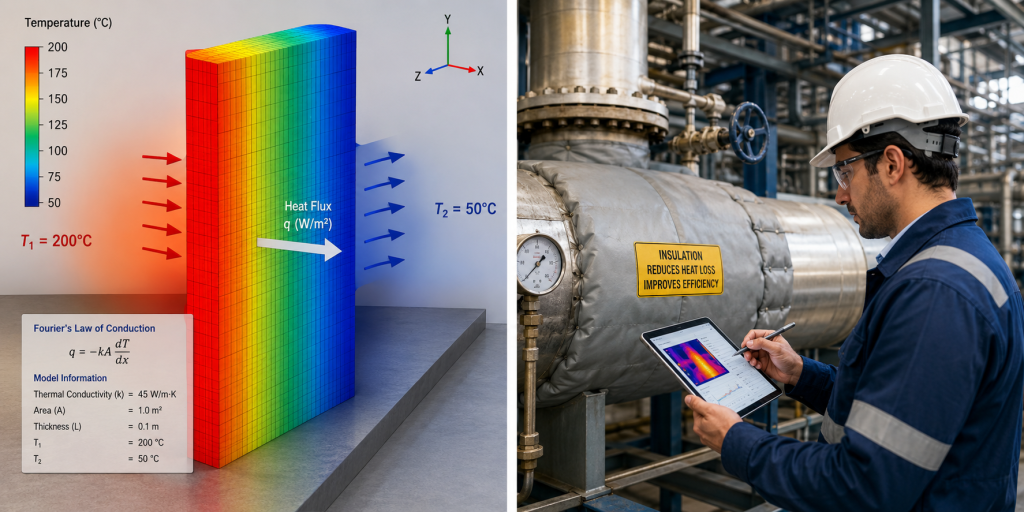
The fundamental equation governing thermal conduction is Fourier’s Law.
q=−kA dT/dx
Where:
- q = heat transfer rate
- k = thermal conductivity
- A = cross-sectional area
- dT/dx = temperature gradient
The negative sign indicates that heat flows from higher temperature toward lower temperature.
According to thermal engineering literature, Fourier’s Law is the foundation for most industrial heat transfer calculations.
What Is Thermal Conductivity?
Thermal conductivity measures a material’s ability to conduct heat. It is represented by the symbol k and usually measured in W/m·K.
Materials with high thermal conductivity transfer heat quickly, while low-conductivity materials resist heat flow.
Common Thermal Conductivity Values
| Material | Approximate Thermal Conductivity |
|---|---|
| Copper | 400 W/m·K |
| Aluminum | 205 W/m·K |
| Steel | 50 W/m·K |
| Glass | 1 W/m·K |
| Wood | 0.1–0.2 W/m·K |
| Air | 0.024 W/m·K |
Copper and aluminum are commonly used in heat exchangers because of their excellent conductivity, while fiberglass and foam are used as insulation because they resist heat flow.
What Is a Thermal Conductor?
A thermal conductor is a material that transfers heat efficiently.
Good thermal conductors include:
- Copper
- Aluminum
- Silver
- Brass
- Steel
These materials are widely used in:
- Heat exchangers
- Industrial ovens
- Electronics cooling
- Automotive radiators
- Thermal management systems
Metals conduct heat efficiently because free electrons transport thermal energy rapidly throughout the material.
What Are Examples of Thermal Conduction?
Thermal conduction appears in countless engineering and everyday situations.
Everyday Examples
- A frying pan heating on a stove
- Ironing clothes with a heated iron
- Ice melting in your hand
- A hot mug warming your fingers
- Metal railings feeling colder than wood during winter
Industrial Examples
- Heat transfer through boiler walls
- Cooling electronic processors with heat sinks
- Heat movement through insulated pipes
- Thermal analysis in aerospace structures
- Heat treatment processes in steel manufacturing
Engineering systems rely heavily on accurate conduction analysis to avoid overheating, improve efficiency, and reduce operational costs.
How Is Thermal Conduction Used in Everyday Life?
Many household products are intentionally designed around thermal conduction principles.
Cooking Equipment
Pots and pans are made from conductive metals to transfer heat efficiently from the stove to food.
Building Insulation
Walls and roofs use low-conductivity materials to reduce heat transfer and lower energy costs.
Electronics
Laptops and smartphones contain conductive components that move heat away from processors.
Refrigeration Systems
Refrigerators rely on conductive heat transfer inside coils and evaporators.
Clothing and Protective Equipment
Thermal insulation materials reduce unwanted conduction and improve thermal comfort.
What Are 5 Examples of Thermal Conductors?
The five most common thermal conductors are:
- Copper
- Aluminum
- Silver
- Brass
- Steel
Each material is selected based on:
- Thermal conductivity
- Cost
- Corrosion resistance
- Mechanical strength
- Manufacturability
Copper is especially common in industrial thermal systems because of its high conductivity and reliability.
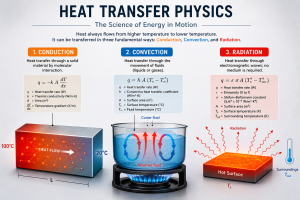
What Are the 4 Types of Thermal Transfer?
Heat transfer occurs through four major mechanisms:
| Type | Description |
|---|---|
| Conduction | Heat transfer through direct contact |
| Convection | Heat transfer through fluid movement |
| Radiation | Heat transfer through electromagnetic waves |
| Phase Change | Heat transfer during evaporation or condensation |
Conduction
Dominant in solids and stationary materials.
Convection
Occurs in liquids and gases when fluids circulate.
Radiation
Transfers heat without physical contact.
Phase Change
Important in refrigeration, boilers, and condensers.
Modern engineering systems usually involve multiple heat transfer mechanisms simultaneously.
Steady-State vs Transient Thermal Conduction
Thermal conduction problems are often divided into two categories.
Steady-State Conduction
In steady-state conduction, temperature remains constant over time.
Example:
- A continuously operating furnace wall
Transient Conduction
In transient conduction, temperature changes over time.
Example:
- A metal component heating during startup
Transient analysis is especially important in:
- Aerospace systems
- Automotive engines
- Electronics cooling
- Industrial process startup conditions
How to Calculate Thermal Conduction
For simple flat-wall conduction, engineers commonly use:
Q=kA(T1−T2)/LQ
Where:
- Q = heat transfer rate
- k = thermal conductivity
- A = area
- T₁ − T₂ = temperature difference
- L = wall thickness
Example Calculation
Suppose:
- Steel wall conductivity = 50 W/m·K
- Area = 2 m²
- Thickness = 0.05 m
- Temperature difference = 100°C
Then:
Q = (50 × 2 × 100) / 0.05
Q = 200,000 W
This means 200 kW of heat transfers through the wall.
Factors Affecting Thermal Conduction
Several variables influence conductive heat transfer.
Material Type
Metals conduct heat better than plastics or air.
Temperature Difference
Greater temperature differences increase heat transfer.
Thickness
Thicker materials reduce conduction rates.
Surface Area
Larger areas increase heat transfer.
Material Structure
Porous and composite materials alter conductivity behavior.
Material selection is one of the most important decisions in thermal engineering design.
Thermal Conduction in Engineering Applications
Electronics Cooling
Modern processors generate significant heat. Engineers use:
- Heat sinks
- Thermal interface materials
- Conductive metals
- Vapor chambers
to prevent overheating.
Industrial Furnaces
Furnace walls must balance:
- Heat retention
- Structural integrity
- Energy efficiency
Aerospace Engineering
Aircraft and spacecraft experience extreme thermal environments. Thermal conduction analysis helps engineers:
- Protect sensitive systems
- Reduce thermal stress
- Improve reliability
Heat Exchangers
Heat exchangers depend heavily on conductive heat transfer between fluids separated by metal surfaces.
Oil and Gas Pipelines
Pipeline insulation minimizes unwanted conductive heat loss during transport.
Thermal Insulation and Energy Efficiency
One of the most important uses of thermal conduction analysis is reducing energy loss.
Thermal insulation materials:
- Slow heat transfer
- Improve process efficiency
- Lower energy consumption
- Reduce operating costs
Common insulation materials include:
- Mineral wool
- Ceramic fiber
- Polyurethane foam
- Fiberglass
Industries increasingly invest in advanced insulation systems to meet sustainability goals and reduce carbon emissions.
Advanced Thermal Conduction Analysis
Simple calculations work for basic systems, but complex industrial equipment often requires simulation software.
Engineers use:
- Finite Element Analysis (FEA)
- Computational Fluid Dynamics (CFD)
- Thermal modeling software
to analyze:
- Temperature distribution
- Thermal stress
- Multi-material systems
- Transient heat transfer
Modern simulation tools allow engineers to optimize designs before manufacturing begins.
Challenges in Thermal Conduction Engineering
Thermal engineers face several challenges:
Temperature-Dependent Properties
Material conductivity changes with temperature.
Composite Materials
Modern systems often combine metals, ceramics, and polymers.
Thermal Expansion
Uneven heating causes mechanical stress.
Miniaturization
Smaller electronic devices create higher heat densities.
Sustainability
Energy-efficient thermal management is increasingly important for environmental compliance.
The Future of Thermal Conduction Technology
Emerging technologies are transforming thermal engineering.
Nanomaterials
Advanced materials improve heat transfer efficiency dramatically.
Smart Thermal Systems
Sensors and AI help optimize thermal performance in real time.
Sustainable Materials
Industries seek eco-friendly insulation and conductive materials.
High-Performance Electronics
Thermal management becomes increasingly critical as electronic devices become more powerful and compact.
Research into phonon behavior and nanoscale conduction is opening new opportunities for thermal engineering innovation.
Conclusion
Thermal conduction is one of the most important principles in engineering and industrial design. From electronics cooling and aerospace systems to building insulation and manufacturing processes, conductive heat transfer influences efficiency, reliability, safety, and operational cost.
Understanding thermal conduction allows engineers to:
- Improve energy efficiency
- Design safer systems
- Reduce thermal failures
- Optimize industrial processes
- Enhance equipment performance
As industries move toward sustainability, electrification, and higher-performance technologies, thermal conduction analysis will become even more critical. Businesses and engineering teams that understand conductive heat transfer principles are better positioned to improve system reliability and maintain competitive advantage in modern industrial markets.