Introduction
Thermal conduction is one of the most fundamental heat transfer mechanisms in engineering and industrial systems. From process equipment in chemical plants to electronic devices, metals play a central role in transferring heat efficiently and reliably.
Understanding thermal conduction in metals is essential not only for engineers designing thermal systems but also for decision-makers who need to optimize performance, energy efficiency, and safety in industrial operations.
In this article, we will explore:
- What thermal conduction is
- How metals conduct heat at the microscopic level
- Real-world examples of thermal conductors
- The best metals for heat conduction
- Engineering applications and design considerations
We will also highlight how thermal conduction modeling connects to broader engineering analysis and simulation approaches.
What is Thermal Conduction?
Thermal conduction is the process by which heat energy is transferred through a material without any movement of the material as a whole. Instead, energy is transferred through molecular and atomic interactions.
In simple terms:
Heat flows from a region of higher temperature to a region of lower temperature through direct contact between particles.
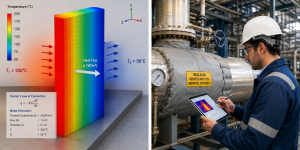
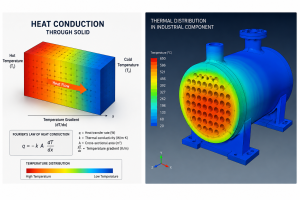
This mechanism is governed by Fourier’s Law of Heat Conduction, which states:
- Heat transfer rate is proportional to the temperature gradient
- Heat flows in the direction of decreasing temperature
- The proportionality constant is the thermal conductivity (k) of the material
Key Characteristics of Thermal Conduction:
- No bulk movement of material
- Occurs in solids, liquids, and gases (most effective in solids)
- Strongly dependent on material structure and bonding
How Do Metals Conduct Thermal Energy?
Metals are among the best thermal conductors due to their unique atomic structure. Unlike insulators, metals contain a large number of free electrons, which are not bound tightly to atoms.
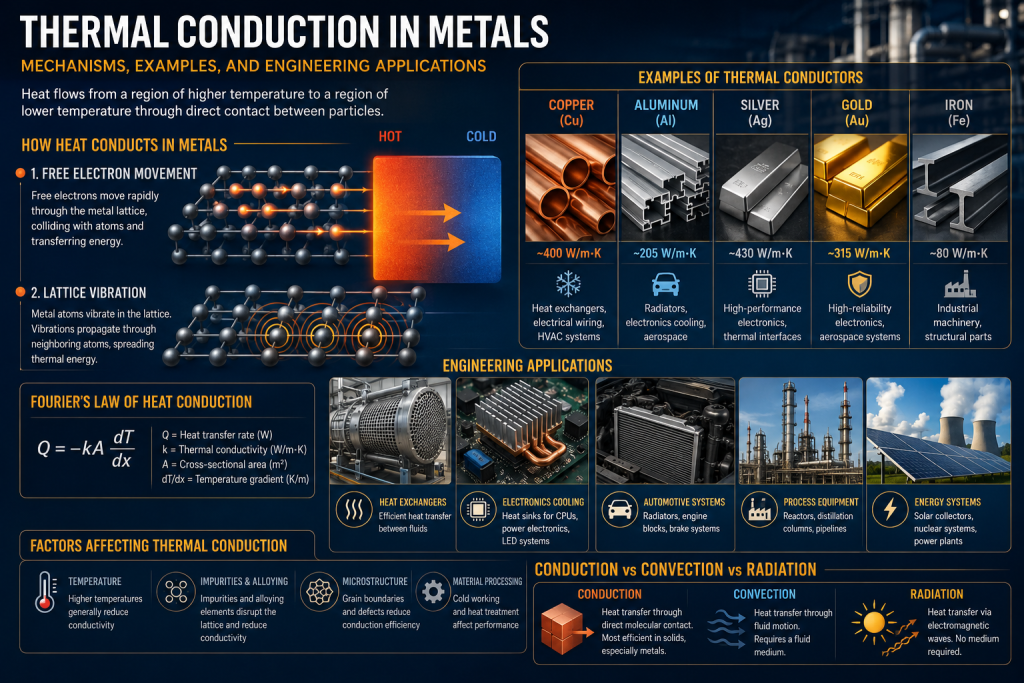
1. Free Electron Movement (Primary Mechanism)
In metals, electrons are loosely bound and can move freely throughout the lattice structure. When heat is applied:
- Electrons gain kinetic energy
- They move rapidly through the metal lattice
- They collide with atoms and transfer energy
This electron movement is the dominant mechanism of heat conduction in metals.
2. Lattice Vibration (Phonon Contribution)
In addition to electrons, metal atoms vibrate within a structured lattice:
- Heating increases atomic vibration
- Vibrations propagate through neighboring atoms
- Energy spreads through the material
However, in metals, lattice vibration plays a secondary role compared to electron transport.
3. Why Metals Are Better Than Non-Metals
Non-metals rely mainly on lattice vibrations only, which is much slower. Metals benefit from:
- Dual heat transfer mechanism (electrons + lattice)
- High electron mobility
- Dense atomic structure
This combination makes metals excellent thermal conductors.
What is Thermal Conduction in Engineering Context?
In engineering, thermal conduction is not just a physical phenomenon—it is a design parameter.
Engineers use conduction principles to:
- Design heat exchangers
- Manage thermal loads in machinery
- Prevent overheating in electronic systems
- Optimize energy efficiency in industrial processes
The general conduction equation used in engineering is:
- Q = -kA(dT/dx)
Where:
- Q = heat transfer rate
- k = thermal conductivity
- A = cross-sectional area
- dT/dx = temperature gradient
Engineering relevance:
Thermal conduction modeling is essential in:
- CFD simulations
- Process design
- Equipment sizing
- Material selection
What Are 5 Examples of Thermal Conductors?
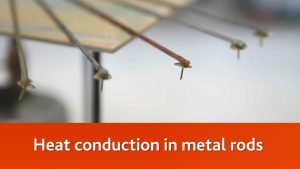
Here are five commonly used thermal conductors in engineering applications:
1. Copper (Cu)
- Thermal conductivity: ~400 W/m·K
- Excellent electrical and thermal conductor
- Widely used in heat exchangers and electrical wiring
Applications:
- HVAC systems
- Electrical motors
- Heat sinks
2. Aluminum (Al)
- Thermal conductivity: ~205 W/m·K
- Lightweight and cost-effective
- Easier to machine than copper
Applications:
- Automotive radiators
- Electronics cooling
- Aerospace components
3. Silver (Ag)
- Highest thermal conductivity (~430 W/m·K)
- Expensive, so limited industrial use
Applications:
- Specialized electronics
- High-performance thermal interfaces
4. Gold (Au)
- Good thermal conductivity (~315 W/m·K)
- Extremely resistant to corrosion
Applications:
- High-reliability electronics
- Space and aerospace systems
5. Iron (Fe)
- Moderate thermal conductivity (~80 W/m·K)
- Strong and widely available
Applications:
- Industrial machinery
- Structural components
What is the Best Metal for Thermal Conduction?
The answer depends on both thermal performance and practical constraints.
Pure Thermal Performance:
| Metal | Thermal Conductivity (W/m·K) | Ranking |
|---|---|---|
| Silver | ~430 | 1 |
| Copper | ~400 | 2 |
| Gold | ~315 | 3 |
| Aluminum | ~205 | 4 |
| Iron | ~80 | 5 |
Why Silver is Not Always Used
Even though silver is the best conductor:
- It is very expensive
- It tarnishes over time
- It is not practical for large-scale industrial systems
Copper: The Engineering Standard
Copper is widely considered the best practical thermal conductor because:
- High thermal conductivity
- Good mechanical strength
- Cost-effective compared to silver
- Easy fabrication and joining
Aluminum: Lightweight Alternative
Aluminum is preferred when:
- Weight is critical (aerospace, automotive)
- Moderate thermal performance is acceptable
- Cost reduction is important
Factors Affecting Thermal Conduction in Metals
Even within metals, thermal conductivity can vary depending on several factors:
1. Temperature
- Higher temperatures generally reduce conductivity
- Electron scattering increases with heat
2. Impurities and Alloying
- Pure metals conduct heat better than alloys
- Alloying introduces lattice disruptions
3. Microstructure
- Grain boundaries reduce conduction efficiency
- Crystal alignment improves conductivity
4. Material Processing
- Cold working vs heat treatment affects structure
Industrial Applications of Thermal Conduction in Metals
1. Heat Exchangers
Metals like copper and aluminum are used to transfer heat between fluids efficiently.
2. Electronics Cooling
Modern electronics rely heavily on metal heat sinks.
- CPUs
- Power electronics
- LED systems
3. Automotive Systems
- Radiators
- Engine blocks
- Brake systems
4. Process Industry Equipment
In chemical and petrochemical plants:
- Reactors
- Distillation columns
- Pipelines
Metals ensure controlled heat transfer for safe operation.
5. Energy Systems
- Solar thermal collectors
- Nuclear heat exchangers
- Power plants
Thermal Conduction vs Other Heat Transfer Modes
To fully understand conduction, it is important to compare it with:
Convection
- Heat transfer through fluid motion
- Requires fluid medium
Radiation
- Heat transfer via electromagnetic waves
- No medium required
Conduction
- Requires direct molecular contact
- Most efficient in solids, especially metals
Why Metals Dominate Engineering Heat Transfer Design
Metals remain essential because they offer:
- High thermal conductivity
- Structural strength
- Manufacturability
- Predictable performance
However, modern engineering increasingly combines metals with:
- Thermal interface materials
- Composites
- Coatings
- Advanced alloys
This hybrid approach allows engineers to optimize performance beyond pure metals.
Conclusion
Thermal conduction in metals is a cornerstone of modern engineering design. From copper and aluminum in everyday applications to specialized metals used in aerospace and electronics, understanding how heat flows through materials is essential for optimizing performance and efficiency.
Metals conduct heat primarily through free electrons, making them significantly more efficient than non-metallic materials. While silver remains the best conductor in theory, copper dominates industrial applications due to its balance of performance, cost, and availability.
As engineering systems become more complex, accurate modeling of thermal conduction is increasingly important. Advanced simulation tools and process modeling techniques enable engineers to predict, optimize, and control thermal behavior across a wide range of industries.