

Aligning FEA Results with Australian Standards (RPEQ & CPEng)
Introduction Finite Element Analysis (FEA) has become a cornerstone of modern engineering design, enabling engineers to predict structural behavior, validate performance, and optimize systems before physical construction or manufacturing begins. However, in Australia, technical accuracy alone is not sufficient. Engineering outcomes must also comply with regulatory and professional standards, particularly
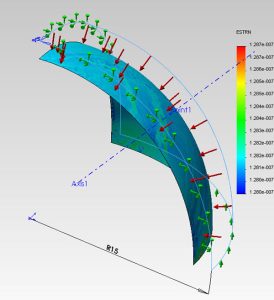
Using NAFEMS Standards to Validate FEA Results
A Technical Guide to FEA Verification, Benchmarks, and Best Practices Introduction Finite Element Analysis (FEA) has become a cornerstone of modern engineering design, enabling accurate prediction of structural behavior, thermal performance, and multi-physics interactions. However, as simulation results increasingly replace physical testing, a critical question arises: how reliable are the
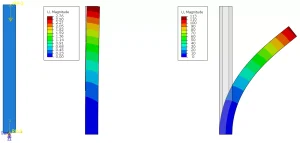
Linear vs. Nonlinear FEA: Differences & Use Cases
Understanding When and Why Nonlinear Analysis Is Required Introduction Finite Element Analysis (FEA) is a fundamental tool in modern engineering design, enabling engineers to predict structural behavior, optimize performance, and reduce physical prototyping costs. While many early-stage simulations rely on linear FEA, real-world engineering problems often involve complexities that linear

3D Scanning Techniques: Structured Light, Laser & Photogrammetry
A Technical Guide for Reverse Engineering and Industrial Applications Introduction As products become more complex and development cycles shorter, 3D scanning technologies have become essential tools in modern engineering workflows. From legacy part reproduction to dimensional inspection and digital twin creation, 3D scanners for reverse engineering enable engineers to capture
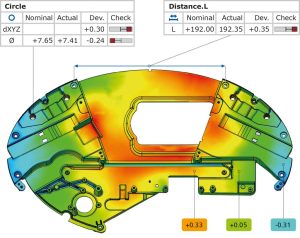
Accuracy & Quality Control in 3D Modeling
Understanding 3D Scanner Accuracy, Precision, Resolution, and ISO 10360 Standards In modern engineering, manufacturing, and industrial inspection, 3D modeling accuracy is no longer optional — it is a critical factor that directly affects product quality, functional performance, compliance, and cost efficiency. With the rapid adoption of 3D scanning technologies in

3D Scanning for Reverse Engineering
Reverse engineering plays a critical role in modern mechanical, industrial, and manufacturing engineering, particularly in cases where original CAD data is unavailable, legacy components must be reproduced, or design optimization is required. With the advancement of high-resolution 3D scanning technologies, reverse engineering has evolved into a precise, data-driven workflow capable