Enhancing Safety, Precision, and Efficiency
Civil engineering projects, ranging from high-rise buildings and bridges to stadiums and infrastructure facilities, rely heavily on structural analysis to ensure safety, stability, and compliance with design codes. Advanced structural analysis software empowers civil engineers to simulate complex loads, evaluate structural performance, optimize designs, and minimize costs.
This blog delves into the various use cases of structural analysis software in civil engineering, covering the modeling of concrete, steel, and composite structures, as well as advanced simulations for earthquake, wind, and dynamic load scenarios. The guide is aimed at civil engineering professionals and firms looking to improve project outcomes through technology-driven analysis.
Why Structural Analysis Software is Crucial for Civil Engineering
Civil engineering projects face numerous challenges including heavy loads, complex geometries, environmental conditions, and strict regulatory requirements. Using structural analysis software helps engineers:
- Ensure Safety: Accurately predict stresses, deflections, and potential failure modes to safeguard occupants and infrastructure.
- Achieve Compliance: Meet local and international building codes, such as Eurocode, ACI, AISC, AS/NZS standards.
- Optimize Materials: Determine efficient member sizes, minimize material waste, and reduce project costs.
- Evaluate Complex Loads: Simulate dead, live, wind, seismic, snow, and dynamic loads that impact real-world performance.
- Enhance Efficiency: Automate calculations, generate detailed reports, and produce design documentation with higher accuracy.
The integration of software in civil engineering workflows ensures that structures are not only safe and compliant but also cost-effective and resilient.
Civil Engineering Use Cases for Structural Analysis Software
1. High-Rise Buildings
High-rise structures are subjected to significant wind and seismic loads. Structural analysis software allows engineers to model:
- Frame systems (steel, concrete, or composite)
- Lateral load-resisting systems (shear walls, braced frames)
- Dynamic load response (wind sway, seismic vibration)
2. Bridges
Bridges experience complex load scenarios, including:
- Vehicular traffic
- Pedestrian loads
- Wind and earthquake forces
- Temperature-induced expansion and contraction
Software tools simulate these loads, evaluate bending, shear, and torsion, and ensure compliance with bridge design standards.
3. Industrial and Infrastructure Facilities
Civil engineers designing factories, power plants, or sports complexes benefit from structural analysis software to:
- Assess heavy machinery loads
- Model long-span structures
- Evaluate roof systems and cantilevered elements
4. Retaining Walls and Earth Structures
Soil-structure interaction is critical in retaining walls, embankments, and foundations. Analysis software can model:
- Lateral earth pressure distribution
- Load transfer from superstructures to soil
- Stability against sliding, overturning, and settlement
5. Seismic Retrofitting
Structural analysis tools are vital for evaluating existing structures under seismic loads, helping engineers design retrofitting solutions such as:
- Base isolators
- Bracing systems
- Dampers and energy-absorbing devices
Modeling Concrete, Steel & Composite Structures
Different materials exhibit unique behaviors under load. Structural analysis software allows precise modeling of material properties and complex geometries.
Concrete Structures
- Reinforced Concrete: Software models steel reinforcement embedded in concrete to capture composite action.
- Prestressed Concrete: Simulate prestressing effects, tendon losses, and long-term deflection.
- Nonlinear Analysis: Account for cracking, creep, and shrinkage effects.
Steel Structures
- Beam-Column Analysis: Calculate bending, axial, shear, and torsional stresses.
- Connection Design: Model bolted, welded, and riveted connections.
- Composite Action: Evaluate steel-concrete composite floors, beams, and columns.
Composite Structures
- Hybrid Systems: Analyze combinations of concrete, steel, and other materials.
- Dynamic Behavior: Evaluate composite bridges, high-rise floors, and industrial frameworks.
- Load Distribution: Model interaction between different materials to optimize design.
Advantages of 3D Modeling
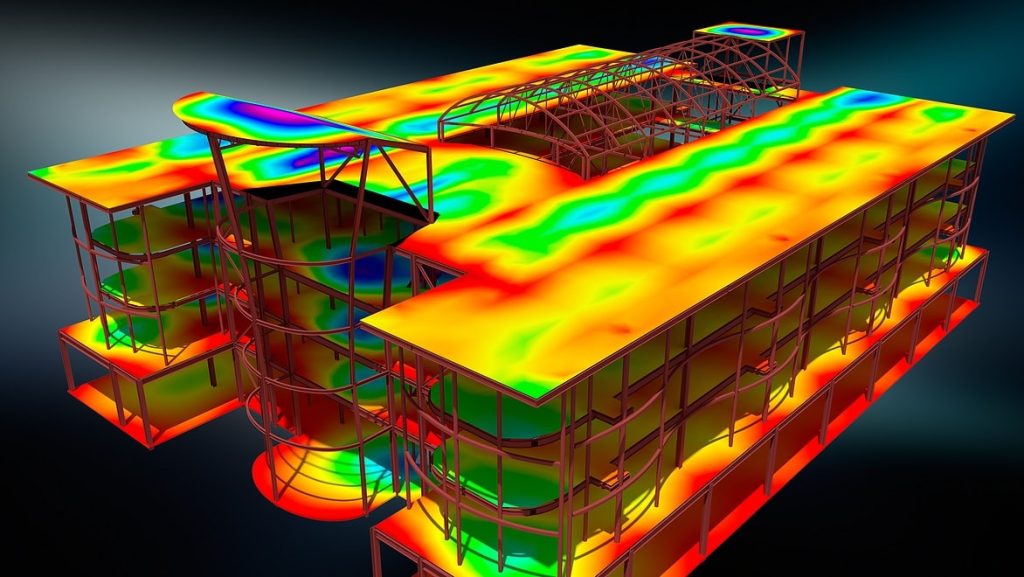
- Visualize structural behavior under realistic loading
- Identify stress concentrations and potential failure zones
- Facilitate BIM integration for construction planning
Earthquake & Wind Simulation
Dynamic environmental loads are critical in civil engineering design. Advanced structural analysis software allows for realistic simulation of wind and earthquake effects.
Earthquake Simulation
- Seismic Load Codes: Apply local and international codes (IBC, Eurocode 8, ASCE 7).
- Response Spectrum Analysis: Evaluate structural response at different frequencies.
- Time History Analysis: Simulate actual seismic events using recorded ground motion.
- Base Isolation & Energy Dissipation: Test effectiveness of seismic retrofitting techniques.
Wind Simulation
- Wind Load Calculations: Generate design wind pressures based on building height, shape, and location.
- CFD Integration: Model aerodynamic effects and vortex shedding.
- Dynamic Analysis: Simulate sway, acceleration, and comfort criteria for occupants.
Combined Load Scenarios
Software can simultaneously account for dead, live, wind, and seismic loads, enabling a holistic structural assessment. This is essential for tall buildings, long-span bridges, and critical infrastructure.

Popular Structural Analysis Software in Civil Engineering
STAAD.Pro
- 3D modeling and multi-material support
- Seismic, wind, and dynamic analysis
- Integration with BIM workflows
- Extensive code library (AISC, Eurocode, IS, AS/NZS)
ETABS
- Specialized for building structures
- Earthquake and wind simulation
- P-Delta and nonlinear analysis
- Reinforced concrete and steel frame design
SAP2000
- General-purpose structural analysis
- Bridges, buildings, and industrial facilities
- Advanced dynamic and nonlinear analysis
- Time history and response spectrum simulations
RISA-3D
- Easy-to-use 3D modeling
- Steel, concrete, and composite structures
- Automated load combinations
- Fatigue and seismic analysis capabilities
ANSYS Civil Structural Module
- Finite element modeling for advanced simulations
- Nonlinear material behavior and large deformation analysis
- Integration with CFD for wind and environmental load simulations
- Fatigue and thermal load assessment
Advantages of Using Structural Analysis Software
- Accuracy: Eliminates human error in complex calculations.
- Efficiency: Reduces design time and accelerates project delivery.
- Visualization: 3D models and simulations improve understanding of structural behavior.
- Optimization: Material usage and design can be refined for cost-effectiveness.
- Compliance: Ensures adherence to international and local codes.
- Collaboration: BIM integration improves coordination with architects and contractors.
Choosing the Right Software
- Project Type: Buildings, bridges, industrial facilities, or special infrastructure.
- Material Focus: Concrete, steel, or composite structures.
- Load Requirements: Static, dynamic, seismic, wind, or combined loads.
- Team Expertise: User-friendly tools for beginners, advanced tools for experienced engineers.
- BIM & Collaboration Needs: Integration with design and construction workflows.
- Budget Considerations: Licensing and training costs.
Conclusion
Structural analysis software is indispensable for modern civil engineering, providing tools to model concrete, steel, and composite structures, simulate earthquake and wind loads, and ensure design compliance. By adopting these tools, engineers can enhance safety, optimize materials, and streamline project workflows.
For firms like Avesta Consulting, using state-of-the-art software enhances accuracy, reduces project risk, and positions the company as a trusted provider of civil engineering solutions. Investing in advanced structural analysis tools is no longer optional—it is a key factor for successful, resilient, and efficient infrastructure projects.