Heat transfer is one of the most fundamental concepts in engineering, manufacturing, construction, and industrial design. Whether engineers are designing heat exchangers, improving HVAC efficiency, protecting electronic equipment from overheating, or optimizing refractory linings in furnaces, understanding how heat moves is essential.
In industrial environments, poor thermal management can lead to energy losses, equipment failure, reduced efficiency, safety hazards, and increased operational costs. That is why heat transfer analysis plays a major role in engineering simulation, Computational Fluid Dynamics (CFD), and thermal assessment studies. Modern engineering tools now allow companies to simulate thermal behaviour before physical production, helping reduce risks and improve design performance.
This guide explores the four methods of heat transfer in detail:
- Conduction
- Convection
- Radiation
- Phase Change Heat Transfer
We will also examine real-world engineering applications, industrial examples, simulation techniques, and how engineers analyse thermal systems using advanced software tools.
What Is Heat Transfer?
Heat transfer is the movement of thermal energy from one object, material, or system to another due to a temperature difference.
According to the second law of thermodynamics, heat naturally flows from a hotter region to a colder region until thermal equilibrium is reached.
Heat transfer is critical in:
- Mechanical engineering
- Chemical processing
- HVAC systems
- Electronics cooling
- Aerospace engineering
- Automotive systems
- Power generation
- Metallurgy
- Refractory engineering
- Building design
Engineers analyse heat transfer to:
- Prevent overheating
- Improve energy efficiency
- Increase equipment lifespan
- Reduce operational costs
- Enhance safety
- Optimize industrial processes
Modern thermal engineering frequently combines CFD and Finite Element Analysis (FEA) to evaluate temperature distribution, airflow, thermal stress, and energy efficiency.
Why Heat Transfer Matters in Engineering
Heat affects nearly every engineering system.
For example:
- Excessive heat can damage electronic components.
- Poor thermal insulation increases energy costs.
- Uneven temperature distribution can create thermal stress.
- Inefficient cooling systems reduce machine performance.
- High furnace temperatures impact refractory durability.
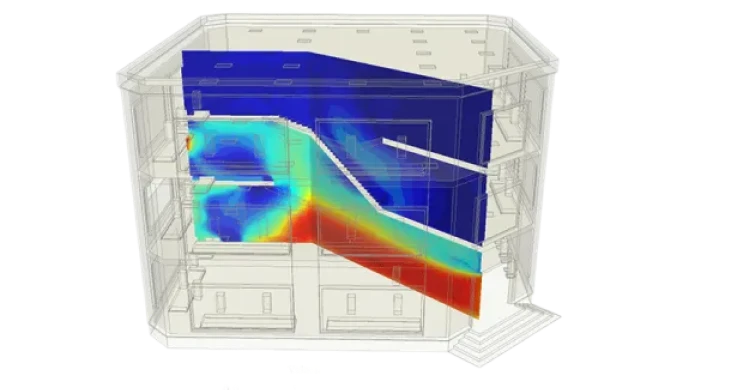
Industries rely on thermal simulations and thermal assessments to predict how heat behaves under operating conditions. CFD simulations are especially important for understanding fluid flow and heat transfer simultaneously.
Common engineering applications include:
- Heat exchangers
- Boilers
- Furnaces
- Turbines
- Cooling systems
- HVAC ducting
- Electronic cooling
- Solar energy systems
- Industrial ovens
- Thermal insulation systems
The 4 Methods of Heat Transfer
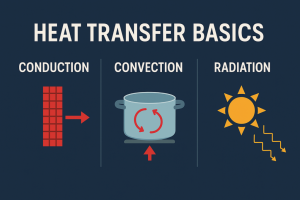
The four primary methods of heat transfer are:
| Heat Transfer Method | Requires Medium? | Main Mechanism |
|---|---|---|
| Conduction | Yes | Direct molecular contact |
| Convection | Yes | Fluid motion |
| Radiation | No | Electromagnetic waves |
| Phase Change Heat Transfer | Usually | Energy absorbed/released during state change |
Each method behaves differently and is used in different engineering applications.
1. Conduction Heat Transfer
Conduction is the transfer of heat through direct contact between molecules or particles.
When one part of a material becomes hot, nearby particles gain energy and transfer that energy to adjacent particles. This process continues through the material.
Fourier’s Law of Heat Conduction
q=−kAdTdxq=-kA\frac{dT}{dx}
Where:
- qq = heat transfer rate
- kk = thermal conductivity
- AA = cross-sectional area
- dT/dxdT/dx = temperature gradient
How Conduction Works
Imagine placing a metal spoon into hot soup.
The submerged end becomes hot first. Eventually, the heat travels through the spoon to the handle. This occurs because metals contain free electrons that efficiently transfer thermal energy.
Materials with high thermal conductivity transfer heat rapidly.
Examples include:
- Copper
- Aluminum
- Steel
- Silver
Insulators transfer heat slowly.
Examples include:
- Wood
- Rubber
- Ceramic insulation
- Fiberglass
- Air
Engineering Applications of Conduction
Conduction plays a major role in:
Heat Exchangers
Heat exchangers transfer thermal energy between fluids through conductive surfaces.
Electronic Cooling
Computer processors and industrial electronics rely on thermal conduction through heat sinks.
Refractory Systems
Industrial furnaces use refractory linings to control conductive heat loss and protect structural shells from excessive temperatures.
Building Insulation
Walls, roofs, and windows are designed to reduce conductive heat transfer.
Thermal Barrier Coatings
Aerospace and gas turbine systems use coatings that minimize heat conduction into metal components.
Factors Affecting Conduction
Several factors influence conductive heat transfer:
Thermal Conductivity
Higher conductivity means faster heat transfer.
Temperature Difference
Larger temperature differences increase heat flow.
Material Thickness
Thicker materials reduce conductive heat transfer.
Surface Area
Larger contact areas allow more heat transfer.
Conduction in Engineering Simulation
FEA software and thermal simulation tools help engineers predict conductive heat flow through components and structures. Engineers can evaluate:
- Temperature gradients
- Thermal stresses
- Material expansion
- Heat loss
- Insulation effectiveness
Thermal analysis within FEA software is widely used for predicting heat transfer in mechanical and industrial systems.
2. Convection Heat Transfer
Convection is heat transfer caused by the movement of fluids such as liquids or gases.
Unlike conduction, convection depends on fluid motion.
Newton’s Law of Cooling
q=hA(Ts−Tf)q=hA(T_s-T_f)
Where:
- qq = heat transfer rate
- hh = convection coefficient
- AA = surface area
- TsT_s = surface temperature
- TfT_f = fluid temperature
Types of Convection
There are two main types:
Natural Convection
Fluid motion occurs naturally due to density differences caused by temperature variations.
Example:
Hot air rising above a radiator.
Forced Convection
Fluid motion is generated using external devices such as fans, pumps, or blowers.
Example:
Industrial cooling systems using forced airflow.
Real-World Examples of Convection
Convection is used in:
- HVAC systems
- Air conditioning units
- Automotive radiators
- Industrial cooling towers
- Heat exchangers
- Electronic cooling systems
- Boiler systems
- Chemical processing plants
CFD simulations are commonly used to study airflow, turbulence, and heat transfer in convection-driven systems.
Why Convection Is Important in Engineering
Poor convection performance can cause:
- Overheating
- Equipment damage
- Reduced efficiency
- Uneven temperature distribution
- Higher operating costs
Engineers optimize convection systems by adjusting:
- Flow velocity
- Surface geometry
- Turbulence levels
- Fan configurations
- Pipe arrangements
CFD and Convection Analysis
Computational Fluid Dynamics (CFD) is one of the most powerful tools for analyzing convective heat transfer.
CFD allows engineers to simulate:
- Airflow patterns
- Temperature fields
- Pressure distribution
- Turbulence
- Cooling efficiency
Industries using CFD include aerospace, automotive, energy, electronics, and HVAC engineering.
3. Radiation Heat Transfer
Radiation is the transfer of heat through electromagnetic waves.
Unlike conduction and convection, radiation does not require physical contact or a medium.
This is how heat from the sun reaches Earth through space.
Stefan–Boltzmann Law
q=σAT4q=\sigma A T^4
Where:
- qq = radiated heat
- σ\sigma = Stefan–Boltzmann constant
- AA = surface area
- TT = absolute temperature
How Radiation Works
All objects emit thermal radiation based on their temperature.
Hotter objects emit more radiant energy.
Examples include:
- The sun heating the Earth
- Infrared heaters
- Industrial furnaces
- Hot metal surfaces
- Fireplaces
Radiation in Industrial Applications
Radiation becomes extremely important at high temperatures.
Industries that rely heavily on radiative heat transfer include:
- Steel manufacturing
- Glass production
- Power plants
- Aerospace
- Refractory engineering
- Solar energy systems
Refractory systems are specifically designed to withstand high radiant heat loads while minimizing thermal losses.
Factors Affecting Radiation
Surface Temperature
Radiation increases rapidly as temperature rises.
Surface Emissivity
Dark, rough surfaces emit more radiation than shiny reflective surfaces.
Surface Area
Larger surfaces radiate more energy.
Engineering Applications of Radiation
Radiation analyzis is used for:
- Furnace design
- Spacecraft thermal protection
- Solar collector systems
- Thermal insulation
- Fire safety engineering
- High-temperature process equipment
Thermal simulations often combine conduction, convection, and radiation together for accurate engineering predictions.
4. Phase Change Heat Transfer
The fourth method of heat transfer involves energy absorbed or released during phase changes.
Examples include:
- Melting
- Freezing
- Boiling
- Condensation
- Evaporation
During phase change, temperature may remain constant while energy transfer continues.
Latent Heat Equation
Q=mLQ=mL
Where:
- QQ = heat energy
- mm = mass
- LL = latent heat
Examples of Phase Change Heat Transfer
Boiling Water
Water absorbs heat until it changes from liquid to vapor.
Condensation in HVAC Systems
Air conditioning systems remove heat through refrigerant phase changes.
Steam Power Plants
Steam turbines rely on evaporation and condensation cycles.
Refrigeration Systems
Refrigerants absorb and release heat during phase changes.
Why Phase Change Heat Transfer Is Important
Phase change processes allow large amounts of heat transfer with relatively small temperature changes.
This makes them highly efficient for:
- Cooling systems
- Refrigeration
- Power generation
- Thermal energy storage
- Chemical processing
Combined Heat Transfer Mechanisms
In real engineering systems, heat transfer methods rarely occur independently.
Most systems involve multiple mechanisms simultaneously.
For example:
Industrial Furnace
- Radiation from flames
- Conduction through refractory walls
- Convection from hot gases
Electronic Cooling
- Conduction through chips
- Convection via airflow
- Radiation from hot surfaces
Heat Exchanger
- Conduction through metal walls
- Convection inside fluid channels
Modern engineering simulation software can model these combined effects with high accuracy.
Heat Transfer in CFD and Thermal Simulation
Simulation technologies have transformed thermal engineering.
Instead of relying solely on physical testing, engineers now use simulation software to predict thermal performance before manufacturing begins.
CFD and FEA tools are commonly used to analyze:
- Heat flow
- Fluid movement
- Thermal stress
- Cooling performance
- Energy efficiency
- Temperature distribution
Engineering simulations help reduce:
- Design costs
- Development time
- Prototype requirements
- Operational risks
Advanced simulation methods are widely used across industrial engineering applications.
Heat Transfer Applications Across Industries
Aerospace Engineering
- Aircraft cooling systems
- Thermal protection systems
- Jet engine analysis
Automotive Engineering
- Engine cooling
- Battery thermal management
- HVAC optimization
Electronics Industry
- Processor cooling
- Heat sink optimization
- Thermal management systems
Building Engineering
- Energy-efficient insulation
- HVAC airflow analysis
- Thermal comfort assessment
Manufacturing
- Furnace design
- Casting processes
- Welding analysis
Energy Sector
- Heat exchangers
- Boilers
- Nuclear reactors
- Solar thermal systems
Challenges in Heat Transfer Engineering
Engineers face several thermal management challenges:
Thermal Stress
Uneven heating causes material expansion and structural stress.
Energy Loss
Poor insulation increases operating costs.
Overheating
Excessive temperatures reduce equipment lifespan.
Complex Fluid Behaviour
Turbulence makes thermal predictions difficult.
Material Limitations
Different materials respond differently to heat.
Simulation software helps engineers address these challenges early in the design process.
Future Trends in Heat Transfer Technology
The future of thermal engineering includes:
- AI-assisted thermal optimization
- Advanced CFD modelling
- Digital twin simulation
- Sustainable thermal systems
- Smart cooling technologies
- High-efficiency heat exchangers
- Phase-change thermal storage materials
High-performance computing is also improving the accuracy and speed of thermal simulations.
Conclusion
Understanding the four methods of heat transfer is essential for engineers, designers, manufacturers, and industrial operators.
Conduction, convection, radiation, and phase change heat transfer each play a critical role in thermal engineering systems. In real-world applications, these mechanisms often work together simultaneously, influencing performance, safety, efficiency, and operating costs.
Modern industries increasingly rely on CFD, FEA and advanced thermal simulation software to analyze and optimize heat transfer behaviour before production and installation. From electronic cooling and HVAC systems to refractory linings and aerospace engineering, thermal management has become a key part of modern engineering design.
As industries continue to pursue energy efficiency, sustainability, and high-performance systems, heat transfer engineering will remain one of the most important disciplines in advanced engineering analysis.