ckbone of modern infrastructure. From bridges and skyscrapers to tunnels and dams, it plays a vital role in shaping our built environment. However, like all materials, concrete is not immune to wear and tear. Cracks are a common problem in concrete structures, often leading to costly maintenance, reduced durability, and safety concerns. Enter self-healing concrete, an innovation poised to revolutionize structural engineering by enabling concrete to autonomously repair its own cracks.
This blog explores the fascinating world of self-healing concrete—from how it works and its benefits to challenges, real-world applications, and future potential. As infrastructure ages and sustainability becomes a pressing concern, self-healing materials offer a timely and transformative solution.
How Self-Healing Concrete Works
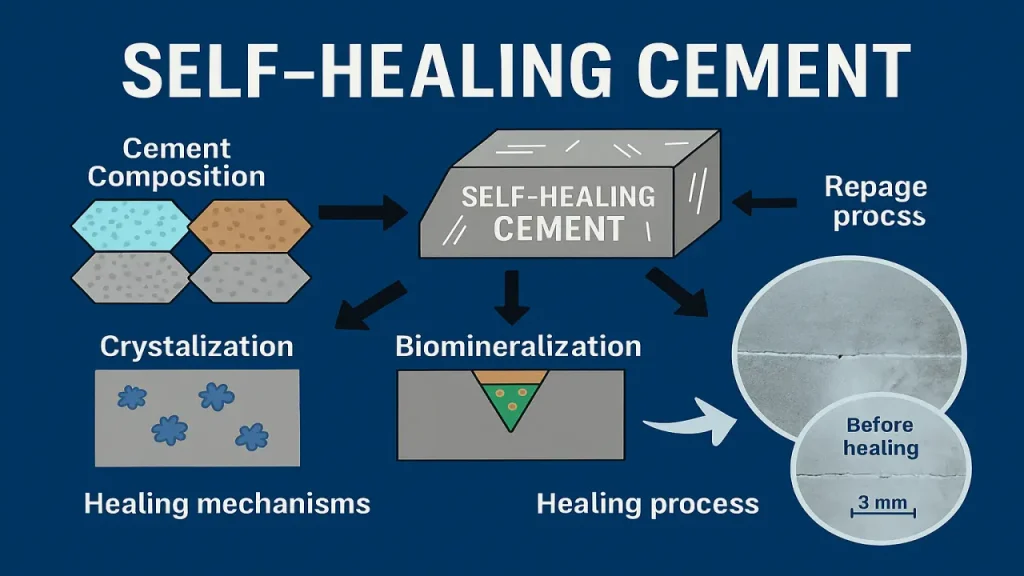
Self-healing concrete mimics the human body’s ability to repair itself. It incorporates healing agents within its structure that become active when a crack forms. These agents are typically encapsulated bacteria, polymers, or mineral additives that react with environmental stimuli (such as water and air) to seal cracks and restore integrity.
Bacterial-Based Healing
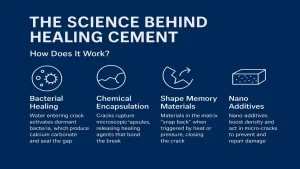
One of the most studied methods uses bacteria, such as Bacillus subtilis or Bacillus pseudofirmus, which are mixed into the concrete in spore form along with a nutrient (usually calcium lactate). When cracks allow water and air to penetrate the concrete, the bacteria activate and produce calcium carbonate (CaCO3), a mineral that fills and seals the cracks.
Capsule-Based Healing
Another approach involves embedding microcapsules filled with healing agents like epoxy or polyurethane. When a crack propagates through the concrete, these capsules rupture and release their contents into the fissure, bonding the two sides and halting further damage.
Vascular Networks
Inspired by biological systems, some researchers have experimented with vascular networks embedded in concrete. These networks can transport healing agents to damaged areas much like blood vessels carry nutrients.
Autogenous Healing
Concrete can also naturally heal micro-cracks through continued hydration of unreacted cement particles and carbonation. While limited in scope, this phenomenon can be enhanced with admixtures to improve its effectiveness.
Benefits for Structural Durability
The benefits of self-healing concrete extend beyond simple crack repair. Here are some key advantages:
Increased Longevity
Structures built with self-healing concrete last significantly longer than traditional ones. The automatic repair process prevents crack propagation, reducing the need for major repairs.
Cost Savings
Although the initial investment is higher, self-healing concrete significantly reduces long-term maintenance costs. This is especially beneficial for hard-to-access infrastructure such as underwater tunnels or tall buildings.
Environmental Impact
Reducing the frequency of repairs means fewer raw materials and energy used over the life cycle of a structure, aligning with sustainable construction goals.
Enhanced Safety
Cracks in concrete can compromise structural integrity. Self-healing capabilities help maintain the structure’s strength and reduce the risk of failure.
Water Tightness
For infrastructure such as dams, reservoirs, or wastewater treatment plants, self-healing concrete maintains impermeability, improving both safety and efficiency.
Applications in Modern Construction
Self-healing concrete is increasingly being adopted in high-demand construction sectors:
- Bridges and highways: These structures are exposed to constant stress and environmental fluctuations.
- Tunnels and underground systems: Maintenance is difficult and costly in these environments.
- Marine structures: Constant exposure to water accelerates degradation.
- Nuclear power plants: Require high integrity and minimal risk of leaks.
- Residential and commercial high-rises: Reduce long-term maintenance and improve building value.
Case Studies: Successful Implementations
The Netherlands: Delft University Projects
Researchers at Delft University of Technology have applied bacterial self-healing concrete in pedestrian bridges. The results showed a significant reduction in visible cracks and increased structural lifespan.
United Kingdom: Smart Motorways
Trial sections of the M4 motorway were built using self-healing concrete. Monitoring over several years showed improved durability and reduced maintenance incidents.
South Korea: High-Rise Buildings
Developers have used self-healing concrete in skyscraper foundations, showing better load distribution and reduced cracking, especially during seismic activity.
Italy: Tunnel Systems
The use of polymer-based healing agents in tunnel linings has proven effective in preventing water ingress and improving structural reliability.
Challenges and Limitations
Despite its promise, self-healing concrete is not without its challenges:
Cost
Self-healing agents significantly increase the cost per cubic meter of concrete. While long-term savings may offset this, initial costs remain a barrier.
Limited Healing Range
Current systems are most effective on cracks under 0.5mm wide. Wider cracks may not fully heal or require multiple cycles of healing.
Longevity of Healing Agents
There is ongoing research into how long healing agents remain active in concrete, especially in harsh environments.
Standardization
Lack of standard testing methods makes it difficult to evaluate and compare different products.
Environmental Sensitivity
Bacterial healing depends on moisture and air, which may be scarce in some concrete environments, limiting effectiveness.
Future Trends in Self-Healing Materials
As technology advances, several exciting trends are shaping the future of self-healing concrete:
Integration with IoT
Smart sensors embedded in concrete could detect cracks and trigger targeted healing responses or alert maintenance teams.
AI-Powered Predictive Maintenance
Combining AI with self-healing materials could enable real-time monitoring and predictive modeling of structural health.
3D Printing with Self-Healing Concrete
Additive manufacturing with self-healing formulations could streamline construction and reduce waste.
Biocompatible Healing Agents
Research is underway into using environmentally friendly, biodegradable healing agents for eco-conscious construction.
Regulatory Frameworks
Efforts are being made to standardize self-healing concrete for mass adoption through updated building codes and certification systems.
Conclusion: The Road Ahead for Structural Engineering
Self-healing concrete is a transformative innovation with the potential to redefine how we build, maintain, and think about infrastructure. As urbanization accelerates and environmental concerns intensify, materials that offer extended life, reduced carbon footprint, and superior resilience are not just beneficial—they’re essential.
While there are still hurdles to overcome, ongoing research, industry interest, and successful case studies suggest that self-healing concrete will soon move from niche innovation to industry standard. Engineers, developers, and policymakers who embrace this technology early will be best positioned to lead the next era of sustainable construction.
Stay tuned to Avesta Consulting’s blog for more insights into the technologies shaping the future of engineering and industrial innovation.