Heat transfer physics is one of the most important foundations of engineering and industrial design. From power generation plants and heavy manufacturing equipment to electronics cooling systems and building insulation, the movement of thermal energy affects efficiency, safety, durability, and operating costs.
In industrial environments, uncontrolled heat transfer can lead to equipment failure, excessive thermal stress, energy losses, reduced productivity, and safety risks. On the other hand, well-designed thermal systems improve operational reliability, optimize energy consumption, and extend the lifespan of engineering assets.
For engineers, understanding the physical principles of heat transfer is essential when designing systems that operate under varying thermal conditions. For clients and project stakeholders, heat transfer analysis provides confidence that a system will perform efficiently while minimizing maintenance and operational costs.
This article explores the physics behind heat transfer, the major modes of thermal energy movement, the governing equations used in engineering analysis, and the role of modern simulation technologies such as Computational Fluid Dynamics (CFD) and Finite Element Analysis (FEA) in thermal design.
What Is Heat Transfer Physics?
Heat transfer physics refers to the study of how thermal energy moves between materials, surfaces, fluids, or environments due to temperature differences. According to the second law of thermodynamics, heat naturally flows from regions of higher temperature to regions of lower temperature until thermal equilibrium is reached.
The science of heat transfer combines principles from:
- Thermodynamics
- Fluid mechanics
- Material science
- Mechanical engineering
- Energy engineering
- Computational simulation
Understanding heat transfer allows engineers to predict temperature distributions, thermal stresses, energy losses, and cooling or heating requirements in real-world systems.
Heat transfer analysis is critical in industries such as:
- Mining and bulk materials handling
- Oil and gas
- Power generation
- Aerospace
- Automotive
- Manufacturing
- HVAC systems
- Refractory engineering
- Electronics cooling
- Renewable energy
Without effective thermal management, industrial systems may experience overheating, fatigue failure, reduced efficiency, or catastrophic breakdown.
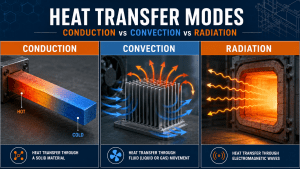
The Three Modes of Heat Transfer
Thermal energy moves through three primary mechanisms:
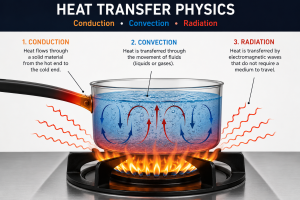
- Conduction
- Convection
- Radiation
In many engineering systems, all three mechanisms occur simultaneously.
Conduction Heat Transfer
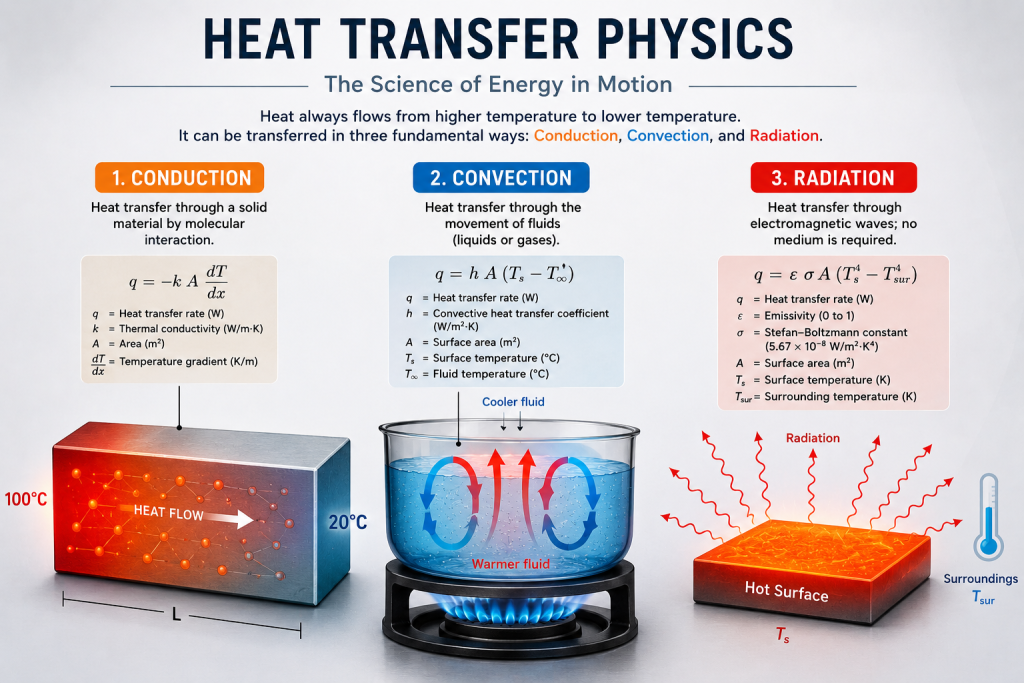
Conduction is the transfer of heat through direct molecular interaction between materials or within a solid body.
When one side of a material becomes hotter, the molecules gain kinetic energy and transfer that energy to neighbouring molecules through vibration and collision.
Metals are excellent conductors because they contain free electrons that transfer energy rapidly. Materials such as ceramic fibre, rubber, and insulation foam are poor conductors and are commonly used as thermal insulators.
Fourier’s Law of Heat Conduction
The basic equation governing conductive heat transfer is Fourier’s Law:
Q = -kA(dT/dx)
Where:
- Q = heat transfer rate
- k = thermal conductivity
- A = cross-sectional area
- dT/dx = temperature gradient
This equation helps engineers determine how quickly heat moves through a material.
Factors Affecting Conduction
Several factors influence conductive heat transfer:
Thermal Conductivity
Materials with high thermal conductivity transfer heat more efficiently.
Examples:
- Copper
- Aluminium
- Steel
Low-conductivity materials resist heat flow and are suitable for insulation applications.
Temperature Difference
Larger temperature differences increase heat transfer rates.
Material Thickness
Thicker materials reduce heat transfer.
Surface Area
Larger areas allow more thermal energy to pass through.
Engineering Applications of Conduction
Conduction analysis is essential in:
- Heat exchanger design
- Refractory lining systems
- Furnace walls
- Electronic circuit boards
- Thermal insulation systems
- Pressure vessels
- Pipeline engineering
In refractory engineering, conduction determines how much heat escapes through furnace linings and how effectively insulation protects external steel structures from thermal damage.
Convection Heat Transfer
Convection involves heat transfer through the movement of fluids such as liquids and gases.
As fluid temperature increases, density changes occur. Hotter fluid rises while cooler fluid sinks, creating circulation patterns that transfer heat.
Convection can occur naturally or through mechanical assistance.
Types of Convection
Natural Convection
Natural convection occurs due to density differences caused by temperature variations.
Examples include:
- Warm air rising from heaters
- Cooling of hot pipes in open air
- Atmospheric circulation
Forced Convection
Forced convection uses pumps, fans, or blowers to move fluid and improve heat transfer.
Examples include:
- Cooling fans in electronics
- Industrial ventilation systems
- Heat exchangers
- Cooling towers
- Automotive radiators
Newton’s Law of Cooling
The rate of convective heat transfer is commonly estimated using:
Q = hA(Ts − T∞)
Where:
- Q = heat transfer rate
- h = convective heat transfer coefficient
- A = surface area
- Ts = surface temperature
- T∞ = fluid temperature
Factors Affecting Convection
Fluid Velocity
Faster-moving fluids increase heat transfer.
Fluid Properties
Density, viscosity, and thermal conductivity affect convection performance.
Surface Geometry
Complex geometries influence airflow patterns and thermal distribution.
Turbulence
Turbulent flow typically improves heat transfer compared to laminar flow.
Industrial Applications of Convection
Convection plays a critical role in:
- HVAC systems
- Cooling of industrial machinery
- Power plant boilers
- Turbine cooling
- Electronic equipment
- Chemical processing plants
- Ventilation systems
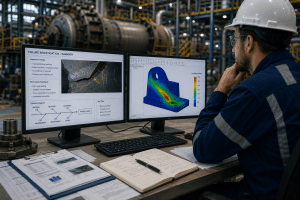
In industrial environments, engineers frequently use CFD simulations to study convection behaviour and optimize airflow performance.
Radiation Heat Transfer
Radiation transfers thermal energy through electromagnetic waves and does not require physical contact or fluid movement.
All objects above absolute zero emit thermal radiation. The amount of radiation emitted depends on temperature and surface characteristics.
Unlike conduction and convection, radiation can transfer heat through a vacuum.
The most familiar example is heat from the sun reaching Earth.
Stefan–Boltzmann Law
Thermal radiation is governed by the Stefan–Boltzmann equation:
Q = εσAT⁴
Where:
- Q = radiated energy
- ε = emissivity
- σ = Stefan–Boltzmann constant
- A = surface area
- T = absolute temperature
Factors Affecting Radiation
Surface Emissivity
Dark, rough surfaces emit and absorb radiation more effectively.
Temperature
Radiation increases rapidly with temperature.
Surface Orientation
The angle between surfaces affects radiant heat exchange.
Engineering Applications of Radiation
Radiation analysis is important in:
- High-temperature furnaces
- Kilns
- Solar energy systems
- Spacecraft thermal protection
- Gas turbines
- Fire safety engineering
- Refractory systems
In high-temperature industries, radiation often becomes the dominant heat transfer mechanism.
Combined Heat Transfer Mechanisms
Most real engineering systems involve all three heat transfer modes simultaneously.
For example, in an industrial furnace:
- Radiation transfers heat from flames to refractory walls.
- Conduction moves heat through refractory materials.
- Convection distributes heat through combustion gases.
Similarly, in electronics cooling:
- Conduction transfers heat from chips to heat sinks.
- Convection removes heat using airflow.
- Radiation dissipates additional thermal energy.
Understanding the interaction between these mechanisms is essential for accurate thermal analysis.
Heat Transfer and Thermodynamics
Although closely related, thermodynamics and heat transfer are different disciplines.
Thermodynamics studies energy relationships and equilibrium states.
Heat transfer focuses on:
- How quickly heat moves
- Temperature distribution over time
- Mechanisms of thermal energy transport
Thermodynamics may determine the total energy required for a process, while heat transfer analysis determines how that energy moves through the system.
This distinction is critical in engineering design because thermal gradients often produce stress concentrations, deformation, and material fatigue.
Thermal Conductivity and Material Selection
Material selection is one of the most important considerations in thermal engineering.
Different materials behave very differently under thermal loading.
High Thermal Conductivity Materials
These materials transfer heat efficiently:
- Copper
- Aluminium
- Silver
- Graphite
Applications include:
- Heat sinks
- Cooling systems
- Heat exchangers
- Thermal interfaces
Low Thermal Conductivity Materials
These materials resist heat transfer:
- Ceramic fibre
- Mineral wool
- Aerogel insulation
- Refractory brick
Applications include:
- Furnace insulation
- Building envelopes
- Cryogenic systems
- Fire protection
Proper material selection improves:
- Energy efficiency
- Safety
- Equipment lifespan
- Thermal stability
- Operational reliability
Thermal Stress and Structural Integrity
Heat transfer not only affects temperature but also structural behaviour.
When materials expand or contract due to temperature changes, thermal stresses develop.
Excessive thermal stress can cause:
- Cracking
- Warping
- Fatigue failure
- Buckling
- Joint failure
- Delamination
Thermal Expansion
Different materials expand at different rates.
This becomes especially important in:
- Multi-material assemblies
- Refractory systems
- Welded structures
- Pipelines
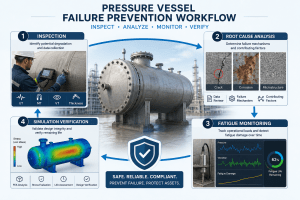
- Pressure vessels
Engineers use thermal stress analysis to predict how structures respond under operating temperatures.
Modern FEA software allows engineers to simulate coupled thermal-structural behaviour with high accuracy.
Heat Transfer in Industrial Equipment
Thermal engineering plays a central role in industrial operations.
Heat Exchangers
Heat exchangers transfer thermal energy between fluids while preventing direct mixing.
Industries rely on heat exchangers for:
- Power generation
- Chemical processing
- HVAC systems
- Food processing
- Oil refining
Heat exchanger performance depends heavily on:
- Fluid flow behaviour
- Surface area
- Material conductivity
- Fouling resistance
Furnaces and Kilns
High-temperature equipment requires advanced thermal management to:
- Maintain process temperatures
- Reduce heat loss
- Protect structural components
- Improve fuel efficiency
Refractory systems are specifically designed to withstand severe thermal environments.
Boilers and Power Plants
Power generation systems depend on effective heat transfer for steam production and thermal efficiency.
Poor heat transfer can reduce plant performance and increase operational costs.
Electronics Cooling
As electronic devices become smaller and more powerful, thermal management becomes increasingly important.
Overheating can significantly reduce component lifespan and reliability.
Engineers use:
- Heat sinks
- Thermal interface materials
- Liquid cooling
- Forced airflow
- Phase change materials
To control temperatures in sensitive electronic systems.
Computational Heat Transfer Analysis
Traditional engineering calculations remain valuable, but modern industrial systems are often too complex for simplified analytical methods alone.
Advanced simulation technologies allow engineers to visualize and predict heat transfer behaviour in detail.
Computational Fluid Dynamics (CFD)
CFD simulations solve fluid flow and heat transfer equations numerically.
CFD helps engineers analyze:
- Airflow patterns
- Temperature distribution
- Turbulence
- Cooling performance
- Combustion processes
- Heat exchanger efficiency
CFD is widely used in:
- Mining operations
- Industrial ventilation
- Automotive design
- Aerospace engineering
- HVAC systems
- Process industries
CFD reduces the need for costly physical prototypes and improves design optimization.
Finite Element Analysis (FEA)
FEA evaluates thermal stresses and temperature effects in structures.
Thermal FEA is essential for:
- High-temperature equipment
- Structural integrity assessments
- Fatigue analysis
- Refractory systems
- Pressure vessel design
Engineers can simulate steady-state and transient thermal conditions to predict performance before construction or manufacturing begins.
Steady-State vs Transient Heat Transfer
Heat transfer problems are often classified into two categories.
Steady-State Heat Transfer
In steady-state conditions, temperatures remain constant over time.
Examples include:
- Continuous furnace operation
- Stable building temperatures
- Constant cooling systems
Steady-state analysis is useful for evaluating long-term operating conditions.
Transient Heat Transfer
In transient conditions, temperatures change over time.
Examples include:
- Equipment startup and shutdown
- Rapid heating processes
- Fire exposure
- Thermal cycling
Transient analysis is important because sudden temperature changes often create severe thermal stresses.
Heat Transfer in Energy Efficiency and Sustainability
Energy efficiency is a major priority across modern industries.
Poor thermal management results in:
- Energy waste
- Increased emissions
- Higher operational costs
- Reduced equipment efficiency
Optimizing heat transfer improves sustainability by reducing energy consumption.
Industrial Energy Optimization
Thermal engineering contributes to:
- Waste heat recovery
- Improved combustion efficiency
- Reduced cooling requirements
- Better insulation performance
- Lower greenhouse gas emissions
Building Energy Performance
In buildings, heat transfer analysis improves:
- Thermal comfort
- HVAC efficiency
- Passive cooling strategies
- Insulation performance
- Energy ratings
Modern building design increasingly relies on simulation-driven thermal assessment.
Heat Transfer Challenges in Engineering
Although the principles of heat transfer are well understood, practical engineering applications often involve significant complexity.
Common Challenges Include:
Nonlinear Material Behaviour
Material properties can change significantly with temperature.
Complex Geometry
Industrial systems often contain complicated shapes and flow paths.
Multi-Physics Interactions
Thermal systems may involve:
- Structural mechanics
- Fluid flow
- Chemical reactions
- Radiation exchange
Extreme Operating Conditions
High temperatures, pressure variations, and thermal cycling create additional engineering challenges.
Safety Requirements
Thermal failures can have severe safety consequences in industrial facilities.
Advanced simulation and engineering analysis help overcome these challenges by providing accurate predictive modelling .
The Future of Heat Transfer Engineering
Heat transfer engineering continues to evolve with advances in:
- Simulation technology
- Artificial intelligence
- Materials science
- Renewable energy systems
- Electronics miniaturisation
- Sustainable engineering
Emerging technologies include:
- Smart thermal management systems
- Nano materials for heat transfer enhancement
- Additive manufacturing for thermal optimization
- AI-driven simulation workflows
- Advanced thermal coatings
As industries pursue higher efficiency and lower emissions, thermal engineering will remain a critical discipline.
Why Heat Transfer Physics Matters in Engineering Design
Heat transfer physics directly affects:
- Equipment performance
- Energy consumption
- Structural reliability
- Safety compliance
- Maintenance requirements
- Operational costs
A poorly designed thermal system can lead to:
- Overheating
- Material degradation
- Reduced efficiency
- Premature failure
- Safety hazards
Conversely, effective thermal engineering improves productivity, reduces downtime, and enhances long-term operational performance.
For this reason, advanced heat transfer analysis has become an essential part of modern engineering design and simulation.
Conclusion
Heat transfer physics forms the foundation of thermal engineering and plays a vital role across nearly every industrial sector. Understanding conduction, convection, and radiation enables engineers to design safer, more efficient, and more reliable systems.
From refractory linings and power plants to CFD airflow simulations and electronics cooling, heat transfer analysis helps industries optimize performance while reducing energy consumption and operational risk.
As engineering systems continue to become more advanced and energy efficiency becomes increasingly important, the role of thermal analysis and simulation will only continue to grow.
By combining engineering expertise with advanced computational tools such as CFD and FEA, organizations can better understand thermal behaviour, improve system performance, and make more informed engineering decisions.
FAQ Section
What is heat transfer physics?
Heat transfer physics is the study of how thermal energy moves between objects, materials, or fluids due to temperature differences.
What are the three modes of heat transfer?
The three modes are conduction, convection, and radiation.
Why is heat transfer important in engineering?
Heat transfer affects energy efficiency, equipment reliability, structural integrity, and industrial safety.
What industries use heat transfer analysis?
Industries including power generation, manufacturing, mining, aerospace, oil and gas, electronics, and construction rely heavily on thermal analysis.
What is CFD in heat transfer analysis?
Computational Fluid Dynamics (CFD) is a simulation technique used to analyse fluid flow, airflow, and heat transfer behaviour in engineering systems.
What is transient thermal analysis?
Transient thermal analysis studies how temperatures change over time during heating or cooling processes.