Heat transfer plays a fundamental role in nearly every engineering system, from electronic devices and industrial furnaces to building insulation and power plants. Among the three primary heat transfer mechanisms—conduction, convection, and radiation—thermal conduction is often the most important mode when heat moves through solid materials.
Thermal conduction occurs when heat energy transfers through a material due to a temperature difference, without the material itself moving. Heat naturally flows from a higher-temperature region to a lower-temperature region until thermal equilibrium is reached. This mechanism governs how metals, ceramics, composites, polymers, and construction materials behave in real-world applications.
For engineers, understanding thermal conduction is essential for designing efficient equipment, improving product reliability, optimizing energy consumption, and preventing thermal failures. For clients and decision-makers, knowledge of thermal conduction helps explain why certain materials, designs, and engineering analyses are necessary.
This article explores thermal conduction examples across multiple industries and demonstrates how engineering simulation and thermal analysis can improve performance and reduce operational risks.
What Is Thermal Conduction?
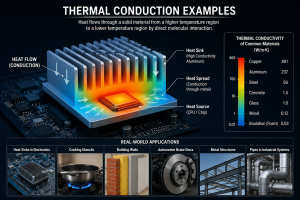
Thermal conduction is the transfer of heat through a stationary material or between materials in direct contact. At the microscopic level, molecules and atoms in a hotter region possess greater kinetic energy. Through molecular interactions and collisions, this energy is transferred toward cooler regions.
The rate of conduction depends on several factors:
- Material thermal conductivity
- Temperature difference
- Contact area
- Material thickness
- Surface conditions
- Presence of thermal interfaces
Materials such as copper and aluminum conduct heat efficiently, while materials like fiberglass, mineral wool, and foam insulation resist heat transfer.
Why Thermal Conduction Matters in Engineering
Many engineering failures are actually thermal failures.
Examples include:
- Overheating electronic components
- Cracking refractory linings
- Thermal fatigue in metals
- Energy losses through building envelopes
- Poor performance of heat exchangers
- Battery degradation
- Excessive equipment temperatures
Understanding thermal conduction allows engineers to:
- Improve product reliability
- Increase energy efficiency
- Reduce maintenance costs
- Extend equipment lifespan
- Optimize material selection
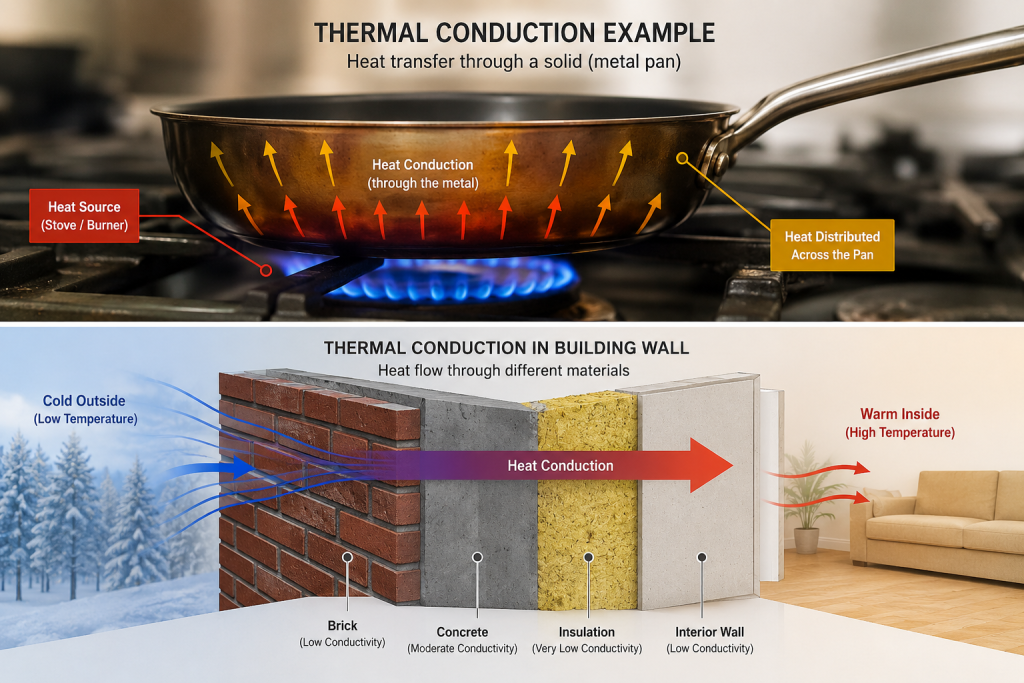
Example 1: Heat Transfer Through a Metal Cooking Pan
One of the simplest thermal conduction examples occurs in a kitchen.
When a metal pan is placed on a hot stove:
- The stove surface becomes hot.
- Heat transfers to the bottom of the pan.
- Thermal conduction distributes heat throughout the metal.
- The food receives heat from the pan surface.
Metals such as aluminum and copper are preferred because of their high thermal conductivity.
Engineering Insight:
Manufacturers carefully design cookware thickness and material composition to achieve uniform heat distribution and prevent hot spots.
Example 2: Heat Sinks in Electronic Devices
Modern electronics generate significant heat.
Examples include:
- Laptops
- Servers
- Smartphones
- Industrial control panels
- Power electronics
Heat generated by processors must be conducted away efficiently to prevent overheating.
A heat sink works by:
- Conducting heat from the chip
- Spreading heat throughout the heat sink body
- Allowing convection to remove heat into surrounding air
Aluminum and copper are commonly selected because of their high thermal conductivity.
Without effective conduction, electronic components may fail prematurely.
Example 3: Thermal Conduction in Industrial Furnaces
Industrial furnaces operate at extremely high temperatures.
Applications include:
- Steel manufacturing
- Cement production
- Glass manufacturing
- Ceramic processing
In these systems, heat conducts through:
- Furnace walls
- Refractory linings
- Steel structures
- Insulation layers
Poor thermal management can cause:
- Energy losses
- Structural damage
- Excessive fuel consumption
- Reduced production efficiency
This is why thermal simulation is commonly used during furnace design.
Example 4: Building Insulation Systems
Buildings continuously exchange heat with their surroundings.
During winter:
- Heat conducts outward through walls.
- Heat escapes through roofs.
- Windows transfer heat to colder outdoor environments.
During summer:
- External heat conducts inward.
Construction materials are selected to reduce unwanted heat conduction.
Common insulating materials include:
- Mineral wool
- Polyurethane foam
- Fiberglass
- Expanded polystyrene
These materials possess low thermal conductivity values and therefore reduce heat loss.
Example 5: Thermal Bridges in Buildings
A thermal bridge occurs when a highly conductive material creates a path for heat transfer through an otherwise insulated structure.
Common examples include:
- Steel beams
- Window frames
- Concrete columns
- Structural connections
Thermal bridges increase:
- Energy consumption
- Heating costs
- Cooling costs
- Condensation risk
Thermal bridging is one of the most important considerations in modern sustainable building design.
Example 6: Heat Transfer in Aircraft Structures
Aircraft operate under extreme environmental conditions.
Thermal conduction occurs through:
- Fuselage panels
- Wings
- Engine components
- Thermal protection systems
Engineers must account for:
- High-temperature gradients
- Material expansion
- Thermal fatigue
- Structural integrity
Advanced thermal analysis ensures aircraft safety and performance.
Example 7: Battery Thermal Management Systems
Electric vehicles rely heavily on battery performance.
Lithium-ion batteries generate heat during:
- Charging
- Discharging
- Fast charging
- High-load operation
Heat conducts through:
- Battery cells
- Cooling plates
- Thermal interface materials
- Battery enclosures
Improper thermal conduction can lead to:
- Capacity loss
- Reduced lifespan
- Thermal runaway
- Safety risks
Thermal management is now one of the most critical aspects of EV design.
Example 8: Heat Conduction in Power Plants
Power plants involve numerous thermal systems.
Examples include:
- Boilers
- Turbines
- Heat exchangers
- Steam pipes
- Condensers
Heat conduction influences:
- Efficiency
- Equipment durability
- Maintenance schedules
Thermal losses through poorly insulated systems can significantly increase operating costs.
Example 9: Heat Exchanger Applications
Heat exchangers are specifically designed to maximize heat transfer.
Industries using heat exchangers include:
- Oil and gas
- Chemical processing
- Food manufacturing
- Power generation
- HVAC
Conduction occurs through metal walls separating hot and cold fluids.
The thermal conductivity of exchanger materials directly affects performance.
Common materials include:
- Stainless steel
- Copper alloys
- Titanium alloys
- Aluminum
Example 10: Thermal Conduction in Electronics Manufacturing
Printed circuit boards (PCBs) contain multiple heat-generating components.
Heat conduction paths include:
- Copper traces
- Thermal vias
- Substrates
- Metal-core PCBs
Designers use thermal analysis to prevent:
- Localized overheating
- Component degradation
- Performance reduction
This is particularly important for:
- Automotive electronics
- Medical devices
- Aerospace systems
Example 11: Thermal Conduction in Injection Molding
Injection molds rely on controlled heat transfer.
During manufacturing:
- Molten plastic enters the mold.
- Heat conducts into mold surfaces.
- Cooling channels remove heat.
Proper thermal conduction affects:
- Cycle time
- Product quality
- Dimensional stability
- Production efficiency
Engineers often perform CFD and thermal simulations to optimize mold cooling.
Example 12: Thermal Conduction in Solar Energy Systems
Solar thermal systems collect solar energy and transfer heat through conductive materials.
Applications include:
- Solar water heaters
- Solar collectors
- Thermal storage systems
Engineers optimize conductive pathways to maximize energy capture and minimize losses.
Example 13: Thermal Conduction in Medical Equipment
Medical devices often require precise temperature control.
Examples include:
- MRI systems
- Diagnostic equipment
- Surgical instruments
- Laboratory analyzers
Thermal conduction affects:
- Accuracy
- Reliability
- Patient safety
Advanced thermal management ensures stable operation under varying conditions.
Common Materials and Their Thermal Conductivity Performance
| Material | Relative Conductivity |
|---|---|
| Copper | Very High |
| Silver | Extremely High |
| Aluminum | High |
| Steel | Moderate |
| Glass | Low |
| Concrete | Low |
| Wood | Very Low |
| Fiberglass | Very Low |
| Polyurethane Foam | Extremely Low |
Material selection often determines whether engineers want to promote or resist thermal conduction.
How Engineers Analyze Thermal Conduction
Modern engineering projects rarely rely on manual calculations alone.
Engineers commonly use:
- Finite Element Analysis (FEA)
- Computational Fluid Dynamics (CFD)
- Thermal network modeling
- Transient thermal simulations
- Coupled thermal-structural simulations
These tools predict:
- Temperature distribution
- Heat flux
- Thermal stresses
- Material behavior
Advanced thermal simulations help identify potential issues before manufacturing begins.
Challenges Associated with Thermal Conduction
While conduction is essential, it can also create engineering challenges:
Excessive Heat Loss
Occurs in buildings, furnaces, and pipelines.
Thermal Expansion
Different materials expand at different rates.
Thermal Stress
Temperature gradients create mechanical stresses.
Hot Spots
Localized overheating damages equipment.
Thermal Fatigue
Repeated heating and cooling cycles reduce component life.
Addressing these challenges requires careful engineering analysis and material selection.
Future Trends in Thermal Conduction Engineering
Emerging technologies are creating new thermal challenges.
Examples include:
- Electric vehicles
- AI data centers
- High-performance computing
- Renewable energy systems
- Advanced aerospace structures
Research is increasingly focused on:
- High-conductivity composites
- Advanced thermal interface materials
- Nanostructured heat spreaders
- Smart thermal management systems
Improved heat conduction control is becoming a competitive advantage across industries.
Conclusion
Thermal conduction is one of the most important heat transfer mechanisms in engineering and everyday life. From cooking pans and electronic devices to industrial furnaces, battery systems, buildings, and power plants, conductive heat transfer influences efficiency, safety, reliability, and operating costs.
Understanding thermal conduction examples helps engineers make better design decisions, select appropriate materials, and optimize system performance. Through modern thermal simulation tools and engineering analysis, organizations can identify thermal risks early, reduce energy losses, and improve product reliability before implementation.
As industries continue to push for higher performance, greater energy efficiency, and increased sustainability, thermal conduction analysis will remain a critical part of engineering design and innovation.
FAQ
What is the best example of thermal conduction?
A metal spoon becoming hot when placed in a cup of hot tea is one of the simplest examples of thermal conduction.
Why are metals good thermal conductors?
Metals contain free electrons that help transfer thermal energy efficiently through the material.
What industries rely heavily on thermal conduction analysis?
Aerospace, automotive, electronics, energy, construction, manufacturing, and chemical processing industries all depend on thermal conduction analysis.
How is thermal conduction different from convection?
Conduction transfers heat through direct molecular interaction, while convection involves heat transfer through fluid movement.
Why is thermal conductivity important?
Thermal conductivity determines how efficiently a material can transfer heat and is a key factor in engineering design.