What Is ASME Tank Design?
Definition of ASME Tanks
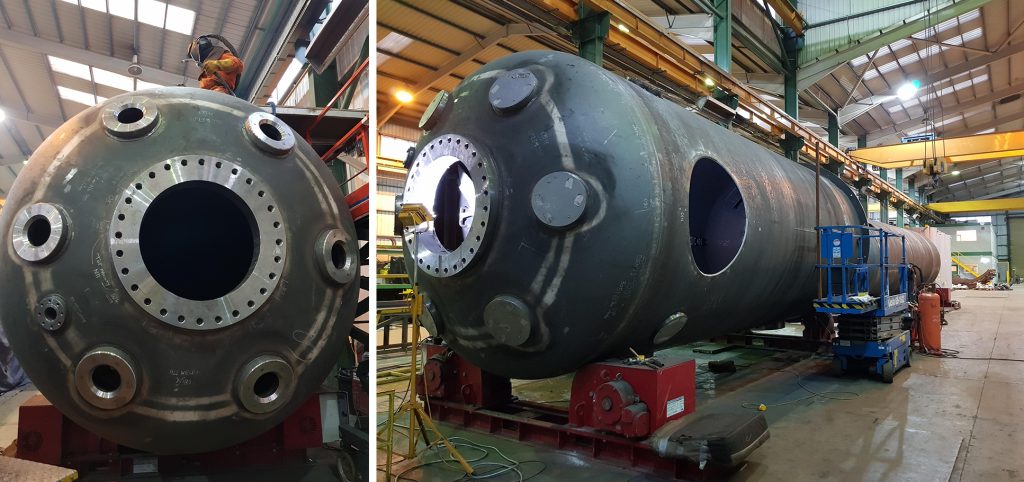
ASME tanks are pressure vessels designed, manufactured, and inspected according to the American Society of Mechanical Engineers (ASME) Boiler and Pressure Vessel Code (BPVC). These tanks are engineered to safely store gases, vapors, or liquids under internal or external pressure.
In industries like oil & gas, where products are often volatile, flammable, or reactive, ASME compliance is not optional — it is essential for safety, reliability, and regulatory approval.
Importance of Compliance with ASME Standards
ASME-certified tanks provide:
- Higher safety margins
- Verified material traceability
- Standardized welding and fabrication techniques
- Rigorous inspection and testing protocols
- Global regulatory compliance
Failure to meet ASME code can result in:
- Catastrophic tank failures
- Environmental damage
- Shutdowns and financial penalties
- Loss of insurance validity
- Legal liabilities
In the oil and gas sector, where pressures, temperatures, and corrosive fluids are extreme, ASME certification dramatically reduces operational risk.
Difference Between ASME Tanks and Other Storage Tanks
| Feature | ASME Tank | Non-ASME Industrial Tank |
|---|---|---|
| Pressure capability | High pressure | Often atmospheric |
| Design code | Strict (BPVC) | Varies or none |
| Inspection | Mandatory | Optional |
| Certification | Stamped & traceable | Not certified |
| Suitable for hazardous fluids | Yes | Often no |
In short: ASME tanks are engineered for high-risk, high-pressure environments, unlike common storage tanks used for water, fuels, or atmospheric materials.
ASME Standards for Tank Design
ASME Boiler and Pressure Vessel Code (BPVC)
The BPVC is a globally recognized standard for tank and pressure vessel design. It includes rules for:
- Design calculations
- Fabrication methods
- Material selection
- Welding procedures
- NDT (non-destructive testing)
- Inspection and certification
Section VIII Division 1: Pressure Vessels
This is the most commonly used standard. Division 1 provides:
- General rules for low-to-moderate pressure vessels
- Allowable stress design
- Standard thickness formulas
- Straightforward construction requirements
It is ideal for typical oil & gas pressure vessels such as:
- Separator tanks
- Knock-out drums
- Surge vessels
- Fuel tanks
Section VIII Division 2: Alternative Rules
Division 2 is used for:
- High-pressure applications
- High-temperature operations
- Large and complex vessels
It allows:
- More detailed stress analysis
- Finite Element Analysis (FEA)
- Higher allowable stresses
- Thinner walls (with stricter requirements)
Common oil & gas applications include:
- Hydrogen storage tanks
- High-pressure gas cylinders
- Reactors and reformers
- Cryogenic tanks
Material and Fabrication Guidelines
ASME sets strict rules for:
- Approved materials (carbon steel, stainless steel, alloys)
- Welding qualifications
- Heat treatment
- PWHT (post-weld heat treatment)
- Rolling, forming, and assembly
- Dimensional tolerances
All materials must include:
- Heat numbers
- Mill certificates
- Chemical composition reports
This ensures complete traceability — critical in oil and gas operations.
Key Principles of ASME Tank Design
Pressure and Temperature Considerations
Design pressure includes:
- Operating pressure
- Static head pressure from fluids
- Possible surges and fluctuations
Design temperature includes:
- Operating temperature
- Possible exposure to fire (required for oil & gas)
- Ambient conditions
Incorrect pressure/temperature assumptions can lead to catastrophic failures.
Wall Thickness and Stress Calculations
Wall thickness is calculated using:
- Internal pressure
- Diameter of tank
- Material allowable stress
- Joint efficiency
- Corrosion allowance
The goal: Maintain structural integrity at maximum conditions.
Safety Factors and Design Margins
ASME applies safety factors to:
- Prevent bursting
- Compensate for unknown stresses
- Account for material variability
- Protect against fabrication defects
Oil & gas environments require higher safety margins due to extreme risk.
Corrosion Allowance and Fatigue Analysis
Corrosion allowance is typically:
- 1.5–3 mm (standard)
- 3–10 mm for severe oil & gas environments
Fatigue analysis is mandatory for:
- Cyclic loading
- Pressure fluctuations
- Temperature variations
Types of ASME Tanks
Cylindrical Vertical Tanks
Used for:
- Separators
- Fractionation columns
- Surge tanks
- Gas processing
Advantages:
- Small footprint
- Easy drainage
- Excellent flow distribution
Horizontal Tanks
Used for:
- Fuel storage
- Produced water tanks
- Knock-out drums
Advantages:
- Stable under high winds
- Easy installation
- Low center of gravity
Spherical Tanks
Used for:
- High-pressure gas storage
- LNG and LPG
- Hydrogen tanks
Advantages:
- Uniform stress distribution
- Highest pressure capability
Specialty and Custom Designs
These include:
- Double-walled cryogenic tanks
- Jacketed tanks for heating
- Vacuum-insulated tanks
- Offshore-rated pressure vessels
Oil & gas projects often require highly specialized custom builds.
Materials and Fabrication
Suitable Metals and Alloys
Common materials include:
- Carbon steel (SA-516, SA-36)
- Stainless steel (304, 316)
- Low-temperature steel (SA-353, SA-662)
- High-strength alloys (Inconel, Hastelloy)
Selection depends on:
- Corrosion level
- Fluid type
- Pressure/temperature
- Sour service (H₂S) conditions
Welding and Joining Techniques
ASME requires:
- Certified welders
- Qualified WPS/PQR
- Radiographic, ultrasonic, or magnetic particle testing
Improper welding is one of the biggest causes of tank failure.
Heat Treatment and Inspection
Heat treatment prevents:
- Stress buildup
- Brittleness
- Failures under pressure
Inspection includes:
- Hydrostatic testing
- Pneumatic testing
- NDT (RT, UT, VT, MT, PT)
Quality Assurance and Testing
QA ensures:
- Weld quality
- Dimensional accuracy
- Material traceability
- Code compliance
Tanks receive an ASME stamp only after passing all tests.
Safety Considerations
Relief Valves and Overpressure Protection
Relief valves must:
- Automatically release excess pressure
- Prevent explosions
- Be sized according to ASME Section VIII
Regular Inspection and Maintenance
Oil & gas operations require:
- Periodic internal inspection
- UT thickness measurements
- Corrosion monitoring
- Testing of relief valves
Compliance with International Safety Standards
ASME tanks also align with:
- API standards
- ISO standards
- OSHA regulations
- Local refinery and offshore standards
Design Calculations and Methodologies
Wall Thickness Calculation Formulas
Wall thickness depends on:
- Internal pressure
- Joint efficiency
- Material stress allowance
- Shape of tank
Stress and Strain Analysis
Analyzes:
- Hoop stress
- Longitudinal stress
- Localized stresses near nozzles
Finite Element Analysis (FEA) Applications
FEA is used for:
- High-pressure designs
- Custom geometries
- Fatigue life estimation
- Stress concentration zones
Burst Pressure and Safety Margin Determination
Burst pressure defines:
- Ultimate failure pressure
- Maximum safe operating level
This ensures tanks remain fail-safe under extreme conditions.
Applications of ASME Tanks
Chemical and Petrochemical Industries
Used for:
- Reactors
- Absorbers
- Heat exchangers
- Storage tanks for acids, solvents, and gases
Oil and Gas Storage
Used in:
- Upstream processing
- Midstream transport
- Downstream refining
These tanks handle:
- Crude oil
- Natural gas
- LPG/LNG
- Produced water
- Hydrogen
Food and Beverage Processing
Used for:
- Pasteurization
- Brewing
- Mixing tanks
(Usually stainless steel.)
Power Generation and Utilities
Used for:
- Steam systems
- Condensate storage
- Boiler feedwater systems
Common Challenges in ASME Tank Design
Meeting Strict Code Requirements
Documentation alone can exceed 300 pages for a single tank.
Managing Extreme Pressures and Temperatures
Oil & gas operations involve:
- Sour gas service
- Cryogenic storage
- High-temperature refining
Balancing Cost, Safety, and Efficiency
Challenges include:
- Material cost
- Welding expenses
- NDT and QA requirements
Best Practices for Effective ASME Tank Design
Use Advanced Simulation and Modeling Tools
Tools include:
- AutoPIPE
- PV Elite
- ANSYS FEA
These reduce design errors and project delays.
Engage Cross-Disciplinary Engineering Teams
Teams include:
- Mechanical
- Structural
- Process
- Corrosion
- QA/NDT
Follow Established ASME Standards and Procedures
Strict adherence ensures:
- Safety
- Long life
- Lower maintenance
Document Design and Testing Thoroughly
Good documentation supports:
- Audits
- Certifications
- Maintenance planning
Conclusion
ASME tank design remains one of the most critical engineering disciplines in the oil and gas industry, where safety, reliability, and compliance are non-negotiable. Whether the application involves high-pressure gas storage, crude oil processing, or harsh chemical environments, ASME-certified tanks ensure that facilities operate efficiently and without unnecessary risk. By following the ASME BPVC standards, selecting the right materials, applying accurate design calculations, and performing rigorous testing, engineering teams can significantly extend the lifespan of their equipment while minimizing maintenance costs and operational hazards.
As oil and gas operations become more complex, companies that adopt advanced simulation tools, maintain strict QA procedures, and invest in proper inspection routines gain a competitive advantage through safer, more efficient, and more compliant operations. Ultimately, ASME tank design is not just about building a vessel — it is about building long-term safety, performance, and trust into every part of the production chain.
Ready to Optimize Your ASME Tank Design?
If you need expert support in designing, reviewing, or optimizing ASME-certified tanks for oil and gas applications, our engineering team is here to help. We specialize in pressure vessel design, simulation, code compliance, FEA analysis, and end-to-end project guidance to ensure your tanks meet the highest safety and performance standards.
Contact us today to discuss your project requirements and discover how we can enhance reliability, reduce risks, and streamline your operations.