Most explanations of frangible roofs stop at a definition and a code clause: the roof-to-shell joint is sized to be weaker than the shell, so it fails first if the tank over pressures. What that framing skips is the part that actually matters in practice — the complete load path from internal pressure through the roof, the joint, the shell, and down into the bottom and foundation, and the specific ways that path gets quietly defeated over a tank’s service life without anyone changing the design on paper.
This guide covers frangible roof behaviour as a load path problem, not just a definition-and-code pairing. It focuses on the preferential failure philosophy the design relies on, the geometry and detail variables that control whether it works, and the failure modes — corrosion, repairs, added attachments — that can leave a tank looking compliant while its frangible behaviour has quietly stopped functioning.
What Is a Frangible Roof-to-Shell Joint?
A frangible roof-to-shell joint is a deliberately weak connection between a storage tank’s fixed roof and its shell, engineered to fail before the shell or bottom does under an internal overpressure event.
Purpose of Preferential Failure
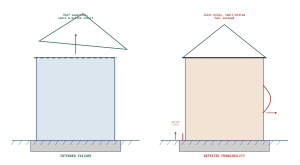
The logic behind frangibility is straightforward once stated: if a tank is going to be over pressured — by a runaway reaction, blocked vent, vapor ignition, or any other internal pressure excursion — the failure needs to happen somewhere that vents pressure safely rather than somewhere that releases the tank’s contents or turns the shell into a projectile. A frangible roof joint gives the overpressure event a controlled, predictable place to fail: the roof lifts and separates from the shell, venting pressure upward, while the shell remains standing and the tank’s contents stay contained. This is a preferential failure design, not a strength design — the joint isn’t made weak by accident, it’s made weak on purpose, and everything else in the tank is meant to be stronger than it.
Frangible Roof vs Emergency Venting
A frangible roof joint is not a substitute for properly sized emergency venting, and the two serve different roles in an overpressure scenario. Emergency venting (relief devices, open vents, or venting per API 2000) is meant to relieve pressure during normal operational upsets, before pressures reach a level that threatens structural integrity. The frangible joint is the last line of defence — a structural fail-safe that activates only if venting hasn’t kept pace with the pressure rise, or has failed outright. Relying on frangibility as a primary means of pressure relief, rather than as a backstop behind adequate venting, misunderstands what the joint is there to do.
How Internal Pressure Changes the Tank Load Path
Understanding frangible behaviour means tracing what internal pressure actually does to a tank’s structure, from the roof down to the foundation, as pressure rises toward the joint’s design failure point.
Roof Uplift and Shell Compression
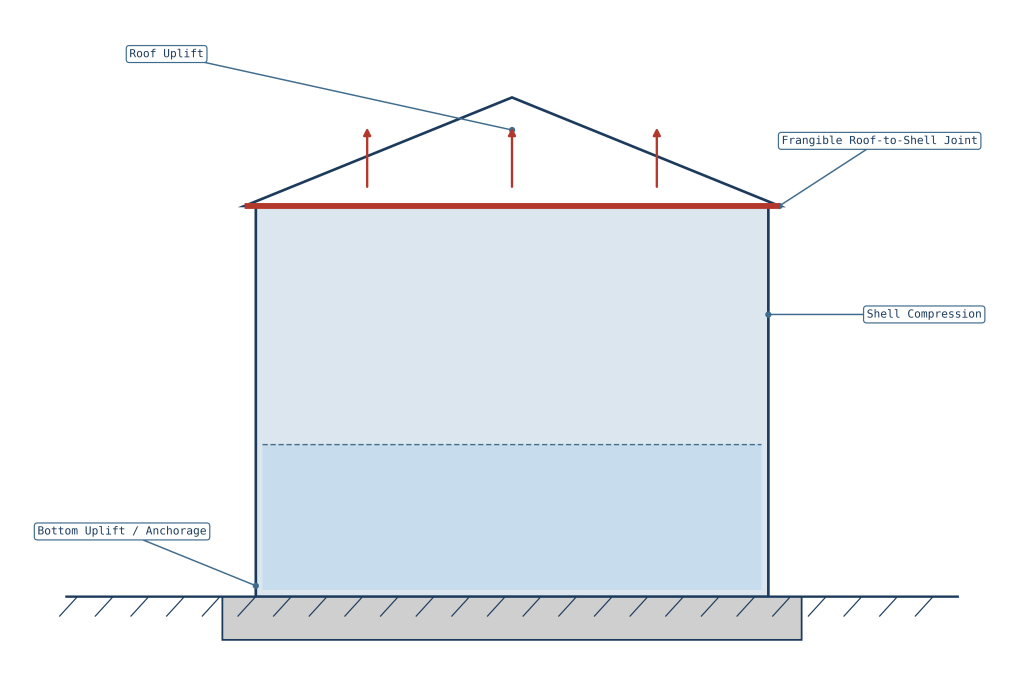
As internal pressure rises, it acts on the underside of the roof, generating an uplift force. Before the roof-to-shell joint fails, this uplift is reacted partly by the roof’s own weight and partly by the joint transferring load into the top of the shell — which, depending on tank geometry, can place the upper shell into compression or add to loads it already carries from wind or the roof’s dead weight. The joint is specifically designed so that as this internal pressure load path approaches the joint’s capacity, the joint yields and separates before the load path finds another way to redistribute through the shell.
Bottom Uplift, Anchors and Foundation Restraint
If the tank is unanchored — as many atmospheric storage tanks are — sufficient internal pressure can also lift the shell and bottom off the foundation before the roof joint fails, particularly in larger-diameter, lighter-shell tanks where the product weight holding the bottom down is proportionally smaller. This is precisely the failure mode the frangible roof joint is meant to pre-empt: if the joint is sized correctly relative to the tank’s uplift resistance, the joint fails at a pressure below what would be needed to lift the shell off its foundation, keeping the failure at the roof rather than at the base. Getting this sequencing wrong — a joint that’s inadvertently stronger than the bottom’s uplift resistance — is one of the ways frangible design intent gets defeated, covered further below.
Code Basis and Applicability
Frangible roof design is governed by a small set of code provisions, and knowing what they do and don’t cover is important before applying them.
API 650 Frangibility Provisions
API 650 Appendix F (and related clauses in the main body of the standard) provides the design-by-rule basis most commonly used for frangible roof-to-shell joints on welded steel storage tanks, defining limits on roof-to-shell joint area and attachment detail intended to keep the joint’s failure pressure below the pressure that would threaten the shell-to-bottom connection or the tank’s overall stability. These provisions apply specifically within the tank sizes, roof types and joint configurations the standard anticipates — a departure from a standard cone or dome roof configuration, or an unusually large or small tank, can fall outside the direct applicability of the design-by-rule approach and require closer engineering judgement.
EEMUA Guidance and Design Limitations
EEMUA guidance on above-ground storage tanks supplements the API 650 provisions with practical commentary on frangible roof performance, inspection considerations, and known limitations of the design-by-rule approach — including scenarios (very large tanks, unusual roof geometries, or tanks with significant internal structure) where the simplified frangibility criteria may not reliably predict actual failure behaviour. Both code bases share an important limitation worth stating plainly: frangibility provisions are a design intent tool, not a guarantee. They establish geometry likely to produce the intended failure sequence under idealized conditions; they do not certify that a specific as-built, as-modified, or as-corroded tank will actually behave that way.
Geometry and Detail Variables That Control Behaviour
Whether a frangible joint actually behaves as intended comes down to a specific set of geometric and detail variables, not just the presence of a nominally frangible joint on the drawing.
Roof Slope, Joint Area and Attachment Detail
Roof slope affects how uplift load is distributed to the joint, while the joint’s cross-sectional area — the weld size and roof plate thickness at the roof-to-shell connection — directly sets the pressure at which the joint is expected to fail. The attachment detail matters as much as the area: a continuous full-penetration weld behaves differently under uplift than the fillet or lap welds the frangibility provisions typically anticipate, and a detail that’s stronger than the code’s design basis assumes can shift the actual failure pressure well above the intended value without any dimension on the drawing appearing wrong.
Shell Diameter, Thickness and Corrosion Allowance
Shell diameter and thickness set the tank’s resistance to bottom uplift and the shell’s own buckling and compression capacity — both of which the joint’s failure pressure needs to remain safely below. Corrosion allowance is built into new-tank shell thickness specifically to preserve this margin over the tank’s service life; as the shell corrodes toward its minimum allowable thickness, the margin between the joint’s failure pressure and the shell’s capacity can narrow in ways that aren’t visible without recalculating against current, measured thickness rather than nominal design thickness.
Failure Modes That Defeat Frangibility
A tank can have a nominally correct frangible roof design on its original drawings and still fail in an uncontrolled way, because frangibility is a relationship between components that can be quietly disrupted long after construction.
Over-Strong Roof Joints and Added Attachments
The most direct way frangibility gets defeated is a roof-to-shell joint that ends up stronger than intended — through a heavier-than-specified weld applied during construction or repair, or through attachments added to the roof or joint area after commissioning (platforms, davits, additional nozzles, structural bracing) that stiffen the connection without anyone re-evaluating its frangibility. Each addition may seem minor in isolation; the cumulative effect can shift the joint’s actual failure pressure above the shell’s or bottom’s capacity, silently converting a frangible-roof tank into one that will fail somewhere else entirely under overpressure.
Corrosion, Repairs and Uncontrolled Modifications
Corrosion of the shell — reducing its uplift and buckling capacity below the design assumption — has the opposite effect to an over-strong joint but produces the same outcome: a margin that no longer exists. Repairs carried out without reference to the original frangibility design intent are a related risk, particularly weld repairs to the roof-to-shell joint itself that inadvertently increase the joint’s effective strength, or shell repairs using thicker-than-original plate that change the shell’s relative capacity. None of these changes necessarily violates any single code clause in isolation; the risk is in the relationship between components going unchecked as each one changes independently.
How to Assess an Existing Tank
Confirming that an existing tank’s frangible design intent is still intact requires looking at the tank as it actually is today, not as it was designed to be.
Document Review and Field Inspection
Assessment starts with the original design basis — the calculation package establishing the intended joint failure pressure relative to shell and bottom capacity — compared against as-built and current condition records: shell thickness measurements from the most recent inspection, a record of any attachments added to the roof or upper shell since construction, and repair history for the joint area specifically. Field inspection should verify that documented modifications match what’s physically present, since undocumented attachments are a common gap between records and reality.
Analytical Checks and Nonlinear FEA
Where the design-by-rule provisions don’t clearly cover the as-found configuration — corroded shell thickness, added attachments, an atypical roof geometry — nonlinear structural FEA can directly model the roof, joint, shell and bottom together to check whether the intended failure sequence still holds under current, measured conditions rather than idealised original-design geometry. This is a case where the tank’s actual behaviour, not just its compliance with a design-by-rule clause, is what the assessment needs to establish, since the whole point of frangibility is a specific sequence of events that either happens or doesn’t.
Inspection and Management of Change
Frangible behaviour has to be actively preserved through a tank’s operating life, which makes inspection scope and change control as important as the original design.
What to Inspect After Repair
Any repair touching the roof, the roof-to-shell joint, the upper shell, or the shell-to-bottom connection warrants a specific check of what that repair did to the frangibility relationship — not just whether the repair itself meets weld quality standards. This includes confirming repair weld sizes match, rather than exceed, the original frangible joint detail, and updating the shell thickness and capacity basis used in any subsequent frangibility check.
When Re-Assessment Is Required
A formal management-of-change review — and, where warranted, a re-assessment against current condition — should be triggered by any addition to the roof or upper shell, any repair to the roof-to-shell joint or shell-to-bottom connection, a re-rate of the tank’s operating pressure, or shell thickness readings approaching the corrosion allowance limit used in the original frangibility basis. Treating these as routine maintenance items without looping back to the frangibility design intent is exactly the gap that leaves a tank non-frangible in practice while still appearing compliant on paper.
Frequently Asked Questions
What is a frangible roof on a storage tank?
A frangible roof is a fixed tank roof with a roof-to-shell joint deliberately designed to fail before the tank shell or bottom, so that an internal overpressure event vents through the roof rather than causing an uncontrolled shell rupture or bottom uplift.
How does a frangible roof-to-shell joint work?
The joint’s weld size, roof plate thickness and attachment detail are sized so its failure pressure falls below the pressure that would threaten the shell’s compression or buckling capacity or lift the shell and bottom off the foundation, so the joint separates first and vents pressure in a controlled way.
Is a frangible roof a substitute for emergency venting?
No — a frangible roof is a structural fail-safe intended to activate only if normal emergency venting has not kept pace with a pressure rise or has failed outright, not a primary means of pressure relief in its own right.
Can tank repairs affect frangible behaviour?
Yes — repairs that inadvertently strengthen the roof-to-shell joint, add attachments to the roof or upper shell, or use thicker replacement shell plate can each shift the relative capacities the frangible design depends on, potentially defeating the intended failure sequence even when each individual repair meets normal weld quality standards.
Conclusion
Frangible roof design works as a system, not a single detail — the roof-to-shell joint has to remain the weakest link in a load path running through the shell, the bottom, and the foundation, and that relationship can be quietly disrupted by corrosion, repairs, or added attachments long after the original design was signed off. A tank that looks compliant on its general arrangement drawing can still have lost its frangible behaviour in practice, which is exactly the gap a documentation review alone won’t catch.
Need an assessment of frangible roof behaviour on an existing tank, or a review of proposed modifications before they go ahead? Our engineering team supports design verification and root cause failure analysis for storage tanks across the load path — roof, shell, bottom and foundation. Get in touch to discuss your tank.