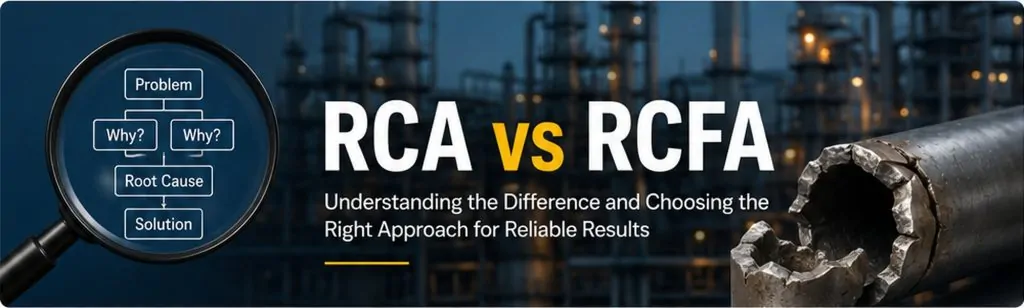
RCA vs RCFA: Key Differences and When to Use Each

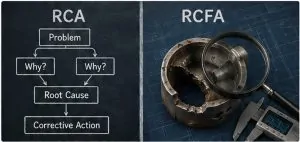
RCA vs RCFA comparison showing process investigation and engineering failure analysis for industrial equipment

RCA vs RCFA: Key Differences and When to Use Each

When a process goes wrong or a critical asset fails, finding the cause is essential. However, not every problem requires the same type of investigation. A production delay, an incorrect inspection record and a fractured pump shaft may all trigger a root cause review, but the evidence, expertise and analysis required for each case are very different.

This is the practical issue behind the RCA vs RCFA comparison.

Root Cause Analysis (RCA) is a broad problem-solving approach used to determine why an undesirable event occurred. It is commonly applied to process problems, operational errors, quality deviations, safety events and weaknesses in organisational controls.

Root Cause Failure Analysis (RCFA) is more specialised. It is normally used when a physical component, machine or engineered system has failed and the investigation must establish the failure mechanism. RCFA may require inspection, material testing, load reconstruction, fracture mechanics, fatigue assessment or finite element analysis.

The terms are sometimes used interchangeably. The meaningful distinction is not the acronym used in the report, but the level of technical proof required.

A missed maintenance task may be resolved by reviewing work-order controls. A repeatedly fractured shaft may require engineers to distinguish between fatigue, overload, misalignment, resonance and material deficiency.

An investigation that is too limited can produce repeated failures, while one that is unnecessarily complex wastes resources. This guide explains how to select the right level of investigation.

What Is Root Cause Analysis (RCA)?

Root Cause Analysis is a structured method used to identify the underlying causes of a problem, incident, deviation or undesirable outcome. Its purpose is not simply to describe what happened. It seeks to determine which conditions, decisions and control weaknesses allowed the event to occur and what should change to prevent recurrence.

A useful RCA separates different levels of causation:

  • The symptom is the visible problem, such as a rejected batch.
  • The immediate cause is the condition directly connected to the event, such as production outside the specified temperature range.
  • A contributing factor increased the likelihood or severity of the problem, such as an unclear operator display.
  • The root cause is a deeper controllable weakness, such as an inadequate alarm-response procedure or a failed management-of-change process.

This distinction prevents the investigation from stopping at vague conclusions such as “operator error”, “poor communication” or “procedure not followed”. These statements may describe an action, but they do not explain why the system allowed that action to create the outcome.

Common RCA methods include Five Whys, Fishbone diagrams, event analysis, barrier analysis, fault trees, change analysis and process mapping. A minor process issue may need a focused review, while a major incident may require a formal multidisciplinary investigation.

Typical RCA Applications

RCA is most effective when the likely causes relate mainly to processes, people, information, procedures or management controls. Common applications include:

  • Production delays and workflow bottlenecks
  • Repeated quality nonconformances
  • Incorrect documentation or data entry
  • Missed inspections or maintenance tasks
  • Customer complaints
  • Inventory and scheduling errors
  • Procedural deviations
  • Inadequate training or supervision
  • Weak approval or communication processes
  • Safety incidents dominated by organisational or procedural factors

For example, if planned inspections are repeatedly overdue, the investigation may examine asset-priority rules, work-order generation, responsibility allocation, contractor availability and escalation controls. Physical testing of the equipment may not be necessary unless the delay has created uncertainty about asset condition.

Strengths of RCA

RCA is flexible, scalable and applicable across industries. It also encourages teams to look beyond blame and examine the systems that influence behaviour and decisions.

RCA is generally efficient when:

  • The event can be reconstructed from records, interviews and process data.
  • The causal chain is mainly operational or organisational.
  • The physical failure mechanism is already known.
  • Corrective actions will focus on procedures, workflow, controls or training.
  • Technical uncertainty is limited.

RCA can therefore provide a practical and cost-effective response to many business and operational problems. Its limitation appears when the conclusion depends on proving how a physical asset failed.

What Is Root Cause Failure Analysis (RCFA)?

Root Cause Failure Analysis is a specialised investigation used to determine why an asset, component or engineered system failed and what changes are required to prevent recurrence.

RCFA includes the causal reasoning used in RCA, but adds a critical technical requirement: the investigation must identify and validate the physical failure mechanism.

The damaged part is not automatically the root cause. A fractured bolt may be the final result of fatigue initiated by joint separation. Joint separation may have developed because of insufficient preload, unsuitable lubrication, loss of stiffness or an incorrect tightening method. Replacing the bolt restores the machine, but it does not correct the conditions that caused the failure.

A strong RCFA examines the failed component within its operating system. Depending on the case, investigators may review:

  • Fracture location and surface features
  • Material composition and properties
  • Design geometry and stress concentrations
  • Fabrication and weld quality
  • Loading and operating history
  • Pressure, temperature and vibration data
  • Alignment, clearances and support conditions
  • Lubrication, wear and contamination
  • Corrosion and environmental exposure
  • Maintenance history and previous repairs
  • Design changes and operating modifications

RCFA connects this physical evidence with human and organisational factors. If a support failed through fatigue after a modification, the investigation must determine not only how the stress developed, but also why the modification was approved without suitable engineering verification.

Typical RCFA Applications

RCFA is commonly used in asset-intensive industries for:

  • Shaft, bolt and structural fractures
  • Repeated weld cracking
  • Bearing and gearbox failures
  • Pump, compressor and fan failures
  • Pressure vessel and piping damage
  • Excessive wear, deformation or overheating
  • Vibration-related equipment damage
  • Corrosion and wall-thinning failures
  • Electrical and insulation breakdowns
  • Mining and materials-handling equipment failures
  • Failure following a design or operating change

RCFA can also be appropriate before complete failure. A growing crack, severe vibration or local deformation may require investigation to determine the mechanism and whether continued operation is acceptable.

Strengths of RCFA

RCFA provides a stronger connection between observed damage, engineering behaviour and corrective action. It helps distinguish between competing explanations and prevents modifications based only on assumption.

For example, high vibration may initially be attributed to imbalance, while modal testing and structural analysis reveal resonance. A crack near a weld may be blamed on workmanship, while stress analysis shows that the detail is exposed to excessive secondary bending. A pressure component may appear overloaded, while thermal analysis identifies restrained expansion as the controlling cause.

RCFA can support decisions to:

  • Modify geometry or improve structural stiffness
  • Change materials or fabrication details
  • Revise operating limits
  • Improve inspection intervals and monitoring
  • Correct alignment, lubrication or installation practices
  • Assess similar assets across a plant
  • Repair, replace or retire equipment

Engineering evidence makes RCFA especially valuable for repeated, expensive or safety-critical failures.

RCA vs RCFA: Key Differences

RCA and RCFA have the same broad objective: preventing recurrence by identifying underlying causes. The difference is the type and depth of evidence needed to reach a defensible conclusion.

Comparison area RCA RCFA
Primary focus Processes, people, systems and organisational controls Physical asset, component or engineered-system failure
Main question Why did the undesirable event occur? How did the asset fail, and why did that mechanism develop?
Typical evidence Procedures, records, interviews, timelines and process data Physical evidence, inspection results, material data, measurements, loads and engineering models
Technical depth Low to high, depending on the event Usually moderate to very high
Common team members Operations, quality, safety, management and process specialists Reliability, mechanical, structural, materials and specialist engineers, plus operations and maintenance
Typical tools Five Whys, Fishbone, process mapping, barrier analysis and event analysis RCA tools plus material testing, vibration analysis, fracture mechanics, fatigue analysis and FEA
Typical output Process and management-system corrective actions Technical modifications supported by process and organisational actions
Time and cost Usually lower Usually higher because specialist testing and analysis may be required

Place the in-article image immediately after this table.

The boundary is not absolute. A complex RCA may include technical specialists, and a complete RCFA must still investigate procedures, decisions and organisational controls. In practical terms, RCFA is a deeper engineering-focused form of root cause investigation.

Scope of Investigation

RCA normally begins with an undesirable event and expands into the process that produced it. The scope may include responsibilities, communication, procedures, workload, training, planning and management controls.

For example, an RCA into repeated inspection delays may examine how work is requested, who approves it, whether asset priorities are defined and how overdue activities are escalated.

RCFA begins with a failed or damaged physical system. Its scope must include the component, the surrounding equipment, the operating environment and the organisational system that allowed the failure conditions to exist.

An RCFA into a fractured pump shaft may investigate shaft geometry, material properties, fracture morphology, coupling alignment, bearing loads, speed changes, vibration history, previous repairs and maintenance practices. It must then connect the mechanism to deeper causes. If misalignment caused fatigue, why was the misalignment introduced, and why was it not detected before failure?

This is why a complete RCFA generally contains an RCA component, while many RCA investigations do not require RCFA.

Data Requirements

RCA can often be completed using information already available within the organisation, including:

  • Incident and quality reports
  • Procedures and work instructions
  • Training and competency records
  • Production and alarm data
  • Interviews and communication records
  • Maintenance work orders
  • Audit and management-of-change documentation

Interviews should be compared with objective records. Human memory is valuable for understanding context, but it should not be treated as the only evidence.

RCFA usually requires a broader data set. In addition to RCA records, it may need failed components, photographs, non-destructive testing results, dimensional surveys, material certificates, metallurgical testing, vibration measurements, pressure and temperature trends, operating-cycle data, CAD models and original design calculations.

Evidence preservation is particularly important. Cleaning a fracture surface, grinding out a crack, discarding a failed bearing or dismantling equipment without documentation can destroy the evidence required to identify the mechanism. Failed parts should be photographed in position, orientation should be recorded and destructive examination should be planned rather than improvised.

Engineering Analysis Requirements

Many RCA investigations can be resolved through process review and causal analysis. RCFA often requires engineers to test whether a proposed cause is physically possible and consistent with the evidence.

Engineering analysis may be required to answer questions such as:

  • Were actual loads greater than the original design loads?
  • Did the component experience resonance or dynamic amplification?
  • Was the local stress range sufficient to cause fatigue?
  • Could the observed crack grow to a critical size?
  • Did thermal expansion introduce secondary loads?
  • Was yielding, buckling or contact separation likely?
  • Would the proposed modification prevent the same failure mechanism?

The objective is not to create the most complex model possible. The objective is to use sufficient analysis to confirm or reject the leading failure hypotheses. A transparent hand calculation based on reliable data may be more useful than an advanced simulation built on uncertain assumptions.

Investigation Complexity

RCA is usually less complex because the required evidence already exists and the corrective actions often involve workflow, procedures or controls.

RCFA becomes more complex when several mechanisms interact. A crack may have developed through fatigue, but the fatigue may have resulted from resonance. The resonance may have appeared after an operating-speed change, and that change may have been approved without reviewing the structure’s natural frequencies.

A professional investigation must clearly separate confirmed facts, test results, calculations, assumptions, contributing factors and unsupported speculation. This distinction is essential for costly or safety-critical decisions.

When Should You Use RCA?
RCFA engineering investigation using fracture mechanics, fatigue analysis and FEA to identify equipment failure causes

RCA is suitable when the problem is mainly procedural, operational or organisational and there is little uncertainty about physical asset behaviour.

Process Issues

Use RCA for problems such as delayed approvals, poor handovers, inaccurate data entry, missed scheduling, document-control weaknesses and production-flow bottlenecks.

For example, if inspection work is repeatedly delayed because the maintenance system assigns incorrect priorities, the solution may involve asset criticality, workflow configuration and clearer accountability. An engineering failure study would add little value unless the delay has allowed significant damage to develop.

Operational Problems

RCA is also appropriate for incorrect operating sequences, repeated alarms, poor shift handovers, unsuitable setpoints and weak responses to abnormal conditions. The analysis may identify unclear procedures, inadequate training or weak change management. Escalate to RCFA when equipment is damaged or its physical response is uncertain.

Quality Deviations

Quality problems such as dimensional nonconformance, incorrect labelling, batch variation, packaging defects and incomplete inspection records are often well suited to RCA.

The investigation may focus on measurement methods, calibration, sampling plans, supplier controls and production parameters. RCFA becomes necessary only when the deviation involves a physical failure mechanism that must be technically established.

When Should You Use RCFA?

The need for RCFA increases with consequence, recurrence, asset criticality and technical uncertainty.

Equipment Failures

RCFA is appropriate when equipment experiences fracture, deformation, bearing damage, gear failure, overheating, unexpected wear, severe corrosion or vibration-related damage and the mechanism is not already clear.

Not every failed consumable requires advanced investigation. A low-cost component that reaches its expected service life may only need routine maintenance review. RCFA is justified when the damage is unexpected, inconsistent with normal service or likely to require a design change.

Repeated Asset Failures

Recurrence is a strong sign that previous actions treated the symptom rather than the cause.

Examples include bearings failing every few months, cracks returning after weld repair, repeated coupling damage or recurring seal failures. The replaced part may simply be the weakest point in a system affected by misalignment, resonance, thermal movement or excessive loading.

An RCFA should compare previous events, identify patterns and determine whether similar assets are exposed to the same mechanism.

High-Cost Downtime Events

A formal RCFA is often justified when failure causes major production loss, emergency repair costs, contractual exposure or damage to surrounding equipment.

Specialist analysis may appear expensive, but its cost should be compared with the potential cost of recurrence. High-cost events also require stronger technical evidence because management may need to approve capital expenditure or changes to the operating strategy.

Safety-Critical Incidents

RCFA should be strongly considered when failure could cause injury, loss of containment, fire, explosion, structural collapse, dropped loads or environmental release.

The investigation must evaluate both the physical mechanism and the barriers intended to prevent the event. It should ask whether inspection could have detected the damage, whether operating limits remained valid, whether warning signs were ignored and whether similar assets require immediate assessment.

RCA and RCFA Investigation Workflow

A practical RCFA investigation workflow follows the same basic causal logic as RCA but adds evidence-preservation and engineering-validation stages.

1. Stabilise and Secure the Situation

Make the area safe, isolate hazards and prevent additional damage. Where possible, avoid destroying evidence during emergency repair.

2. Define the Undesired Outcome

Describe the event precisely. “The machine failed” is too vague. A useful statement identifies the asset, location, operating condition, damage and consequence.

3. Select the Investigation Level

Consider safety impact, downtime, cost, recurrence, asset criticality and technical uncertainty. A low-consequence process problem may remain an RCA. A complex physical failure should be escalated to RCFA.

4. Collect and Preserve Evidence

Gather photographs, records, operating trends, measurements and witness information. For RCFA, document the failed component before cleaning, cutting or testing.

5. Build the Event Timeline

Identify operating changes, maintenance activities, alarms, modifications, inspections and warning signs before and after the event.

6. Develop Possible Causes

Use structured RCA and RCFA tools to identify hypotheses involving design, material, fabrication, operation, maintenance, environment and organisational controls.

7. Determine the Failure Mechanism

For RCFA, inspect and analyse the evidence to determine whether the damage resulted from fatigue, overload, brittle fracture, wear, corrosion, creep, thermal cycling, buckling, resonance or another mechanism.

8. Test the Hypotheses

Each proposed cause must explain the physical evidence, event timeline and operating data. Contradictory findings should not be ignored.

9. Identify Root and Contributing Causes

Connect the failure mechanism to design, operating, maintenance and organisational weaknesses. A strong conclusion explains both how the component failed and why the relevant conditions were allowed to develop.

10. Implement and Verify Corrective Actions

Actions may include design modification, improved monitoring, revised operating limits, inspection of similar assets, procedural changes or independent design verification. The organisation should confirm that the actions were completed and that the failure has not recurred.

Engineering Tools Commonly Used in RCFA

The tool should be selected to answer a specific investigation question. RCFA does not automatically require every available analysis method.

Fracture Mechanics

Fracture mechanics is used when a component contains a crack or crack-like defect. It evaluates whether the crack can remain stable under the applied loading and how close it may be to a critical condition.

An assessment may consider crack dimensions, applied and residual stresses, material toughness, temperature and loading mode. It can help determine whether a defect caused final fracture, what crack size would be critical and whether similar equipment can remain in service.

When progressive growth is important, crack-growth analysis may be used to estimate how a defect developed under repeated loading and to support inspection planning.

Fatigue Analysis

Fatigue is progressive damage caused by repeated or fluctuating loads. It can occur even when the maximum stress is below the material’s static strength.

A vibration and fatigue analysis may consider stress range, cycle count, weld detail, stress concentration, surface condition, mean stress and environmental effects.

The investigation should not stop at the statement “fatigue caused the failure”. It must determine why the cyclic demand was excessive. Possible causes include resonance, poor geometry, inadequate stiffness, misalignment, thermal cycling or unexpected start-stop conditions.

FEA and Simulation

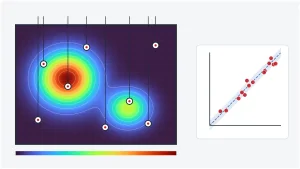
Advanced simulation can help evaluate complex geometry, load paths, local stresses, contact, thermal gradients, natural frequencies, buckling and plastic deformation.

An RCFA model should reproduce the observed behaviour. Predicted stress concentration should align with the crack location, and modal results should be compared with measured vibration frequencies where possible.

The reliability of FEA depends on geometry, loads, boundary conditions, material models, contact definitions and validation. A colourful stress contour is not evidence by itself. The model must be supported by inspection, measurement and engineering judgement.

Where deformation, contact or material yielding is significant, the distinction between linear and nonlinear FEA may become important when testing the failure hypothesis or proposed modification.

Common Mistakes When Choosing RCA Instead of RCFA

Stopping at “Human Error”

Human action may be part of the event, but it does not explain why the system allowed that action to cause equipment failure. The investigation should examine controls, alarms, protection and the asset’s tolerance to foreseeable operating variation.

Treating the Failed Part as the Root Cause

A damaged bearing, bolt, seal or weld is the location of failure, not necessarily its cause. The part may have been exposed to misalignment, overload, vibration, thermal expansion or unsuitable installation.

Using Five Whys Without Technical Validation

Five Whys can organise reasoning, but it cannot prove a fracture or fatigue mechanism. Statements such as “the shaft was overloaded” require support from fracture examination, load data or stress analysis.

Repairing Before Preserving Evidence

Cleaning, grinding, discarding or welding failed parts can remove information that would otherwise reveal the crack origin, load direction or damage sequence.

Blaming Every Weld Crack on Workmanship

A crack near a weld does not automatically indicate poor fabrication. The weld may be exposed to an unsuitable stress range, restraint or structural detail.

Accepting Simulation Without Validation

Incorrect restraints or loads can produce convincing but misleading results. A model should be checked against physical evidence, measurements and independent calculations.

Ignoring Similar Assets

A single failure may reveal a wider design or operating risk. Similar equipment should be screened for the same geometry, material, modification and service conditions.

Decision Framework: RCA or RCFA?

Use RCA when:

  • The problem is mainly procedural, operational or organisational.
  • No physical component has failed.
  • The physical mechanism is obvious and low risk.
  • Existing records can explain the event.
  • Corrective actions will focus on workflow, training, controls or documentation.
  • Technical uncertainty is limited.

Use RCFA when:

  • A physical asset or structure has failed.
  • The failure mechanism is uncertain.
  • The same failure has occurred more than once.
  • The event caused major downtime or repair cost.
  • Safety or environmental consequences are significant.
  • A design modification is being considered.
  • Material behaviour, vibration, fracture, fatigue or stress must be evaluated.
  • Similar equipment may be exposed to the same risk.

When the correct level is uncertain, begin with a screening RCA. Escalate to RCFA when several mechanisms remain possible, a design change is proposed, previous actions have failed or an incorrect conclusion would be unacceptable. The decision should be risk-based, not driven only by investigation cost.

Frequently Asked Questions

What is the main difference between RCA and RCFA?

RCA is a broad method for identifying the causes of process, operational, quality and organisational problems. RCFA focuses on physical equipment or structural failure and normally requires technical evidence to establish the failure mechanism.

Is RCFA a type of RCA?

Yes. RCFA uses the same causal principles as RCA but adds engineering examination and validation. It can be considered a specialised form of root cause investigation for asset failures.

Can RCA be used for equipment failures?

Yes, when the failure mechanism is straightforward, the consequence is low and advanced technical analysis is unnecessary. RCFA is preferable when the failure is repeated, costly, safety-critical or technically uncertain.

Is failure analysis the same as RCFA?

No. Failure analysis usually focuses on how a component physically failed. RCFA connects that mechanism to design, operation, maintenance and organisational causes and develops actions to prevent recurrence.

Does every RCFA require FEA?

No. Simple failures may be resolved through inspection, material examination, measurements and hand calculations. FEA is useful when geometry, loading, contact, dynamics or nonlinear behaviour cannot be evaluated adequately using simpler methods.

Who should participate in an RCFA?

The team should match the failure and may include operations, maintenance, reliability, mechanical, structural, materials, inspection and safety specialists. Independent experts may be appropriate for high-consequence events.

What makes a root cause conclusion credible?

A credible conclusion is supported by evidence, explains the observed event, distinguishes facts from assumptions and leads to corrective actions that reduce the risk of recurrence.

How long does an RCFA take?

A focused investigation may take several days, while a complex failure involving testing and simulation may take weeks. Scope should reflect consequence, complexity and evidence availability.

Conclusion

RCA and RCFA are closely related, but they are suited to different types of problems.

RCA is an effective framework for process issues, operational problems, quality deviations and organisational weaknesses. It is usually appropriate when the event can be explained through records, interviews and causal analysis and when the physical behaviour of equipment is already understood.

RCFA is required when a physical asset has failed and the failure mechanism must be established through engineering evidence. It may combine inspection, material testing, fracture mechanics, fatigue analysis, vibration assessment and FEA with a wider review of maintenance, operations and management controls.

The most important distinction is the required level of proof. A process problem may need a structured workshop, while a repeated crack or safety-critical failure may require a multidisciplinary engineering investigation.

Organisations should avoid both under-investigation and unnecessary complexity. A limited RCA can produce repeated failures when the physical mechanism remains unknown. An overly elaborate RCFA may waste resources when the problem is a straightforward process weakness.

The best approach is to define the event clearly, assess consequence and technical uncertainty, preserve evidence and escalate the investigation when the failure mechanism must be proven.

Complex asset failures often require more than a standard root cause workshop. Avesta Consulting combines physical evidence, engineering calculations, fracture mechanics, fatigue analysis and simulation to identify failure mechanisms and verify practical corrective actions. Learn more about our engineering RCFA services or contact our team to discuss a specific failure investigation.