What Is Simulation-Driven Design?
Most engineering teams already own FEA and CFD software. Far fewer have actually restructured their design process around it. That distinction — using simulation as a verification step at the end of a design versus using it to drive the design itself — is the difference between traditional engineering and simulation-driven design.
This article isn’t a tour of simulation software. It’s about a shift in how engineering decisions get made: moving simulation from the end of the process, where it can only confirm or reject a finished design, to the center of it, where it actively shapes the design as it’s being developed. That shift is what “simulation-driven design” actually means, and it’s increasingly what separates engineering teams delivering faster, more reliable products from those still discovering problems after tooling has already been cut.
What Is Simulation-Driven Design?
Simulation-driven design is an engineering methodology where simulation — structural, fluid, thermal, or multiphysics — is integrated into the design process from the concept stage onward, rather than applied only once a design is finalized. Instead of designing first and validating later, engineers use simulation results to actively guide geometry, material selection, and configuration decisions as the design develops.
The distinction matters because it changes what simulation is actually used for. In a traditional workflow, simulation answers the question “did this design pass?” In simulation-driven design, it answers a different question throughout: “which of these design directions actually performs better, and why?” The second question is where most of the cost and schedule savings come from, because it catches problems while they’re still cheap to fix — in the model, not in a physical prototype.
Traditional Design vs Simulation-Driven Design
| Factor | Traditional Trial-and-Error Design | Simulation-Driven Design |
|---|---|---|
| When simulation happens | After the design is finalized | Throughout concept and development |
| Role of simulation | Pass/fail validation | Active input to design decisions |
| Prototyping | Multiple physical iterations | Reduced to final-stage confirmation |
| Cost of late-stage changes | High — often requires re-tooling | Low — changes happen in the model |
| Design confidence at handover | Based on limited physical testing | Backed by iterative virtual testing |
| Engineering risk | Discovered late, often expensive | Identified and resolved early |
Traditional Trial-and-Error Design
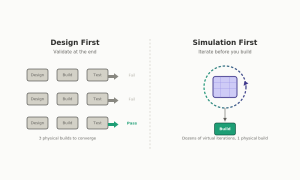
In a conventional workflow, a design is developed largely on engineering judgment, past experience, and hand calculations, then built as a physical prototype to see how it actually performs. If it fails — under load, under flow, under thermal cycling — the team revises the design and builds another prototype. This “design first, test later” approach works, but every iteration costs real time and money, and the most expensive failures are the ones discovered only after physical parts exist.
Simulation-Led Engineering Approach
Simulation-driven design flips the sequence. Multiple design variants are modeled and tested virtually before any physical prototype exists, so the iteration loop happens in software — where a design change costs an afternoon of re-running a model, not weeks of re-tooling. By the time a physical prototype is built, it’s built to confirm a design that’s already been through dozens of virtual iterations, not to discover whether the first attempt works at all.
How Simulation-Driven Design Works
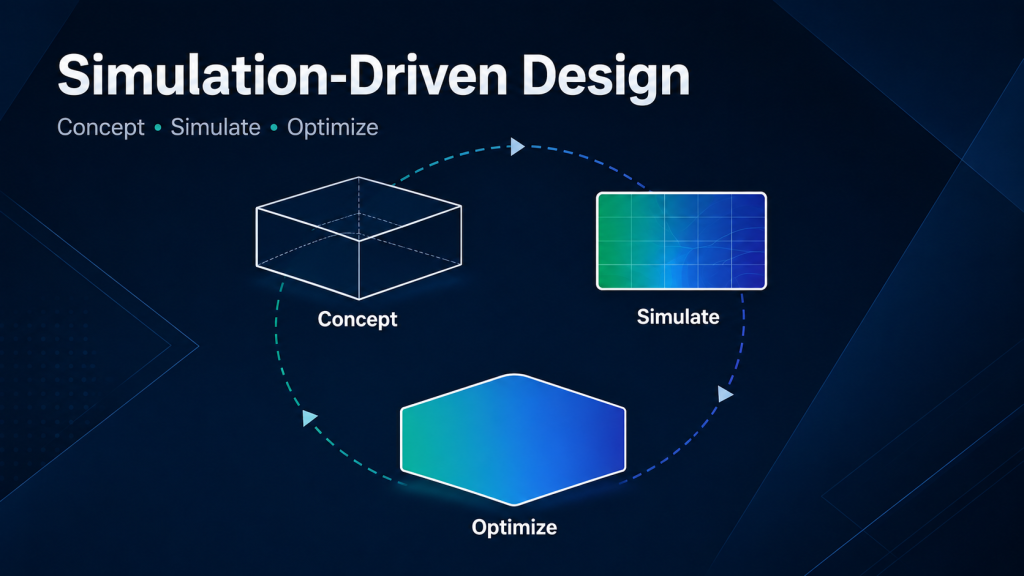
A simulation-driven workflow follows a consistent sequence, though the number of iterations through steps 3–5 is where most of the value gets created.
- Creating the initial concept — Design intent, functional requirements, and constraints are defined before any detailed geometry work begins, so simulation has clear performance targets to test against.
- Building the digital model — A CAD model is developed to a level of detail sufficient for meaningful simulation, balancing geometric accuracy against the complexity it adds to the analysis.
- Running engineering simulations — Structural (FEA), fluid (CFD), thermal, or coupled multiphysics simulations are run against the model to predict how it will actually behave under real operating conditions.
- Evaluating results — Simulation output is interpreted against the original performance targets, identifying where the design falls short, where it’s over-engineered, and where trade-offs exist between competing requirements.
- Optimizing the design — Geometry, materials, or configuration are adjusted based on those results, and the model is re-simulated — often across several cycles — until the design converges on a solution that meets its requirements without unnecessary conservatism.
This loop, not any single simulation run, is what defines simulation-driven design. A single FEA check at the end of a project is validation. Multiple cycles of simulate-evaluate-optimize before a design is finalized is a genuinely different process.
Key Technologies Behind Simulation-Driven Design
The methodology depends on a handful of underlying technologies working together, though the technology itself isn’t the point — how it’s used within the design decision loop is.
CAD Systems
Digital models built in CAD form the geometric basis for every simulation that follows. In simulation-driven workflows, CAD and simulation typically stay tightly linked, so geometry changes can be re-tested quickly rather than requiring a full model rebuild each iteration.
Finite Element Analysis (FEA)
FEA predicts structural response — stress, deformation, and failure risk — under real loading conditions. Within a simulation-driven process, it’s used repeatedly across design iterations to compare options, not just once to sign off on a finished geometry. We’ve covered FEA’s role in structural verification in more depth in FEA Applications in Marine & Coastal Structures.
Computational Fluid Dynamics (CFD)
Where fluid flow, heat transfer, or aerodynamic performance matters, CFD plays the same iterative role FEA plays for structural behavior — testing how design variants perform before committing to physical testing.
Design Optimization Algorithms
Beyond manual iteration, optimization algorithms can automatically explore a design space — varying geometry or parameters within defined constraints and using simulation results to converge on the best-performing configuration. This is where simulation-driven design moves from “engineer tests a few ideas” to systematically searching a much larger space of possible designs than manual iteration could cover.
Benefits of Simulation-Driven Design
Faster Product Development
Because design flaws surface during virtual iteration rather than physical testing, fewer prototype-build-test cycles are needed to reach a validated design — directly compressing development schedules.
Reduced Physical Prototyping Costs
Every physical prototype avoided is real cost saved — materials, fabrication time, and testing resources. Simulation doesn’t eliminate physical prototyping entirely, but it shifts it from an exploratory step to a final confirmation step.
Better Product Performance
Testing many design variants virtually, rather than settling on the first design that passes a single physical test, tends to produce genuinely better-performing designs — lighter, more efficient, or more durable than a design arrived at through limited trial and error.
Improved Reliability and Safety
Simulating a wider range of operating and failure conditions than physical testing could practically cover — including edge cases and extreme loading scenarios — surfaces reliability and safety risks earlier, when they’re still straightforward to design out.
Reduced Engineering Risk
Design decisions backed by iterative simulation evidence are inherently more defensible than decisions based on judgment and a single prototype result, reducing the risk of a costly late-stage design failure or field issue.
Real-World Applications of Simulation-Driven Design
| Industry | Typical Application |
|---|---|
| Mining & Resources | Structural and fatigue optimization of heavy equipment components under cyclic loading |
| Oil & Gas | Pressure system and pipework design validated against process and thermal loading before fabrication |
| Infrastructure | Structural performance of bridges, platforms, and support structures under environmental and dynamic loads |
| Manufacturing Equipment | Iterative structural and thermal optimization of machinery components before physical build |
Mining and Resources
Heavy equipment components in mining operations face extreme cyclic loading and harsh operating environments. Simulation-driven design lets engineers iterate on component geometry and material selection against realistic fatigue loading before committing to fabrication — critical when a design failure means unplanned downtime on a production-critical asset.
Oil and Gas
Pressure-containing equipment and pipework need to perform reliably across a wide range of process and thermal conditions. Running structural and thermal simulations across multiple design iterations, rather than validating a single finished design, catches configuration issues — thermal expansion conflicts, stress concentrations at nozzles — well before fabrication begins.
Infrastructure Projects
Bridges, support structures, and platforms are exposed to dynamic and environmental loading that’s difficult to fully replicate in physical testing. Simulation-driven design allows engineers to test structural response across a range of load cases and configurations, refining the design before construction rather than relying solely on code-based conservative assumptions.
Manufacturing Equipment
Machinery components subject to combined structural and thermal loads benefit from iterative virtual testing that would be prohibitively expensive to replicate physically across every design variant under consideration.
Simulation-Driven Design and Digital Twins
Simulation-driven design and digital twins are related but distinct. Simulation-driven design uses virtual models to shape a design before it exists physically. A digital twin extends that same simulation approach into the operational phase — a live, continuously updated virtual model of an asset that’s already in service, fed by real operating data. The two increasingly connect: a design validated through simulation-driven engineering can become the baseline model for a digital twin once the asset is operating, extending the value of that original simulation work well beyond the design phase and into ongoing monitoring and predictive maintenance.
Common Challenges and Limitations
- Simulation accuracy depends on input quality. Results are only as reliable as the loading conditions, material properties, and boundary conditions used to define the model.
- Not every design question can be fully simulated. Complex multiphysics interactions or highly nonlinear behavior sometimes still require physical testing to fully validate.
- It requires specialized expertise. Getting genuine value from simulation-driven design — rather than misleading results from a poorly set-up model — depends on engineers who understand both the physics and the software.
- Computational cost scales with iteration. Running many design variants through detailed simulation can demand significant computing resources, particularly for complex multiphysics problems.
- It’s easy to over-rely on simulation results without engineering judgment. Simulation supports decision-making — it doesn’t replace the engineering experience needed to interpret results correctly and know when a result warrants further scrutiny.
Frequently Asked Questions
What is simulation-driven design? It’s an engineering methodology where simulation is integrated throughout the design process — from concept through iteration — to actively guide design decisions, rather than being used only to validate a finished design.
How does simulation-driven design improve product development? By catching performance and reliability issues during virtual iteration rather than physical prototyping, it reduces the number of costly build-test cycles needed and shortens overall development time.
What software is used for simulation-driven design? CAD platforms combined with FEA, CFD, and thermal simulation tools, often supported by design optimization software that automates iteration across a defined design space.
What is the difference between simulation-driven design and traditional design? Traditional design uses simulation mainly to validate a finished design. Simulation-driven design uses it throughout development to actively shape design decisions across multiple iterations.
Can simulation-driven design reduce engineering costs? Yes — primarily by reducing the number of physical prototypes needed and by catching design issues early, when they’re inexpensive to correct, rather than after fabrication or field deployment.
Is simulation-driven design suitable for complex industrial projects? Yes, and arguably more so than for simple projects — the more complex the loading conditions and failure modes, the more value there is in testing multiple design iterations virtually before committing to a physical build.
Conclusion
Simulation-driven design isn’t defined by which software a team uses — it’s defined by where simulation sits in the decision-making process. Used only at the end, it validates. Integrated from the start, it actively shapes better, more reliable designs while reducing the cost and risk of getting there. For projects with complex loading conditions, tight performance requirements, or high consequences of failure, that shift is increasingly not optional.
Looking to improve design performance, reduce development costs and accelerate project delivery? Our engineering team uses simulation-driven design methodologies — combining Engineering Design, Advanced Simulation, and Design Verification — to solve complex engineering challenges. Get in touch to talk through your next project.