
Thermal Conductivity of Silver: The Complete Engineering Guide
Understanding Silver’s Exceptional Heat Transfer Properties and Industrial Applications Silver is widely recognized as one of the world’s most valuable precious metals, but its importance extends far beyond jewelry, currency, and investment. In engineering, manufacturing, electronics, and thermal management systems, silver is renowned for possessing the highest thermal conductivity of

Thermal Conductivity of Iron: Properties, K-Value, Heat Transfer, and Engineering Applications
Introduction Thermal conductivity is one of the most important material properties considered in engineering, manufacturing, construction, and industrial design. Whether engineers are designing heat exchangers, industrial furnaces, pressure vessels, structural components, or manufacturing equipment, understanding how efficiently a material transfers heat is essential for ensuring safety, energy efficiency, and long-term
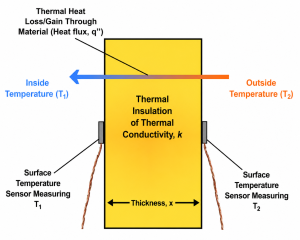
Thermal Conductivity of Steel: Understanding K-Value, W/mK, R-Value, and Engineering Applications
Introduction Thermal conductivity is one of the most important material properties considered in engineering design, manufacturing, construction, energy systems, and industrial processes. Whether designing pressure vessels, heat exchangers, furnaces, pipelines, structural components, or industrial equipment, engineers must understand how heat travels through materials. Steel remains one of the most widely
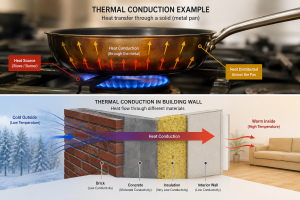
Thermal Conduction Examples: Understanding Heat Transfer Through Everyday and Industrial Applications
Heat transfer plays a fundamental role in nearly every engineering system, from electronic devices and industrial furnaces to building insulation and power plants. Among the three primary heat transfer mechanisms—conduction, convection, and radiation—thermal conduction is often the most important mode when heat moves through solid materials. Thermal conduction occurs when
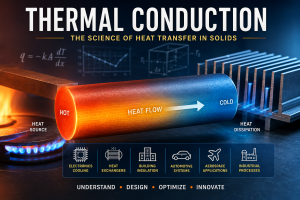
Thermal Conduction in Heat Transfer: Principles, Mechanisms, and Real-World Applications
Introduction Thermal conduction is one of the most fundamental mechanisms of heat transfer and plays a critical role in almost every engineering system—from microelectronics and building insulation to industrial heat exchangers and manufacturing processes. Despite being a basic concept in physics, thermal conduction becomes highly complex when applied to real-world
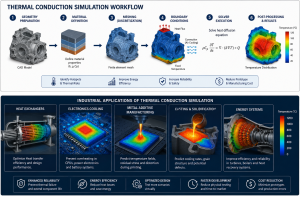
Thermal Conduction Simulation in Engineering Systems: Methods, Models, and Industrial Applications
Thermal conduction is one of the most fundamental physical phenomena in engineering, governing how heat moves through solid materials. In industrial applications—especially in metals, composites, electronics, energy systems, and manufacturing processes—understanding conduction alone is not enough. Engineers need to simulate, predict, and optimize heat transfer behavior before physical prototypes are