Heat transfer is one of the most important principles in engineering. Whether engineers are designing a pressure vessel, heat exchanger, industrial furnace, electronic cooling system, HVAC system, pipeline, power plant component, or manufacturing process, they must understand how heat moves from one place to another.
In real engineering systems, heat rarely travels in only one way. A hot pipe may conduct heat through its metal wall, lose heat by convection to the surrounding air, and radiate thermal energy from its external surface. A heat exchanger may depend on conduction through tube walls, forced convection inside fluids, and sometimes radiation if temperatures are high enough. An electronic device may transfer heat from a chip by conduction into a heat sink, by convection into airflow, and by radiation from exposed surfaces.
The three main modes of heat transfer are conduction, convection, and radiation. Each one works differently, depends on different physical conditions, and requires different engineering methods for analysis and control.
This guide explains what conduction, convection, and radiation are, how they work, where they appear in real engineering applications, and why simulation tools such as CFD and thermal analysis are essential for designing safe, efficient, and reliable systems.
What Is Heat Transfer?
Heat transfer is the movement of thermal energy from a region of higher temperature to a region of lower temperature. This movement occurs because systems naturally tend toward thermal equilibrium. When two objects, materials, or regions have different temperatures, heat flows from the hotter region to the colder region until the temperature difference is reduced.
In engineering, heat transfer is not only a scientific concept. It directly affects performance, safety, reliability, energy efficiency, material life, and operating cost.
For example, if heat is not removed properly from an electronic component, the component may overheat and fail. If heat transfer is not properly managed in a pressure vessel or reactor, thermal stress may cause cracking or distortion. If a furnace loses too much heat through its walls, energy consumption increases. If a heat exchanger is poorly designed, it may fail to reach the required outlet temperature or may create excessive pressure drop.
Heat transfer analysis helps engineers answer questions such as:
How fast will a component heat up or cool down?
What temperature will the material reach during operation?
Is the insulation thickness sufficient?
Will thermal expansion create stress?
Is the cooling system powerful enough?
Where are the thermal hotspots?
How can energy loss be reduced?
Will the system remain safe during start-up, shutdown, or abnormal operation?
To answer these questions, engineers must understand the three main modes of heat transfer: conduction, convection, and radiation.
The Three Modes of Heat Transfer
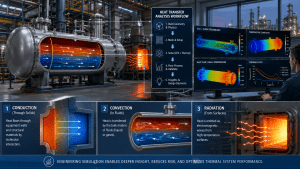
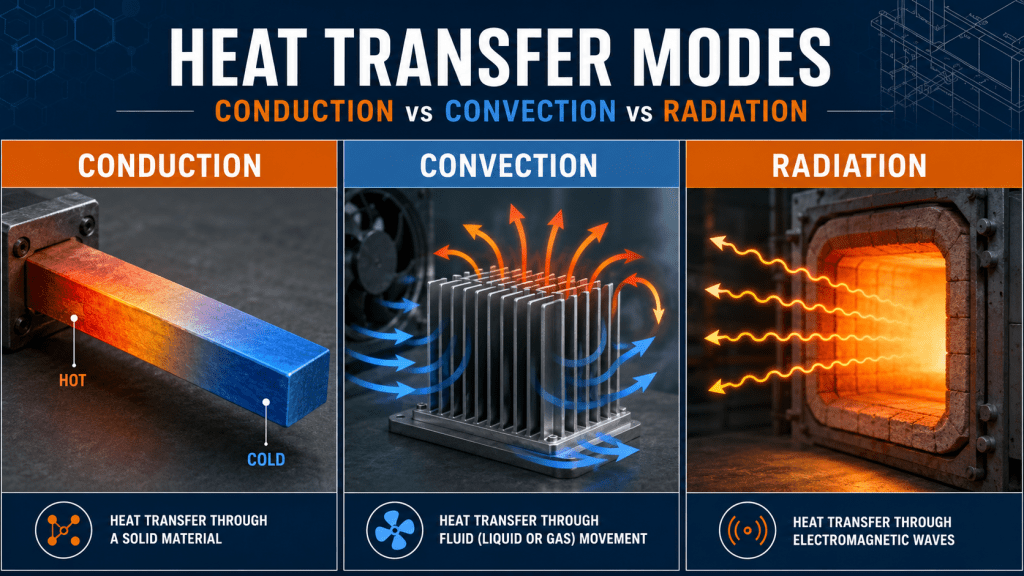
The three modes of heat transfer are:
Conduction
Convection
Radiation
Conduction is heat transfer through direct contact within a material or between materials touching each other.
Convection is heat transfer between a surface and a moving fluid, such as air, water, oil, gas, or steam.
Radiation is heat transfer through electromagnetic waves and does not require a physical medium.
Although each mode is different, most industrial and engineering systems involve a combination of all three. The challenge for engineers is to identify which mode dominates, how the modes interact, and how to design the system accordingly.
What Is Conduction?
Conduction is the transfer of heat through a solid material or between materials in direct contact. It occurs because particles with higher energy transfer energy to neighbouring particles with lower energy.
In solids, conduction is usually the most important mode of heat transfer. Metals such as copper, aluminium, silver, and steel conduct heat relatively well because their internal structure allows energy to move efficiently. Non-metallic materials such as rubber, wood, ceramics, plastics, and insulation materials generally conduct heat less efficiently, although some ceramics and engineered materials can have special thermal properties.
Conduction does not require the material to move. Heat moves through the material while the material itself remains in place.
A simple example is a metal spoon placed in a hot cup of tea. The end of the spoon in the tea becomes hot first. Heat then travels along the spoon by conduction until the handle also becomes warm.
In engineering terms, conduction is controlled by several main factors:
The temperature difference across the material
The material’s thermal conductivity
The thickness of the material
The surface area available for heat flow
The direction and length of the heat path
A material with high thermal conductivity allows heat to pass through easily. A material with low thermal conductivity resists heat flow and acts as an insulator.
How Conduction Works
At the microscopic level, conduction occurs because energy is transferred between atoms, molecules, and electrons. In metals, free electrons play a major role in transferring heat. This is why many metals are good thermal conductors. In non-metals, heat transfer is mainly due to molecular vibrations.
The basic engineering equation for steady-state conduction through a flat wall is based on Fourier’s Law. The heat transfer rate increases when the temperature difference is larger, the thermal conductivity is higher, or the heat transfer area is greater. It decreases when the wall is thicker.
This is why a thin metal sheet transfers heat more quickly than a thick insulated panel. It is also why adding insulation reduces heat loss from pipes, vessels, furnaces, and buildings.
Conduction can be one-dimensional, two-dimensional, or three-dimensional depending on the geometry and temperature distribution. In simple cases, hand calculations may be enough. In complex systems, thermal simulation is often needed to calculate temperature gradients accurately.
Examples of Conduction
Conduction appears in many everyday and industrial situations.
A hot pan transfers heat to food by conduction.
A metal rod becomes hot when one end is placed in a flame.
Heat moves through the wall of a pressure vessel from hot fluid inside to the external surface.
Heat travels from an electronic chip into a heat sink through a thermal interface material.
Heat passes through insulation, refractory lining, or furnace walls.
A welded structure experiences thermal conduction during fabrication.
Heat spreads through a machine component during frictional heating.
In all these examples, heat travels through a solid or direct-contact path.
Engineering Applications of Conduction
Conduction is critical in many engineering applications.
In pressure vessels, heat may conduct through the vessel wall when the internal fluid is hotter or colder than the surrounding environment. This temperature difference can create thermal gradients, which may lead to thermal stress, expansion, or fatigue if not properly considered.
In heat exchangers, conduction occurs through tube walls or plates separating two fluids. Even though the main purpose of a heat exchanger is to transfer heat between fluids, conduction through the solid barrier is essential.
In electronics, conduction is used to move heat away from chips, processors, power modules, and batteries. Thermal pads, heat spreaders, heat sinks, and metal housings are designed to improve conduction.
In industrial furnaces, conduction occurs through refractory linings, insulation, metal shells, and loaded materials. Engineers must control conduction to reduce energy loss and protect external structures.
In building and infrastructure engineering, conduction affects insulation performance, thermal bridging, and energy efficiency.
In manufacturing, conduction controls cooling rates during casting, welding, forging, heat treatment, and additive manufacturing.
Because conduction is strongly linked to material properties, engineers must choose materials carefully. A material that is structurally strong may not have the required thermal conductivity. Similarly, a material that is thermally efficient may not be suitable for high stress, corrosion, or high-temperature service.
What Is Convection?
Convection is heat transfer between a solid surface and a moving fluid. The fluid may be a liquid or a gas. Examples include air, water, oil, steam, process gas, coolant, refrigerant, or combustion products.
Convection combines two effects: heat conduction at the surface and movement of the fluid. First, heat transfers between the surface and the fluid layer next to it. Then fluid motion carries the heat away or brings new fluid into contact with the surface.
A simple example is hot soup cooling in a bowl. Heat moves from the soup to the surrounding air. Warm air rises and cooler air replaces it, creating natural convection. If you blow on the soup, forced air movement increases convection and cools the soup faster.
In engineering systems, convection is often one of the most important heat transfer modes because many machines and industrial processes involve moving fluids.
How Convection Works
Convection depends on fluid motion. The faster and more effectively the fluid moves across a surface, the more heat it can remove or deliver.
The heat transfer rate in convection depends on:
The temperature difference between the surface and the fluid
The surface area
The convection heat transfer coefficient
The fluid velocity
The fluid properties
The flow regime, such as laminar or turbulent flow
The geometry of the surface
A key engineering parameter in convection is the heat transfer coefficient. This coefficient represents how effectively heat transfers between the surface and the fluid. It depends on the flow conditions and fluid behaviour.
For example, still air has a relatively low convection heat transfer coefficient. Moving air improves heat transfer. Water usually provides stronger convection than air because it has higher heat capacity and thermal properties. Turbulent flow often increases convection because it mixes the fluid more effectively and reduces thermal boundary layer resistance.
This is why fans, pumps, fins, cooling channels, and turbulent flow designs are commonly used to improve convective heat transfer.
Natural vs Forced Convection
Convection can be divided into two main types: natural convection and forced convection.
Natural convection occurs when fluid motion is caused by density differences due to temperature changes. When a fluid is heated, it often becomes less dense and rises. Cooler, denser fluid moves downward or replaces it. This creates circulation without a fan or pump.
Examples of natural convection include:
Warm air rising from a radiator
Air circulation around a hot pipe
Water movement in a heated tank
Heat loss from a vertical wall to still air
Cooling of outdoor industrial equipment by surrounding air
Forced convection occurs when fluid motion is created by an external device such as a fan, blower, pump, compressor, or agitator.
Examples of forced convection include:
Airflow through an electronic cooling fan
Water circulation in a cooling jacket
Oil flow through a heat exchanger
Steam flow through process equipment
Coolant flow in engines and power systems
Ventilation airflow in tunnels or industrial buildings
Forced convection is usually stronger and more controllable than natural convection. Engineers use forced convection when heat must be removed or supplied reliably and at a predictable rate.
Engineering Applications of Convection
Convection is essential in many engineering systems.
In heat exchangers, convection occurs on both sides of the heat transfer surface. One fluid transfers heat to the wall, and another fluid receives heat from the wall. The performance of the heat exchanger depends heavily on fluid velocity, turbulence, flow arrangement, fouling, and heat transfer coefficients.
In pressure vessels and tanks, convection inside the vessel affects temperature distribution, mixing, heating, cooling, and thermal gradients. External convection also affects heat loss from the vessel surface.
In electronic cooling systems, forced convection is commonly used to remove heat from heat sinks, circuit boards, power electronics, batteries, and enclosures. Fans and airflow pathways are designed to prevent hotspots.
In industrial furnaces and ovens, convection affects how heat moves through hot gases and how evenly products are heated. Poor airflow distribution can create uneven temperature zones and product quality issues.
In HVAC and ventilation systems, convection is the main method of distributing heating or cooling through air movement.
In power plants, convection is critical in boilers, condensers, cooling towers, turbines, and heat recovery systems.
In mining and heavy industry, convection affects equipment cooling, process heating, exhaust systems, and ventilation performance.
Because convection depends on fluid flow, it is often more difficult to predict than conduction. Flow may separate, recirculate, become turbulent, create dead zones, or produce uneven cooling. This is why CFD is widely used for convection analysis.
What Is Radiation?
Radiation is heat transfer by electromagnetic waves. Unlike conduction and convection, radiation does not require physical contact or a fluid medium. It can occur through vacuum, air, gases, transparent materials, and open space.
The most familiar example of radiation is heat from the sun reaching Earth. There is no solid or fluid connection between the sun and Earth, but thermal energy travels through space as electromagnetic radiation.
All objects emit thermal radiation depending on their temperature and surface properties. Hotter objects emit more radiation. At high temperatures, radiation can become the dominant heat transfer mode.
Radiation is especially important in furnaces, combustion chambers, boilers, kilns, high-temperature pressure vessels, hot pipes, refractory systems, aerospace applications, solar systems, and fire exposure analysis.
How Radiation Works
Radiative heat transfer depends on the temperature of the surfaces, their emissivity, geometry, surface area, and view factor.
Emissivity describes how effectively a surface emits thermal radiation. A black, rough surface generally emits and absorbs radiation more effectively than a shiny polished metal surface. This is why surface finish and coating selection can significantly affect radiation heat transfer.
Radiation increases strongly with temperature. At moderate temperatures, convection and conduction may dominate. At high temperatures, radiation can become extremely significant.
For example, in an industrial furnace, heat is transferred to the load not only by hot gas convection but also by radiation from flames, refractory walls, and hot surfaces. Ignoring radiation in such systems can lead to serious thermal design errors.
Radiation can also occur between nearby surfaces at different temperatures. If a hot pipe runs near a cooler structure, radiative heat exchange can increase the temperature of the nearby component even without direct contact.
Examples of Radiative Heat Transfer
Radiation appears in many practical situations.
Heat from the sun warming a surface
Heat felt from a fire without touching it
Thermal radiation from furnace walls
Radiation from hot exhaust pipes
Heat transfer from glowing metal during forging
Radiation between hot process equipment and nearby structures
Radiation from electronic components inside compact enclosures
Fire exposure heating the outside of a pressure vessel
Heat loss from high-temperature pipelines and vessels
Unlike conduction and convection, radiation can transfer heat across empty space. This makes it especially important in high-temperature and open-surface applications.
Engineering Applications of Radiation
Radiation is critical in high-temperature engineering.
In industrial furnaces, radiation may dominate heat transfer to the product, refractory, and furnace structure. Engineers must consider flame radiation, wall radiation, surface emissivity, and temperature distribution.
In boilers and combustion systems, radiation from flames and hot gases contributes significantly to heat transfer. Furnace wall temperature, tube exposure, and material life depend on radiative heat loads.
In pressure vessels exposed to fire or high-temperature environments, radiation can rapidly heat the external shell. This can reduce material strength and increase internal pressure, creating a serious safety risk if not properly managed.
In aerospace and high-temperature transportation systems, radiation affects thermal protection systems, exhaust components, and external heating.
In solar energy systems, radiation is the primary heat source. Solar collectors, photovoltaic panels, and concentrated solar power systems all depend on radiative energy.
In electronics, radiation is usually less dominant than conduction and convection, but it can still contribute to heat dissipation, especially in sealed or low-airflow environments.
Radiation analysis is particularly important when temperatures are high, surfaces are exposed, or convection is limited.
Conduction vs Convection vs Radiation
The main difference between conduction, convection, and radiation is how heat is transferred.
Conduction transfers heat through direct contact within solids or between touching materials. It is controlled mainly by thermal conductivity, thickness, surface area, and temperature difference.
Convection transfers heat between a surface and a moving fluid. It depends on fluid velocity, flow pattern, turbulence, fluid properties, geometry, and temperature difference.
Radiation transfers heat through electromagnetic waves. It depends on surface temperature, emissivity, geometry, view factor, and surface area. It does not require a material medium.
A simple comparison is:
Conduction: heat through a solid wall
Convection: heat carried away by air or liquid movement
Radiation: heat emitted from a hot surface across space
In real systems, these modes often occur together. For example, consider a hot pressure vessel containing heated fluid. Heat transfers from the fluid to the inner wall by convection. It moves through the steel wall by conduction. Then it leaves the external surface by convection to air and radiation to surrounding surfaces.
If insulation is added, conduction through the insulation becomes important. If the vessel is outdoors, wind increases convection. If the vessel operates at high temperature, radiation becomes more significant.
This is why engineers must evaluate the complete heat transfer path, not just one mode.
Real-World Engineering Examples
Heat Exchangers
Heat exchangers are classic examples of combined heat transfer. In a shell-and-tube heat exchanger, one fluid flows inside tubes while another fluid flows around the outside of the tubes. Heat transfers from the hot fluid to the tube wall by convection, through the tube wall by conduction, and from the tube wall to the cold fluid by convection.
In most standard heat exchangers, radiation is usually less important unless temperatures are very high. However, conduction and convection are essential.
Heat exchanger performance depends on tube material, wall thickness, fouling, flow velocity, turbulence, fluid properties, baffle arrangement, and temperature difference.
If convection is weak, heat transfer is poor even if the tube material conducts well. If the tube wall has low conductivity or becomes fouled, performance drops. If flow distribution is uneven, some areas may overheat while others are underused.
Engineers use thermal design calculations and CFD to improve flow distribution, heat transfer efficiency, pressure drop, and reliability.
Pressure Vessels
Pressure vessels often involve complex heat transfer. A vessel may contain hot liquid, steam, gas, chemicals, or reacting fluids. Heat may transfer through the vessel wall, insulation, supports, nozzles, internal components, and surrounding air.
Conduction occurs through the vessel shell, heads, nozzles, supports, and insulation. Convection occurs between the internal fluid and inner wall, and between the external surface and surrounding air. Radiation may become important if the vessel operates at high temperature or is exposed to fire, furnace conditions, or nearby hot equipment.
Thermal gradients in pressure vessels can create stress. If one part of the vessel heats faster than another, differential expansion occurs. This may cause distortion, cracking, fatigue, or local stress concentration.
Start-up and shutdown cycles are especially important. Rapid heating or cooling can create thermal shock and thermal fatigue. Engineers must consider not only the maximum operating temperature but also how quickly temperature changes.
Thermal analysis helps determine whether the vessel can operate safely under expected and abnormal conditions.
Electronic Cooling Systems
Modern electronics generate significant heat in small spaces. Processors, power modules, batteries, LED systems, inverters, and control units must be cooled effectively to prevent overheating and failure.
Conduction transfers heat from electronic components into thermal pads, copper layers, heat spreaders, metal housings, and heat sinks. Convection removes heat from heat sinks or surfaces into surrounding air or liquid coolant. Radiation may also contribute, especially in sealed enclosures or high-temperature environments.
Poor conduction between a chip and heat sink can create high junction temperatures. Poor airflow can reduce convection and cause hotspots. Poor enclosure design can trap heat.
Engineers use thermal simulation and CFD to evaluate airflow, heat sink performance, fan placement, vent design, component spacing, and temperature distribution.
For electronics, heat transfer is not only about cooling. It directly affects reliability, lifespan, signal performance, and safety.
Industrial Furnaces
Industrial furnaces involve high temperatures, making radiation especially important. Furnaces are used in heat treatment, metal processing, ceramics, glass production, chemical processing, and many manufacturing applications.
Radiation from flames, hot gases, heating elements, and refractory walls transfers heat to the product. Convection from hot gas flow also contributes. Conduction occurs inside the product being heated and through furnace walls, insulation, and support structures.
If radiation is not considered, engineers may underestimate heating rates or surface temperatures. If convection is poorly controlled, heating may be uneven. If conduction through insulation is too high, energy losses increase and external shell temperatures may become unsafe.
Furnace design requires careful control of heat distribution, refractory thickness, insulation, burner arrangement, airflow, exhaust, and material temperature.
Thermal simulation and CFD can help improve energy efficiency, product quality, and equipment life.
Why Engineers Must Consider All Three Heat Transfer Modes
Engineers must consider all three modes because real systems rarely behave in a simplified way. Ignoring one mode can lead to incorrect temperatures, unsafe designs, poor performance, or unexpected failures.
If radiation is ignored in a high-temperature furnace, calculated heat transfer may be too low. If convection is ignored in an electronics enclosure, hotspots may not be predicted. If conduction through supports is ignored, heat losses or local stress may be underestimated.
Considering all three modes helps engineers:
Predict accurate temperatures
Prevent overheating
Reduce energy loss
Improve equipment reliability
Avoid thermal stress and fatigue
Protect materials from degradation
Improve insulation design
Optimize cooling systems
Validate safety margins
Support compliance and design verification
Heat transfer also interacts with other engineering phenomena. Temperature changes can affect material strength, thermal expansion, corrosion rate, viscosity, pressure, chemical reaction rate, and fatigue life. Because of this, heat transfer analysis is often part of a larger engineering assessment.
How Simulation Helps Analyze Heat Transfer
Simulation helps engineers analyze heat transfer in systems that are too complex for simple hand calculations. While basic equations are useful for early estimates, real systems often involve complex geometry, changing materials, turbulent flow, transient operation, mixed boundary conditions, and multiple heat transfer modes.
Simulation can predict:
Temperature distribution
Heat flux
Thermal gradients
Hotspots
Cooling performance
Insulation performance
Fluid temperature changes
Thermal stress
Transient heating and cooling
Radiation exchange between surfaces
Simulation also allows engineers to compare design options before manufacturing or modification. For example, engineers can test different insulation thicknesses, fan speeds, baffle designs, heat sink shapes, material selections, and operating conditions virtually.
This reduces the need for expensive trial-and-error testing and helps identify problems earlier.
CFD for Convection Analysis
Computational Fluid Dynamics, or CFD, is especially useful for convection because convection depends strongly on fluid flow. CFD solves fluid flow and heat transfer equations to predict velocity, pressure, temperature, turbulence, and heat transfer rates.
CFD is used for:
Heat exchanger flow and thermal performance
Electronic enclosure cooling
HVAC airflow and comfort analysis
Industrial ventilation
Cooling jackets
Process tanks
Furnaces and combustion systems
Tunnel and duct ventilation
Fan and blower systems
Thermal mixing in vessels
CFD helps engineers see how fluid actually moves through a system. It can reveal dead zones, recirculation, uneven flow distribution, local overheating, excessive pressure drop, and poor mixing.
For convection problems, this visibility is extremely valuable. Two designs may look similar on drawings but perform very differently because of flow behaviour.
CFD also supports optimization. Engineers can adjust geometry, inlet locations, outlet positions, baffles, fins, fan speeds, and flow rates to improve cooling or heating performance.
Thermal Simulation for Complex Systems
Thermal simulation is used to model conduction, convection, radiation, and transient temperature changes in complex systems. It may be performed as a standalone thermal analysis or as part of a multiphysics simulation.
For example, a pressure vessel may require thermal analysis to determine shell temperature gradients, followed by structural analysis to calculate thermal stress. An electronic module may require conduction analysis through materials, convection analysis through airflow, and radiation analysis between internal surfaces. A furnace may require combined radiation, convection, and conduction modelling.
Thermal simulation is useful when:
Geometry is complex
Materials vary across the system
Boundary conditions are uncertain
Temperature changes over time
Multiple heat transfer modes interact
Thermal stress is a concern
Testing is expensive or risky
Design optimization is required
High safety or reliability is required
The most effective thermal simulations are based on realistic operating conditions and validated assumptions. Inputs such as material properties, heat generation rates, flow rates, surface emissivity, contact resistance, insulation properties, and environmental conditions must be carefully selected.
Simulation results should also be reviewed using engineering judgment. A colourful temperature plot is not enough. Engineers must interpret what the results mean for safety, performance, reliability, and design improvement.
Frequently Asked Questions
What are the three types of heat transfer?
The three main types of heat transfer are conduction, convection, and radiation. Conduction transfers heat through direct contact, convection transfers heat through fluid motion, and radiation transfers heat through electromagnetic waves.
What is the main difference between conduction and convection?
Conduction occurs through a material or direct contact without bulk movement of the material. Convection occurs when heat is transferred between a surface and a moving fluid such as air, water, oil, gas, or steam.
What is the main difference between convection and radiation?
Convection requires a fluid medium and depends on fluid motion. Radiation does not require a fluid or solid medium and can transfer heat through empty space.
What is an example of conduction?
A metal spoon becoming hot in a cup of tea is an example of conduction. In engineering, heat moving through a pressure vessel wall, heat exchanger tube, or metal heat sink is also conduction.
What is an example of convection?
Warm air rising from a heater is an example of natural convection. Airflow from a fan cooling an electronic heat sink is an example of forced convection.
What is an example of radiation?
Heat from the sun reaching Earth is an example of radiation. In engineering, heat from furnace walls, flames, hot exhaust pipes, and glowing metal surfaces is radiative heat transfer.
Which heat transfer mode is fastest?
There is no single answer because it depends on the materials, temperatures, geometry, and flow conditions. Conduction can be very fast in metals, convection can be very effective with moving fluids, and radiation can dominate at high temperatures.
Do all three heat transfer modes happen at the same time?
Yes, in many real systems all three modes occur together. For example, a hot pipe conducts heat through its wall, loses heat by convection to surrounding air, and radiates heat from its external surface.
Why is CFD useful for heat transfer?
CFD is useful because it predicts how fluids move and how heat transfers through convection. It helps engineers analyze airflow, cooling systems, heat exchangers, furnaces, ventilation systems, and thermal mixing.
Why is thermal simulation important in engineering?
Thermal simulation helps engineers predict temperature distribution, hotspots, heat loss, cooling performance, and thermal stress. It supports safer, more efficient, and more reliable design decisions.
Conclusion
Conduction, convection, and radiation are the three fundamental modes of heat transfer. Each mode works differently, but in real engineering systems they often occur together.
Conduction transfers heat through solids and direct contact. It is essential in pressure vessel walls, heat exchanger tubes, electronics, insulation, furnace linings, and structural components.
Convection transfers heat between surfaces and moving fluids. It is critical in heat exchangers, cooling systems, HVAC, process vessels, industrial ventilation, and electronic cooling.
Radiation transfers heat through electromagnetic waves. It becomes especially important in high-temperature systems such as furnaces, combustion chambers, boilers, fire exposure conditions, and solar applications.
For engineers, understanding the differences between conduction, convection, and radiation is essential for safe and efficient thermal design. It helps prevent overheating, reduce energy loss, improve equipment reliability, and manage thermal stress.
Because real systems are often complex, simulation plays an important role. CFD helps analyze convection and fluid flow. Thermal simulation helps evaluate conduction, radiation, transient heating, and combined heat transfer effects. When used correctly, these tools allow engineers to design better systems, solve thermal problems, and make confident engineering decisions.
In modern engineering, heat transfer is not only about temperature. It is about safety, performance, reliability, efficiency, and long-term asset integrity.