
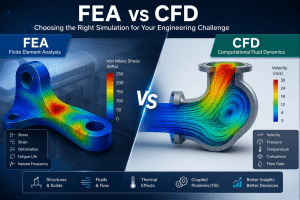
FEA vs CFD: Key Differences, Applications, and How to Choose the Right Simulation Method
Engineering simulation allows engineers to evaluate designs before manufacturing, installation, or construction begins. However, not every simulation method solves the same problem. Two of the most widely used methods are Finite Element Analysis and Computational Fluid Dynamics. These methods are commonly known as FEA and CFD. FEA usually evaluates the

Crack Growth Analysis: Methods, Models and Applications
Cracks are among the most serious defects found in industrial equipment and engineering structures. A small crack may appear harmless during an inspection. However, repeated loading can cause it to grow over time. Eventually, the crack may reach a critical size. At that point, the remaining section may no longer

Conduction vs Convection vs Radiation: A Complete Engineering Guide
Heat transfer is one of the most important principles in engineering. Whether engineers are designing a pressure vessel, heat exchanger, industrial furnace, electronic cooling system, HVAC system, pipeline, power plant component, or manufacturing process, they must understand how heat moves from one place to another. In real engineering systems, heat
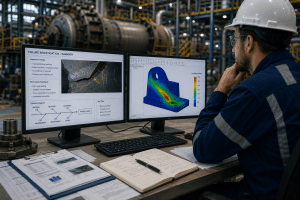
Common RCFA Tools: A Complete Guide for Engineering and Reliability Teams
Root Cause Failure Analysis, commonly known as RCFA, is one of the most important investigation methods used in engineering, maintenance, reliability, manufacturing, mining, oil and gas, power generation, infrastructure, and industrial operations. When equipment fails, production stops, safety risks increase, and repair costs rise. However, the most expensive mistake is
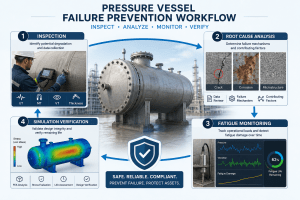
Common Pressure Vessel Failures and How to Prevent Them
Pressure vessels are among the most critical assets in industrial facilities. They store or process gases, vapours, liquids, and chemical products under pressure, often in demanding environments involving high temperature, corrosive fluids, cyclic loading, vibration, and strict safety requirements. Because of this, pressure vessel failures are rarely minor events. A
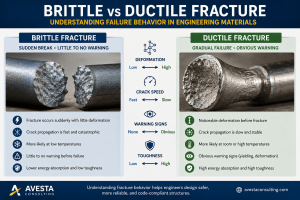
Brittle vs Ductile Fracture: Key Differences, Causes, Examples, and Prevention
Fracture is one of the most important failure modes in engineering materials. Whether the component is a pressure vessel, pipeline, bridge connection, mining structure, rotating machine part, lifting attachment, or welded steel frame, the way a material fractures can determine whether failure is gradual and detectable or sudden and catastrophic.