Knowing that a Root Cause Failure Analysis needs to happen is one thing. Knowing which tool to reach for once the investigation starts is another — and it’s the decision that most often determines whether an RCFA actually finds the root cause or just documents the symptoms more thoroughly.
We’ve already covered the step-by-step RCFA process and the distinction between RCA and RCFA elsewhere on this site. This article picks up from there, focusing on the part investigators usually get wrong: matching the tool to the failure. That includes the basic problem-solving tools most reliability teams already know, and the advanced engineering methods — fracture mechanics, fatigue analysis, FEA, metallurgical testing — that basic tools can’t reach on their own.
Why RCFA Tools Matter
An RCFA is only as good as the tool used to run it. A 5 Whys session on a complex, multi-component failure will produce a plausible-sounding answer that’s often wrong, simply because the tool isn’t built to handle interacting causes. Conversely, running a full Fault Tree Analysis on a simple, single-cause failure burns time and budget the investigation didn’t need to spend.
The right tool does three things: it structures the investigation so nothing important gets skipped, it forces conclusions to be backed by evidence rather than assumption, and it produces a result the rest of the organization can actually act on. Get the tool selection wrong, and even a well-run investigation can land on a corrective action that doesn’t stop the failure from recurring.
How Engineers Select RCFA Tools
In practice, the choice of tool comes down to a handful of factors:
- Failure complexity — a single, isolated cause versus multiple interacting factors
- System criticality — safety-critical or high-consequence equipment versus routine assets
- Data availability — whether there’s enough physical or operational evidence to support a quantitative method
- Investigation timeline — how much time and resourcing the investigation has been given
- Failure mechanism — whether the failure is procedural/human-factors in nature, or a physical/material failure that needs engineering analysis to explain
- Regulatory or client requirements — some industries and clients expect a specific level of analytical rigor
None of these factors work in isolation. A safety-critical failure with limited data, for example, often needs a combination of tools rather than a single method — more on that later.
The Most Common RCFA Tools
These are the tools most reliability and maintenance teams reach for first. We’re covering them briefly here — for full definitions and worked examples of each, see our RCFA process guide.
5 Whys Analysis
5 Whys works by repeatedly asking “why” until the investigation reaches a cause that’s controllable and preventable. It’s fast and requires no special training, which makes it the default starting point for straightforward failures. A conveyor belt tripping repeatedly on the same fault code, traced back through five whys to a misaligned sensor bracket, is a typical case — the method works because there’s genuinely one causal chain to follow. It breaks down quickly on failures with multiple contributing factors, where forcing a single linear chain oversimplifies what actually happened.
Fishbone Diagram (Ishikawa Diagram)
The Fishbone diagram sorts potential causes into categories — typically equipment, people, methods, materials, environment, and management — branching off a central failure statement. It’s the most widely used RCFA tool because it’s visual, works well in group investigation sessions, and surfaces causes across categories that a linear method like 5 Whys can miss. A recurring pump seal failure investigated by a cross-functional team, for example, might reveal contributing factors spanning lubrication practice (methods), seal material selection (materials), and ambient temperature (environment) — a spread a single “why” chain would likely miss.
Fault Tree Analysis (FTA)
FTA works backward from an undesired top event, using logic gates (AND/OR) to map every combination of underlying failures that could cause it. It’s the tool of choice for safety-critical systems and complex equipment, because it captures how multiple simultaneous conditions combine to produce a failure — something neither 5 Whys nor Fishbone diagrams are built to quantify. A pressure relief system failing to activate during an upset condition is a typical FTA candidate: the top event only occurs if several independent barriers fail together, and FTA is what makes that combination visible and, where enough data exists, quantifiable.
Failure Mode and Effects Analysis (FMEA)
FMEA is proactive by design — it identifies potential failure modes before they occur and ranks them by severity, occurrence, and detectability. In an RCFA context, it’s used two ways: to check whether a failure was already flagged as a risk, and to update the FMEA afterward so the finding feeds forward. A gearbox failure that traces back to a lubrication failure mode already listed but ranked too low to trigger action is a common finding — one that usually prompts a re-scoring of that risk priority.
Event and Causal Factor Analysis
This method reconstructs a detailed timeline of the events and conditions leading up to a failure, mapping how each event and causal factor connects to the next. It suits complex incidents with multiple contributing events unfolding over time — process upsets, multi-stage equipment failures, or incidents involving both human and system factors. A furnace trip investigation mapping operator actions, control responses, and equipment behavior across a 40-minute window is typical — the timeline itself becomes the analysis, revealing where an intervention could have changed the outcome.
Pareto Analysis
Pareto Analysis applies the 80/20 principle to failure data, ranking failure modes or causes by frequency or impact to identify where investigation and improvement effort will have the biggest return. It doesn’t investigate a single failure — it prioritizes across many. A maintenance team reviewing twelve months of pump failures and finding that three failure modes account for most of the downtime is a classic Pareto outcome, and it’s often the step that determines which failure gets a full RCFA in the first place.
Advanced Engineering Tools Used in RCFA
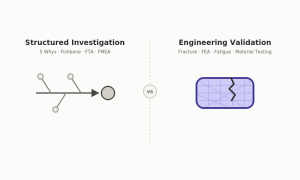
The tools above are essential for structuring an investigation, but they all depend on someone being able to correctly diagnose the physical failure mechanism in the first place. On complex mechanical, structural, or material failures, that diagnosis requires engineering analysis — not just a structured discussion. This is where most RCFA tool discussions stop short, and where the actual technical depth of an investigation gets decided.
Fracture Mechanics
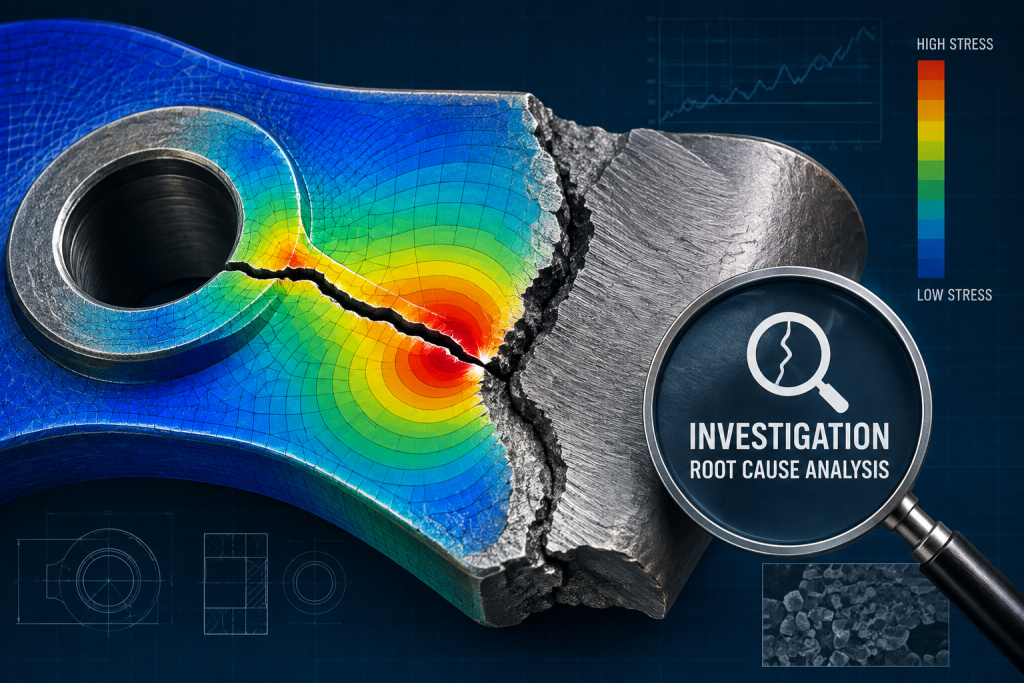
When a component fails by cracking, fracture surface analysis and fracture mechanics calculations can determine whether the failure was caused by overload, fatigue crack growth, brittle fracture, or environmentally assisted cracking — and estimate how long the crack had been propagating before final failure. This distinction changes the corrective action entirely: brittle fracture points to material toughness, slow crack growth points to loading or inspection intervals. Our fracture mechanics team applies this analysis directly within RCFA investigations involving cracked or fractured components.
Fatigue Analysis
Cyclic loading failures rarely show obvious warning signs until the component has already failed, making fatigue one of the harder mechanisms to diagnose from operational data alone. Fatigue analysis combines stress history, material S-N behavior, and often finite element modelling to confirm whether cyclic loading — rather than a single overload event — drove the failure, and to estimate remaining life in similar components still in service. We cover the underlying mechanisms in High Cycle vs Low Cycle Fatigue, and our fatigue analysis service applies this directly to failure investigations.
Finite Element Analysis (FEA)
FEA lets investigators reconstruct the stress and deformation state a component actually experienced at the moment of failure — something that’s often impossible to determine from inspection alone. By building a model of the failed component and applying the real (or best-estimate) loading conditions, FEA can confirm or rule out a hypothesized failure mechanism, identify stress concentrations that weren’t obvious from the geometry, and test whether a proposed design fix actually resolves the root cause before it’s implemented.
Material Testing and Metallurgical Analysis
Physical testing — hardness testing, tensile testing, chemical composition analysis, and metallurgical examination — establishes whether the failed component’s actual material properties matched its specification. It’s a step that’s easy to skip under schedule pressure, but a surprising number of failures ultimately trace back to a material substitution, an out-of-spec heat treatment, or a manufacturing defect that no amount of stress analysis alone would have caught. It’s often the tool that turns a plausible root cause into a confirmed one.
Comparison of Common RCFA Tools
| Tool | Best For | Complexity | Data Required | Output Type |
|---|---|---|---|---|
| 5 Whys | Simple, single-cause failures | Low | Minimal | Linear cause chain |
| Fishbone Diagram | Multi-category brainstorming | Low–Medium | Minimal–Moderate | Categorized cause map |
| Fault Tree Analysis | Complex, safety-critical systems | High | Moderate–Extensive | Logic diagram, quantifiable |
| FMEA | Risk prioritization, proactive/reactive | Medium | Moderate | Ranked failure modes |
| Event & Causal Factor Analysis | Multi-event, time-based incidents | Medium–High | Moderate–Extensive | Timeline with causal links |
| Pareto Analysis | Prioritizing across many failures | Low | Historical failure data | Ranked frequency/impact chart |
Which RCFA Tool Should You Use?
There’s no single “best” RCFA tool — the right choice depends on what kind of failure you’re actually investigating. As a starting point:
| If the failure is… | Start with… | Escalate to… |
|---|---|---|
| A single, obvious cause with a clear fix | 5 Whys | — |
| Likely to involve several contributing factors across categories | Fishbone Diagram | Event & Causal Factor Analysis if a timeline is needed |
| Safety-critical, or dependent on multiple simultaneous failures | Fault Tree Analysis | FEA to quantify the physical loading behind each branch |
| A known risk that wasn’t adequately controlled | FMEA review | Update FMEA post-investigation |
| Spread across many recurring incidents | Pareto Analysis | Full RCFA on the top-ranked failure mode |
| A cracked, fractured, or fatigued component | Fracture mechanics or fatigue analysis | FEA and material testing to confirm the mechanism |
| Unclear whether the material met specification | Material testing | Metallurgical analysis if a manufacturing defect is suspected |
As a general rule: if the failure can be explained with confidence using only operational and maintenance data, a basic tool is usually sufficient. The moment the explanation depends on how a component actually behaved physically — its stress state, its material properties, or how a crack grew over time — an investigation needs to escalate to engineering analysis, because no amount of structured discussion can substitute for that physical evidence.
Combining Multiple RCFA Methods
Most real-world RCFA investigations use more than one tool, applied in sequence rather than in isolation. A single method rarely covers both the organizational causal chain and the physical failure mechanism — and a thorough investigation needs both.
Example Investigation Workflow
- Pareto Analysis identifies which recurring failure mode is consuming the most downtime and therefore justifies a full investigation.
- Event and Causal Factor Analysis reconstructs the timeline leading up to the specific failure event, capturing operating conditions, maintenance history, and any process upsets.
- Fishbone Diagram is used in a cross-functional session to structure hypotheses across equipment, process, and human factors.
- Fracture mechanics or fatigue analysis is applied to the failed component to confirm or rule out the physical failure mechanism identified as most likely.
- FEA validates the hypothesis by reconstructing the stress state the component actually experienced, and tests whether a proposed design change resolves it.
- FMEA is updated with the confirmed failure mode and its corrected risk ranking, closing the loop for future investigations.
Common Mistakes When Using RCFA Tools
- Choosing a tool based on familiarity rather than fit. Teams default to 5 Whys or Fishbone diagrams even when the failure clearly needs quantitative or physical analysis.
- Treating the tool’s output as the root cause. A Fishbone diagram produces hypotheses, not conclusions — each branch still needs testing against evidence.
- Skipping physical evidence in favor of discussion-based tools. A cracked component should go to fracture or metallurgical analysis before the team debates its cause in a workshop.
- Using FTA or FMEA without enough data to support them. Both produce a false sense of rigor if the underlying probabilities are guessed rather than evidenced.
- Stopping at the first tool that produces an answer. A plausible cause from a 5 Whys session isn’t a confirmed one — complex failures usually need a second, corroborating method.
- Not closing the loop. Findings that never make it back into the FMEA or maintenance strategy get rediscovered the next time the same failure occurs.
Frequently Asked Questions
What are the most common RCFA tools? 5 Whys, Fishbone (Ishikawa) diagrams, Fault Tree Analysis, and FMEA are the most widely used, alongside Event and Causal Factor Analysis and Pareto Analysis for prioritization.
What is the best RCFA method? There isn’t a single best method — it depends on the failure’s complexity and whether it’s driven by process/human factors or a physical failure mechanism. Simple failures suit 5 Whys; complex or safety-critical failures usually need Fault Tree Analysis combined with engineering analysis like FEA or fracture mechanics.
When should engineers use Fault Tree Analysis? FTA is most valuable when a failure depends on multiple conditions occurring together, particularly in safety-critical or high-consequence systems where quantifying the probability of combined failures matters.
What is the difference between FMEA and RCFA? FMEA is a proactive risk-assessment tool used to anticipate failure modes before they happen. RCFA is a reactive investigation method used after a failure has occurred. The two connect when RCFA findings are used to update an existing FMEA.
Can multiple RCFA tools be used together? Yes — and for anything beyond a simple, single-cause failure, they usually should be. A typical investigation might combine a causal timeline, a structured brainstorming tool, and engineering analysis to confirm the physical mechanism.
Is FEA considered an RCFA tool? Yes, in the sense that it’s used within RCFA investigations to confirm or rule out a hypothesized failure mechanism by reconstructing the actual stress and loading conditions a component experienced. It’s not a substitute for the structured investigation tools above — it’s what validates the conclusion they point to.
Conclusion
The basic RCFA toolkit — 5 Whys, Fishbone diagrams, FTA, FMEA, causal factor analysis, and Pareto analysis — covers most of what’s needed to structure an investigation and organize evidence. But for failures involving cracked, fatigued, or otherwise physically compromised components, structure alone doesn’t confirm a root cause. That requires fracture mechanics, fatigue analysis, FEA, and material testing to actually validate what happened at the physical level.
Need support conducting a complex failure investigation? Our engineering team combines RCFA methodologies with advanced engineering analysis to identify and eliminate root causes. Get in touch to talk through your investigation.