Most engineers already know that ASME Section VIII governs pressure vessel design. What’s harder is applying it — deciding which Division actually fits a project, where the real cost and schedule trade-offs sit, and which mistakes quietly turn a compliant design into a rejected one.
If you’re looking for a plain breakdown of what Section VIII covers, ASTM material references, and the basic Division 1/2/3 definitions, we’ve already put that together in Pressure Vessel Design According to ASME. This article picks up from there. It’s written for engineers who already understand the code exists — the focus here is on how to use it well: how to choose between Divisions, what typically goes wrong on real projects, and where engineering analysis fits into the compliance picture.
Where Section VIII Sits in the Bigger Picture
The ASME Boiler and Pressure Vessel Code (BPVC) is a family of standards, not a single document. Section VIII is the part that deals specifically with pressure vessels — the design, fabrication, inspection, testing, and certification of equipment operating above 15 psi. Section II, by comparison, handles material specifications; Section V covers non-destructive examination methods. Section VIII pulls on both of these, but it’s the section that ultimately dictates whether a vessel design is acceptable.
For most engineers working on oil & gas, chemical processing, power generation, or minerals processing equipment, Section VIII is the code that shapes the entire design brief — before a single calculation is run, it determines what data you need, what your material options are, and how much analysis the project can justify.
It’s also worth being clear about what Section VIII doesn’t do. It doesn’t tell you which Division is right for your specific project, it doesn’t tell you how conservative to be with a corrosion allowance on a vessel with an uncertain process history, and it doesn’t resolve the tension between a client’s budget and their expectation of a long service life. Those are engineering decisions that sit on top of the code, informed by it but not dictated by it. That’s the gap this article is aimed at.
Why It’s Worth Getting This Right
Getting Section VIII compliance wrong doesn’t usually show up as an obvious code violation. It shows up as:
- A design that passes calculations but fails third-party review, costing weeks of rework
- A Division 1 vessel that’s needlessly overbuilt because nobody assessed whether Division 2 would have been cheaper long-term
- A Division 2 vessel that’s under-resourced for the analysis and documentation burden it actually requires
- Inspection and NDE requirements discovered late, after fabrication has already started
None of these are failures of knowing the code exists — they’re failures of applying it early and deliberately, which is where most of the actual engineering judgment lives.
Division 1 vs Division 2: The Decision That Actually Matters
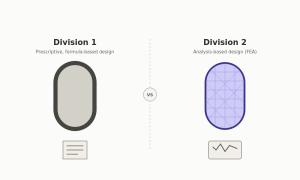
The Division 1/2/3 structure is well documented elsewhere, so we won’t repeat the definitions here. What’s less often discussed is how the decision actually gets made on a live project — because on paper, both Divisions can often produce a compliant vessel. The question is which one produces the right vessel for your constraints.
Design Methodology: Prescriptive vs Analysis-Driven
Division 1 uses prescriptive formulas — you plug in known variables and get a wall thickness. It’s fast, it’s well understood by fabricators, and it doesn’t require in-house FEA capability. Division 2 shifts the burden onto engineering analysis: stress categorization, fatigue evaluation, and often full finite element modelling. The practical question isn’t “which is more accurate” — Division 2 generally is — it’s whether your project timeline and engineering resourcing can absorb that additional analysis work without blowing the schedule.
Safety Margins: A Trade-off, Not Just a Number
Division 1’s higher factor of safety isn’t a weakness — it’s a hedge against uncertainty when detailed stress analysis isn’t being performed. Division 2’s tighter margins are only justifiable because they’re backed by more rigorous analysis. Treat the margin as the price you pay for the depth of analysis you’re willing (or able) to do, not as an arbitrary code number.
Analysis Requirements: What Your Team Needs to Actually Deliver
This is where projects most often stall. Division 2 isn’t just “add some FEA” — it typically requires stress categorization against defined limits, fatigue evaluation for cyclic service, and a documentation trail that a third-party reviewer can follow. If your team doesn’t have that capability in-house, factor in the cost of bringing in specialist support before committing to Division 2 on a proposal or budget.
Cost Implications: Upfront vs Lifecycle
Division 1 is almost always cheaper to get through initial design and certification. Division 2 tends to win on lifecycle cost for vessels that are large, heavily cyclic, or built from expensive alloys, because the material savings from tighter margins compound. The mistake we see most often is evaluating this purely on upfront engineering hours, without modelling what the material and fabrication savings look like over the vessel’s design life.
Key Design Requirements: Where Judgment Beats Formula
The core inputs — material selection, design pressure and temperature, wall thickness, inspection and testing — are the same regardless of Division. What changes is how much room there is for engineering judgment within them.
Material selection isn’t just picking an ASTM-listed grade off a table. It’s balancing allowable stress at temperature, corrosion behaviour in the actual process fluid, weldability, and lead time — a material that’s technically compliant can still be the wrong choice if it extends procurement by months. A stainless grade that looks ideal for corrosion resistance can, in practice, be the slower and more expensive path if a carbon steel option with a suitable lining or coating would meet the same service life at a fraction of the cost and lead time.
Design pressure and temperature should reflect real operating envelopes, including upset conditions, not just steady-state numbers pulled from a process data sheet. Underestimating transient conditions is one of the more common reasons a design gets flagged in review. A vessel sized purely for normal operating pressure can be undersized the moment a control system trips or a relief path is temporarily blocked — and that’s exactly the scenario a reviewer will test for.
Wall thickness is a code calculation, but the inputs that feed it — corrosion allowance, joint efficiency, mill tolerance — are engineering decisions with real cost consequences. A conservative corrosion allowance is cheap insurance on a small vessel; on a large-diameter, thick-walled vessel it can add meaningful cost, and that cost compounds if it pushes the design into a heavier plate category or a different welding procedure altogether.
Inspection and testing requirements scale with Division and service severity. Deciding your NDE strategy after fabrication has started is one of the most expensive mistakes on a pressure vessel project — it belongs in the design phase, not the shop. Retrofitting a higher radiography percentage or an additional hydrostatic test cycle after welding is complete usually means re-sequencing fabrication, which almost always costs more than planning for it upfront.
How Engineering Analysis Supports Compliance
Section VIII compliance isn’t a document review exercise — it’s backed by engineering analysis at several points in the design.
Stress analysis identifies where a vessel is genuinely at risk, not just where the code assumes it might be. We go into this in more depth in our upcoming article on pressure vessel stress analysis.
Fatigue assessment becomes essential for vessels in cyclic service — thermal cycling, pressure cycling, or vibration-heavy environments — where a design that passes static checks can still fail in service. We’ll cover this in detail in a dedicated fatigue analysis article; for a broader look at fatigue mechanisms in industrial equipment, see High Cycle vs Low Cycle Fatigue: Key Differences, Failure Mechanisms, and Analysis Methods.
Design verification is where all of this comes together — confirming through independent analysis, FEA, and testing that a design actually meets its stated requirements before it goes to fabrication. We cover the FEA and hydrostatic testing side of this in Pressure Vessel Design Verification, and our Design Verification service covers how we support this independently for clients.
Common Mistakes in ASME Pressure Vessel Design
A few patterns show up repeatedly across projects, regardless of industry:
- Choosing a Division before scoping the analysis effort. Teams commit to Division 2 for the material savings without confirming they have the FEA and fatigue capability to deliver it on schedule.
- Treating corrosion allowance as a formality. It’s often set by habit rather than by actual process and inspection data, leading to either unnecessary cost or premature vessel retirement.
- Leaving inspection planning until after fabrication starts. NDE and hydrostatic testing requirements should shape the fabrication sequence, not be retrofitted onto it.
- Underestimating transient and upset conditions. Steady-state design pressure and temperature don’t capture start-up, shutdown, or off-spec operating scenarios that can govern the actual design case.
- Assuming Division 1 is always the “safe default.” For heavily cyclic or high-value vessels, sticking with Division 1 out of familiarity can mean carrying unnecessary weight and material cost for the vessel’s entire service life.
- Skipping independent design verification. Internal sign-off isn’t a substitute for independent FEA or third-party review, particularly for vessels operating in high-consequence services.
When Should Engineers Use Division 2 Instead of Division 1?
As a starting point, Division 2 tends to make sense when most of the following apply to a project:
| Factor | Favours Division 1 | Favours Division 2 |
|---|---|---|
| Design pressure | Moderate, within typical Div 1 limits | High, or approaching Div 1’s practical ceiling |
| Loading pattern | Largely static, few pressure/thermal cycles | Cyclic service — frequent start-stop, thermal cycling |
| Material cost | Low-cost, readily available materials | High-value alloys where weight/material savings matter |
| In-house analysis capability | Limited FEA or fatigue expertise available | Established FEA and stress categorization capability |
| Project timeline | Tight schedule, fabrication-ready design needed fast | Timeline allows for detailed analysis and documentation |
| Vessel size / value | Small to mid-size, lower capital cost | Large, high-capital vessels where lifecycle savings compound |
| Regulatory/insurance expectations | Standard compliance sufficient | Client or insurer expects analysis-based justification |
If a project scores mostly in the Division 1 column, it’s rarely worth the added analysis burden of Division 2. If it scores mostly in the Division 2 column — particularly on cyclic loading and material value — the upfront analysis cost is usually recovered many times over across the vessel’s service life.
It’s also worth revisiting this decision at concept stage rather than locking it in early out of habit. We’ve seen projects default to Division 1 simply because it was used on the last similar vessel, without re-checking whether this project’s loading profile, material cost, or client expectations had shifted enough to justify a second look at Division 2. A short feasibility-stage comparison — even a rough one — is usually enough to confirm which path actually suits the project.
Frequently Asked Questions
What is ASME Section VIII? It’s the part of the ASME Boiler and Pressure Vessel Code that governs the design, fabrication, inspection, testing, and certification of pressure vessels operating above 15 psi.
What is the difference between ASME Section VIII Division 1 and Division 2? Division 1 uses prescriptive, formula-based design with higher safety margins and simpler analysis requirements. Division 2 uses analysis-based design — typically involving FEA and fatigue evaluation — with tighter margins that reward more detailed engineering work.
Is ASME Section VIII mandatory? It’s mandatory wherever it’s adopted into local regulation or specified contractually. In Australia, it’s commonly used alongside AS 1210, and many international clients require ASME compliance regardless of local code, particularly for export or multinational projects.
Does ASME Section VIII require FEA? Not always. Division 1 generally doesn’t require FEA. Division 2 relies on it far more heavily, particularly for fatigue evaluation and complex geometries that fall outside standard formulas.
What industries use ASME Section VIII? It’s widely used across oil & gas, chemical and petrochemical processing, power generation, minerals processing, and pharmaceuticals — essentially anywhere pressurised equipment is fabricated to an internationally recognised standard.
How does ASME Section VIII improve pressure vessel safety? It sets a consistent, tested framework for material selection, stress limits, and inspection — reducing the chance that a design decision made in isolation creates an unrecognised failure risk elsewhere in the vessel.
Conclusion
Knowing what ASME Section VIII says is only half the job. The real engineering value is in applying it — choosing the right Division for the project in front of you, resourcing the analysis it demands, and catching the mistakes that don’t show up until fabrication or third-party review. That’s where experienced analysis support pays for itself.
Need support with ASME-compliant pressure vessel design or verification? Our engineering team provides advanced analysis, simulation, and code compliance services for pressure equipment projects. Get in touch to talk through your next project.