A component can carry its rated load safely for years and still fail without warning. Not because the load was ever too high, but because it was applied and removed, again and again, until a crack that started too small to notice finally grew large enough to matter. That’s fatigue — and it’s one of the most common ways industrial equipment actually fails in service, even when every static calculation checked out.
Fatigue analysis is how engineers get ahead of that failure mode: predicting how many cycles a component can survive before cracking becomes a risk, and designing accordingly. This guide explains what fatigue analysis is, what causes fatigue failure, how it develops, the main analysis methods engineers use, and where it matters most across pressure vessels, pipelines, mining equipment, and rotating machinery.
What Is Fatigue Analysis?
Fatigue analysis is the engineering process of predicting how a material or component responds to repeated or fluctuating loads over time, with the goal of estimating how many load cycles it can withstand before a crack initiates and grows to failure.
It’s fundamentally different from a standard strength check. A static analysis asks whether a component can survive its worst-case load once. Fatigue analysis asks whether it can survive that load — or a much smaller one — applied thousands or millions of times. A component can pass every static check with margin to spare and still develop a fatigue crack within a fraction of its intended service life if cyclic loading wasn’t properly assessed.
Why Fatigue Analysis Matters
Fatigue-related failures are disproportionately expensive precisely because they’re unexpected — a component that was “designed strong enough” fails anyway, usually with little visible warning beforehand.
Preventing Unexpected Failures
Because fatigue cracks can grow for a long time before they’re visible or detectable, a fatigue failure often looks sudden even though the underlying damage accumulated gradually. Fatigue analysis catches this risk at the design stage — identifying which locations on a component are likely to crack first, long before the component is ever built.
Improving Equipment Reliability
Equipment that’s properly assessed for fatigue keeps performing predictably across its operating life, rather than developing cracks at inconsistent intervals that are hard to plan maintenance around. This matters most for equipment in continuous or cyclic service, where unplanned downtime for a fatigue-related repair is far more disruptive than a scheduled inspection.
Extending Service Life
Fatigue analysis doesn’t just prevent premature failure — it also prevents unnecessary over-design. Understanding exactly how a component accumulates fatigue damage lets engineers target reinforcement only where it’s genuinely needed, extending service life without adding unjustified weight or cost everywhere else.
What Causes Fatigue Failure?
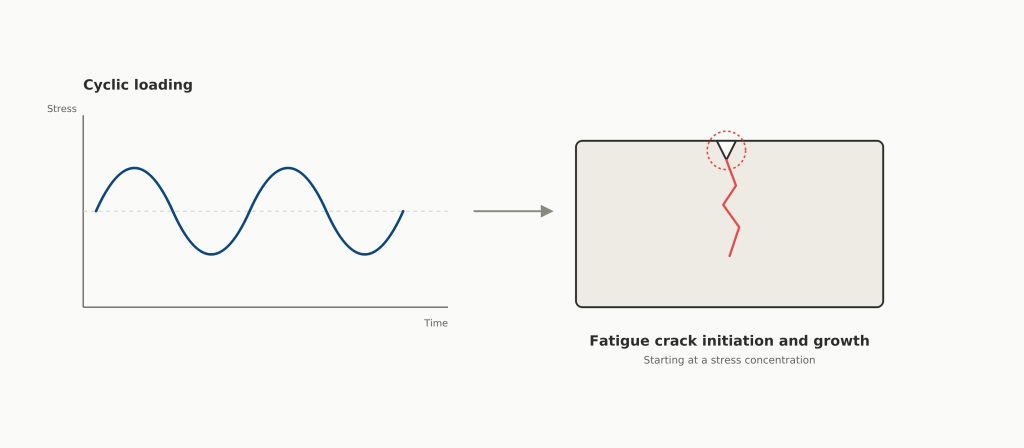
Fatigue failure is rarely caused by a single factor in isolation — it’s usually the combination of a cyclic load, a location where stress concentrates, and a starting point the crack can initiate from.
Cyclic Loading
Repeated loading and unloading is the fundamental cause of fatigue — without it, fatigue simply doesn’t occur, no matter how weak a material or how sharp a notch. Pressure cycling, thermal cycling, vibration, and rotating machinery loads are all common sources of the cyclic stress that drives fatigue damage in industrial equipment.
Stress Concentrations
Geometric features that locally raise stress above the nominal level — notches, holes, weld toes, sharp fillets, and sudden changes in section — are where fatigue cracks overwhelmingly tend to start. A component can have a low average stress and still fail in fatigue if a local stress concentration is high enough.
Material Defects
Inclusions, porosity, weld defects, and machining marks all act as pre-existing stress concentrations at a microscopic scale, effectively giving a fatigue crack a head start. Material and fabrication quality control is as much a part of fatigue resistance as the design itself.
Environmental Factors
Corrosion, elevated temperature, and aggressive process environments can all accelerate fatigue damage — corrosion pitting creates new stress concentrations, while elevated temperature can reduce a material’s fatigue strength. Equipment operating in these conditions typically needs a more conservative fatigue assessment than the same component in a benign environment.
How Fatigue Failure Develops
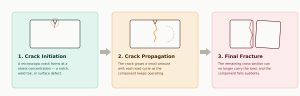
Regardless of the cause, fatigue failure progresses through the same three stages.
- Crack initiation — a microscopic crack forms at a stress concentration
- Crack propagation — the crack grows a small amount with each load cycle
- Final fracture — the remaining cross-section can no longer carry the load
Crack Initiation
Initiation happens at a microscopic scale, typically at a surface stress concentration, and can take up a significant portion of a component’s total fatigue life — or very little of it, depending on how severe the local stress concentration is. Because initiation is difficult to detect directly, fatigue analysis focuses on predicting where and roughly when it’s likely to occur rather than observing it happening. Our Fracture Mechanics service covers how we assess crack behaviour once initiation has occurred or is assumed present.
Crack Propagation
Once initiated, a fatigue crack grows incrementally with each load cycle — often an extremely small amount per cycle, but one that compounds over thousands or millions of cycles into a crack large enough to matter. Propagation rate depends on the stress range, the crack’s current size, and the material’s resistance to crack growth, which is the domain of fracture mechanics rather than standard stress analysis.
Final Fracture
As the crack grows, the remaining intact cross-section shrinks and the effective stress on that smaller area rises, accelerating growth further. Final fracture occurs when the remaining section can no longer support the applied load — often appearing sudden, even though it’s the end point of a gradual process that may have been underway for a long time.
Common Fatigue Analysis Methods
Engineers choose between several established approaches depending on the loading regime and how much detail the project needs. We cover the practical, step-by-step application of these methods within FEA in Fatigue & Failure Analysis Using FEA; the summary below focuses on when each approach fits.
Stress-Life Method (S-N Method)
The stress-life method relates stress amplitude to the number of cycles a component can survive, and is well suited to high-cycle fatigue where stresses stay largely within the material’s elastic range — the most common scenario for equipment subject to vibration or many small load cycles.
Strain-Life Method (ε-N Method)
The strain-life method accounts for local plastic deformation, making it the better choice for low-cycle fatigue — fewer, larger load cycles that push the material beyond its elastic limit locally, such as thermal cycling or start-stop loading in process equipment.
Fracture Mechanics Approach
Where a crack is already known or assumed to exist — from an inspection finding or a conservative design assumption — a fracture mechanics approach predicts how quickly it will grow and how much remaining life the component has. This approach underpins fitness-for-service assessments on equipment already in operation.
Finite Element Analysis (FEA)
For complex geometry or combined loading, FEA provides the detailed stress or strain distribution that stress-life and strain-life methods need as an input, particularly at geometric stress concentrations that simple formulas can’t capture accurately. See Fatigue & Failure Analysis Using FEA for the full FEA fatigue workflow, from meshing through to life prediction.
Fatigue Analysis Applications
Fatigue analysis applies wherever equipment sees repeated loading — which, in industrial settings, is most equipment eventually.
| Application | Typical fatigue driver | Why it matters |
| Pressure vessels | Pressure cycling, thermal cycling | Nozzle-to-shell junctions and welds are common crack initiation sites |
| Pipelines | Pressure surges, thermal expansion, vibration | Weld seams and support points concentrate cyclic stress over long service lives |
| Mining equipment | Repeated impact and heavy dynamic loading | Chutes, crusher structures, and conveyor supports see constant cyclic loading |
| Rotating machinery | Continuous rotational stress cycling | Shafts, couplings, and bearings accumulate millions of cycles quickly |
Pressure Vessels
Pressure vessels in cyclic service — frequent start-stop operation, thermal cycling, or pressure surges — face fatigue risk primarily at nozzle junctions, welds, and geometric transitions. In one verification case we’ve documented, a chemical storage vessel developed early fatigue cracks from high thermal cycling that FEA and hydrostatic testing caught before the vessel entered service — detailed in Pressure Vessel Design Verification.
Pipelines
Pipelines accumulate fatigue damage from pressure surges, thermal expansion and contraction, and vibration — particularly at weld seams, support points, and any location where the pipe run changes direction or diameter. Long service lives mean even a slow crack growth rate can eventually become significant.
Mining Equipment
Mining and processing equipment — crusher structures, chutes, screens, and conveyor supports — experiences some of the harshest cyclic loading in industry, combining high-amplitude impact with near-continuous operation. Fatigue is frequently the actual root cause behind mining equipment failures that initially look like overload failures.
Rotating Machinery
Shafts, couplings, and bearing housings accumulate fatigue cycles extremely quickly simply by rotating, which means even modest stress concentrations can become significant over a realistic service life. Vibration from imbalance or misalignment compounds the cyclic loading these components already see from normal operation.
Fatigue Analysis vs Static Analysis
These two are complementary, not competing — most designs need both, but they answer different questions.
| Aspect | Static Analysis | Fatigue Analysis |
| Question answered | Can the component survive its worst-case load once? | Can the component survive repeated loading over its service life? |
| Loading assumption | Load applied once, held constant | Load applied and removed repeatedly, many times |
| Governing property | Yield or ultimate strength | Fatigue strength (S-N or ε-N behaviour) |
| Typical failure mode addressed | Yielding, excessive deformation, overload fracture | Crack initiation and growth leading to fracture |
| When it can miss a real risk | Doesn’t capture damage accumulation from cyclic loading | Not relevant for components with genuinely static, one-time loading |
Key Inputs Required for Fatigue Analysis
The accuracy of a fatigue assessment depends heavily on the quality of these inputs — a sophisticated analysis built on poor inputs is still an unreliable answer.
| Input | Why it matters |
| Load history | Cycle amplitude, mean stress, and frequency all directly affect fatigue life |
| Material fatigue data | S-N or ε-N curves specific to the actual material and surface condition, not a generic assumption |
| Geometry and stress concentrations | Local stress at notches, welds, and transitions, not just nominal stress |
| Boundary conditions | How the component is actually supported and constrained in service |
| Environmental conditions | Temperature and corrosive exposure, which can reduce fatigue strength |
Common Mistakes in Fatigue Assessment
A few patterns show up repeatedly across projects where fatigue wasn’t properly accounted for:
- Treating a static check as sufficient — assuming a design that passes static analysis is automatically fine in cyclic service
- Underestimating the real load history — using simplified or assumed cycle counts instead of actual operating data
- Using generic material fatigue data — applying textbook S-N curves instead of data that reflects the actual material, surface finish, and fabrication method
- Ignoring environmental degradation — not accounting for corrosion or temperature effects that reduce fatigue strength over time
- Treating fatigue assessment as a one-off checkbox — rather than revisiting it when operating conditions or duty cycles change
- Skipping the link to inspection planning — not using fatigue analysis results to inform where and how often equipment should actually be inspected
How Engineering Simulation Improves Fatigue Predictions
Simplified fatigue calculations work well for straightforward geometry and loading, but most real industrial equipment involves combined loading, complex geometry, or thermal effects that push beyond what hand calculations can reliably capture. Engineering simulation — particularly FEA-based fatigue analysis — resolves the local stress and strain at every geometric feature, rather than relying on simplified stress concentration factors, which materially improves prediction accuracy at exactly the locations where cracks are most likely to start. Combined with vibration and fatigue analysis expertise and independent design verification, simulation turns fatigue assessment from a rough estimate into a decision-ready prediction that can genuinely inform design, material, and inspection choices.
Frequently Asked Questions
What is fatigue analysis?
Fatigue analysis is the engineering process of predicting how a component responds to repeated or fluctuating loads over time, estimating how many cycles it can withstand before a crack initiates and grows to failure.
What causes fatigue failure?
Fatigue failure is caused by cyclic loading acting at a stress concentration — such as a notch, weld, or material defect — which allows a crack to initiate and grow with repeated load cycles, even when the applied stress is well below the material’s static strength.
What is the difference between fatigue analysis and static analysis?
Static analysis checks whether a component survives its worst-case load applied once. Fatigue analysis checks whether it survives repeated loading over its service life, which is a fundamentally different failure mode governed by fatigue strength rather than yield or ultimate strength.
How do engineers predict fatigue life?
Engineers typically combine stress or strain results (from hand calculation or FEA) with material fatigue data (S-N or ε-N curves) to estimate the number of cycles a component can survive, using mean stress corrections and, where cracks are already present, fracture mechanics-based crack growth models.
What industries use fatigue analysis?
Fatigue analysis is widely used across oil & gas, mining and minerals processing, power generation, and general industrial equipment — anywhere pressure vessels, pipelines, rotating machinery, or structural equipment experience repeated or cyclic loading.
Can fatigue analysis prevent equipment failures?
Yes — when performed with accurate load history and material data, fatigue analysis identifies fatigue-critical locations before a component is built or before a failure occurs, allowing design changes, material substitution, or inspection planning to prevent the failure rather than react to it.
Conclusion
A component doesn’t need to see an extreme load to fail — it just needs to see the same moderate load often enough. That’s the risk fatigue analysis exists to manage: not “will this survive once,” but “will this keep surviving, cycle after cycle, for as long as it needs to.” Getting that assessment right, with real load data and material behaviour rather than generic assumptions, is what separates equipment that reaches its design life from equipment that fails early and unexpectedly.
Need support evaluating fatigue life, crack growth, or structural integrity? Our engineering team provides advanced fatigue assessments, fracture mechanics studies, and engineering analysis services. Get in touch to discuss your project.