Most articles about foundation design software start with a list of brand names and a scorecard of features. That approach breaks down quickly in practice, because no single package is the right answer for every foundation problem. A tool built for isolated footing sizing will not represent a piled raft under staged construction loading, and a full soil-structure interaction (SSI) platform is often overkill — and harder to audit — for a simple strip footing on a residential slab.
This guide takes the opposite starting point. Instead of ranking software, it starts with the foundation problem class — footing type, soil model, and verification requirement — and works outward to the capabilities that actually matter for selecting a tool. If you already use a structural analysis program for the superstructure, the foundation software you pair with it should extend that model cleanly, not force you to rebuild it.
What Foundation Design Software Should Actually Solve
Before comparing packages, it helps to separate what foundation software is being asked to do. Two distinctions matter more than any feature list: how much geotechnical behaviour the tool needs to represent, and whether it should stand alone or sit inside a broader finite element workflow.
Geotechnical vs Structural Scope
Foundation design sits at the boundary between structural and geotechnical engineering, and software tends to specialise on one side of that line. Structural-side tools focus on member sizing, reinforcement detailing, and code checks once soil parameters (bearing capacity, subgrade modulus, pile capacity) have already been supplied. Geotechnical-side tools derive those parameters in the first place — from borehole data, CPT results, or soil-spring correlations — and are built around consolidation, settlement, and slope-stability theory rather than reinforcement design.
Selecting software without knowing which side of that boundary your team owns is a common and expensive mistake. A structural team that has to estimate soil parameters manually inside a structural package is effectively doing geotechnical engineering without geotechnical tools; a geotechnical consultant handing over raw spring values without checking how they will be applied risks the same disconnect in reverse.
Standalone Footing Tools vs Integrated FEA
The second decision is whether foundation elements should be modelled as standalone components or as part of an integrated finite element model that includes the superstructure. Standalone footing modules are faster to set up and easier to review for simple, statically determinate cases. Integrated FEA becomes necessary once foundation stiffness meaningfully affects superstructure behaviour — tall or irregular buildings, raft-supported cores, and structures on soft or variable soil all fall into this category, where treating the foundation and superstructure as separate calculations can miss real interaction effects.
Foundation Types and Required Capabilities
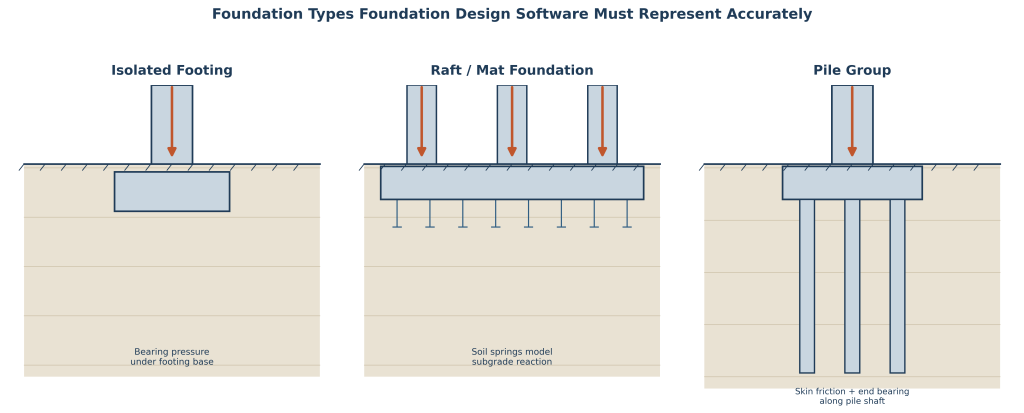
Once scope is clear, the next filter is foundation type. Each type stresses a different part of the software’s engine, and the selection matrix later in this guide is built directly from these distinctions.
Isolated, Combined and Strip Footings
For isolated, combined and strip footings, the core requirements are straightforward: bearing pressure distribution under eccentric and biaxial loading, sliding and overturning checks, and reinforcement design against one-way and punching shear. footing design software aimed at this category typically assumes a rigid footing on a simplified soil model (allowable bearing pressure or a uniform subgrade modulus), which is appropriate for the vast majority of low-rise and light industrial footings and keeps the calculation transparent enough for a quick hand check.
Rafts, Piles and Pile Caps
Raft and mat foundations behave very differently from isolated footings — pressure distribution is rarely uniform, and the raft’s own flexural stiffness interacts with the soil beneath it. This is where mat foundation analysis tools need finite element or finite difference plate modelling with a distributed soil-spring or Winkler foundation, rather than a rigid-body bearing check.
Piled foundations introduce a different set of variables again: axial pile stiffness, group interaction and reduction factors, and lateral pile-soil response for foundations subject to wind or seismic shear. pile foundation software needs to combine geotechnical capacity curves with structural pile-cap design, and — for pile groups — account for load sharing between piles rather than treating each pile in isolation.
Soil-Structure Interaction
Soil-structure interaction (SSI) is where foundation software selection most often goes wrong, because the difference between a crude and a defensible soil model is invisible in the output — both produce a number, but only one of them is representative of how the ground actually responds.
Bearing, Settlement and Springs
soil-structure interaction software needs to represent the soil as more than a single allowable bearing value. Discrete or distributed springs calibrated to a subgrade modulus, layered elastic settlement calculations, and consolidation-based long-term settlement are all different levels of fidelity, and each is appropriate for a different combination of soil type, structure sensitivity, and project stage. Confirming which method a package uses — and whether that method matches the geotechnical report’s recommendations — should happen before the software is adopted, not after the first design is issued.
Nonlinear Soil Models and Staged Construction
Soil stiffness is not constant with load or time, and for larger or more sensitive projects that nonlinearity matters. Capabilities to look for include compression-only springs (soil cannot take tension as a footing rocks), stress-dependent stiffness, and staged-construction sequencing so that settlement and load redistribution during excavation and construction are captured rather than assumed to happen instantaneously. Firms already running linear vs nonlinear structural analysis workflows on the superstructure will recognise the same trade-off between fidelity and review effort here.
Loads, Combinations and Code Checks
Importing Reactions from the Superstructure
Foundation loads originate in the superstructure model, and re-keying reactions by hand is both slow and a common source of transcription error. Foundation software that can import support reactions directly from a structural analysis program — matching load cases and combinations rather than a single enveloped value — keeps the foundation design traceable back to its source loading, which matters as much for review as for speed.
Sliding, Overturning, Punching and Reinforcement
On the code-check side, the software should generate load combinations automatically, run stability checks (sliding, overturning, uplift) against the governing combinations, and carry the results through to punching shear and flexural reinforcement design. The value of automation here is not just speed — it is consistency in which combination governs which check, something that is easy to get wrong when combinations are filtered manually.
Model Interoperability and Workflow
BIM/FEA Data Exchange
Foundation models rarely exist in isolation. Clean exchange with BIM platforms and the structural FEA model — geometry, reinforcement, and levels — avoids duplicate modelling and keeps foundation drawings consistent with the analysis that justified them. This is particularly relevant on projects where the foundation and superstructure are documented by different teams or different firms.
Revision Control and Avoiding Duplicate Input
Superstructure loads change throughout design development, and foundation models need a defined process for picking up those revisions rather than being manually re-run each time. Software that tracks which load case or model revision a foundation design was based on materially reduces the risk of a footing being certified against outdated loading — a quality issue that is disproportionately easy to introduce and hard to catch in review.
Verification and Reporting
Transparent Equations and Hand Checks
A foundation design that cannot be independently hand-checked is a design that cannot be confidently certified. Software that shows intermediate equations, soil parameters, and load combinations — rather than only a pass/fail result — lets a reviewing engineer verify the governing case without reverse-engineering the calculation. This transparency is worth weighting heavily even when a more opaque tool offers a faster workflow.
Calculation Packages and Review Traceability
For submission and peer review, foundation software should produce a calculation package that documents assumptions, soil parameters, load combinations, and governing checks in a format that a second engineer — or a certifying authority — can follow without access to the original model. This is consistent with the design verification discipline applied across other structural deliverables, and it is one of the clearest differentiators between tools built for quick sizing and tools built for auditable, certifiable output.
Practical Software Selection Matrix
Bringing the previous sections together, the table below maps foundation type against the analysis capabilities that matter most — a starting point for shortlisting software against your own project mix rather than a generic ranking.
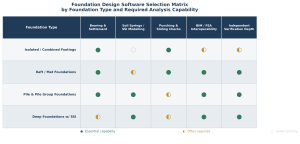
Criteria by Project Complexity
For simple, low-rise footings on well-understood soil, a lightweight footing tool with transparent hand-check-style output is usually the right call — added SSI sophistication mostly adds review burden without changing the design outcome. For rafts, pile groups, or structures on variable or soft soil, prioritise soil-spring or FEA-based modelling and BIM interoperability over ease of use, since the cost of an under-specified soil model rises sharply with structure sensitivity and project scale.
Trial Model, Support, Cost and Governance
Before committing to a package, run one representative model from your actual project mix — not a vendor demo file — through a trial licence, and compare its results against a hand calculation or a known benchmark. Weigh vendor support and update cadence against your certification requirements, and confirm the software supports the internal verification checklists and governance your firm already applies. This mirrors the same licensing, training, and documentation discipline covered in our broader guide to structural analysis programs.
Frequently Asked Questions
What is the best software for foundation design?
There is no single best package — the right choice depends on foundation type, soil model complexity, and verification requirements. A tool that is excellent for isolated footings may be a poor fit for a piled raft under SSI loading, and vice versa. Use the problem-class approach in this guide, then shortlist against the selection matrix above.
Can foundation software calculate settlement?
Many packages can, but with varying methods and accuracy. Some use simplified elastic settlement formulas, while others support layered consolidation settlement or full soil-spring/FEA models. Confirm which method a package uses and whether it matches your geotechnical report’s assumptions before relying on the output.
How do you model soil-structure interaction?
Common approaches include discrete or distributed springs calibrated to a subgrade modulus, layered elastic or consolidation-based settlement analysis, and, for more complex or nonlinear behaviour, full finite element soil models with compression-only or stress-dependent stiffness. The appropriate method depends on soil variability, structure sensitivity, and project stage.
What should a foundation calculation report include?
A defensible calculation report should document the governing load combinations, soil parameters and their source, the analysis method used, intermediate results for stability and reinforcement checks, and a clear statement of the governing case for each check — enough detail for an independent reviewer to verify the design without rebuilding the model.
Final Thoughts
Foundation design software should be chosen the same way any other engineering tool is chosen: by matching its capabilities to the specific problem in front of you, then verifying that its output can be checked and certified with confidence. Brand-driven shortlists skip that step, which is exactly why they tend to under-perform on anything beyond routine footings.
At Avesta Consulting, we help structural and geotechnical teams review their foundation models and correlate software output against site-specific geotechnical data before it goes into a certified design. If you’d like a second look at a current foundation model or help shortlisting software for an upcoming project, get in touch with our team. You may also find our related guides on structural analysis programs and structural analysis methods and applications useful background reading.