Before a pressure vessel is fabricated, a mining chute is welded, or a support frame is bolted into place, someone has to answer a simple but critical question: will it hold?
That question is the entire purpose of structural analysis.
Every piece of industrial equipment carries load — from its own weight, from the process it contains, from wind, vibration, impact, or temperature. Structural analysis is how engineers predict that behaviour before the equipment is ever built, so failures are caught on a screen instead of in the field.
This guide explains what structural analysis is, why it matters, how the process works, the main types of analysis, the methods engineers use to run it, and where it applies across pressure vessels, mining equipment, infrastructure, and manufacturing.
What Is Structural Analysis?
Structural analysis is the engineering process of calculating how a structure or component responds to the loads, supports, and conditions it will experience in service.
It answers practical questions such as:
- Will the structure carry the required load without failing?
- Where will stress concentrate, and is that region acceptable?
- How much will the structure deflect, and does that affect performance?
- Could the structure buckle, fatigue, or fail under repeated loading?
- Does the design meet the relevant code or standard?
To answer these questions, an engineer builds a representation of the real structure — its geometry, material properties, supports, connections, and loads — and calculates the resulting stresses, deformations, and reactions. Simple components can sometimes be checked with hand calculations. More complex geometry, loading, or material behaviour usually calls for Finite Element Analysis (FEA) or another numerical method.
Structural analysis is not a single calculation. It is a broader discipline covering several distinct types of analysis — static, dynamic, linear, nonlinear, thermal, and vibration-related — each suited to different physical behaviour. We cover these in detail below.
Why Structural Analysis Is Important in Engineering
Structural analysis exists because getting a design wrong is expensive at best and dangerous at worst. It sits between concept design and fabrication, giving engineers evidence — not assumption — that a structure will perform as intended.
Ensuring Safety
Structural failure in industrial equipment can put people, plant, and production at risk. Analysis identifies overstressed regions, weak load paths, and failure mechanisms — buckling, yielding, fatigue cracking, excessive deflection — before they become real-world incidents. For safety-critical equipment such as pressure vessels and lifting structures, this verification is often a regulatory requirement, not an optional step.
Improving Reliability
Unplanned equipment failure is disruptive and costly, particularly in continuous operations like mining and mineral processing. Structural analysis helps engineers understand not just whether a structure survives its first load cycle, but whether it will keep performing reliably across its operating life — including repeated loading, vibration, and changing process conditions.
Reducing Costs
Over-designed structures waste material, weight, and fabrication cost. Under-designed structures risk failure, rework, and downtime. Structural analysis allows engineers to size components with confidence — strong enough where it matters, without unnecessary conservatism everywhere else. Catching a design issue during analysis is also far cheaper than catching it after fabrication or, worse, after commissioning.
Supporting Design Decisions
Analysis results directly inform design choices: material selection, section sizing, connection design, and where reinforcement is genuinely needed. Rather than relying on rules of thumb or past projects alone, engineers can compare design options against calculated performance and make decisions backed by data.
How Structural Analysis Works
Every structural analysis, regardless of complexity, follows the same general process.
Creating the Structural Model
The process starts with a representation of the physical structure — its geometry, member sizes, plate thicknesses, material properties, and how components connect to each other. This model can be a simplified hand-calculation representation or a detailed 3D geometry built for FEA. The level of detail should match the complexity of the problem; an overly simplified model can miss real behaviour, while unnecessary detail adds cost and time without improving the answer.
Defining Loads and Constraints
Next, the engineer applies the loads the structure will actually experience — dead weight, live loads, process pressure, wind, seismic loads, thermal loads, or dynamic and impact loads — along with the boundary conditions that represent how the structure is supported or restrained. This step is where many analysis errors originate. A support modelled as fixed when it is actually free to rotate, or a load applied in the wrong direction, can produce misleading results even from an otherwise correct model.
Running the Analysis
With geometry, materials, loads, and supports defined, the model is solved. For simple problems this may be a closed-form calculation. For complex geometry or loading, an FEA solver divides the structure into smaller elements and calculates how each element — and the assembly as a whole — responds. The appropriate solution method depends on the type of analysis required, covered in the next section.
Evaluating Results
The final step is interpreting the output: stresses, deflections, reaction forces, natural frequencies, or fatigue life, depending on the analysis type. Results need to be checked against the relevant design code or acceptance criteria, and reviewed for physical plausibility — a model that “runs” is not automatically a model that is correct. Reaction forces should balance applied loads, deflections should be sensible relative to geometry, and stress concentrations should be scrutinised rather than accepted at face value.
Types of Structural Analysis
Structural analysis is not one method — it’s a set of approaches, each suited to different loading conditions and structural behaviour. Choosing the right type is as important as running the analysis correctly.
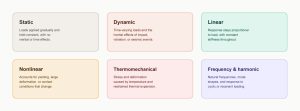
Static Structural Analysis
Static analysis assumes loads are applied gradually and remain constant, with no significant inertial or time-dependent effects. It’s the most common starting point for structural assessment — evaluating dead loads, steady process pressure, or sustained mechanical loads on a frame, vessel, or support structure.
Dynamic Structural Analysis
Dynamic analysis accounts for loads that change with time and the inertial effects that come with them — impact, vibration, seismic events, or rotating machinery forces. Because the structure’s mass and stiffness both influence how it responds over time, dynamic analysis can reveal behaviour, such as resonance or amplified response, that a static model would miss entirely.
Linear Structural Analysis
Linear analysis assumes the structure’s response stays proportional to the applied load — double the load, double the deflection — with constant stiffness throughout. It’s efficient and well suited to routine checks where deformation stays small and the material remains within its elastic range.
Nonlinear Structural Analysis
Nonlinear analysis accounts for changes that occur during loading — material yielding, large deformation, or changing contact conditions — where the response is no longer proportional to the load. It’s more computationally demanding but necessary when a structure could yield, buckle, or experience shifting contact, such as at a bolted joint. Our detailed guide on linear vs nonlinear structural analysis covers how to choose between the two.
Thermomechanical Analysis
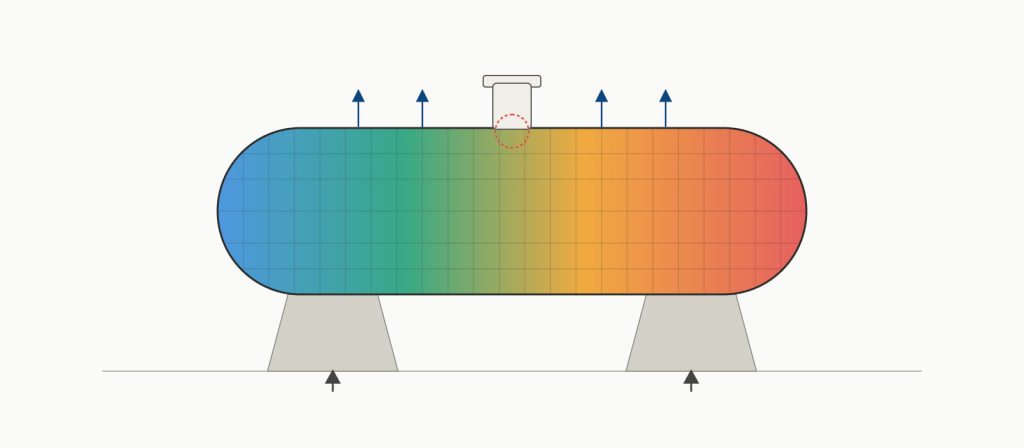
Thermomechanical analysis evaluates stress and deformation caused by temperature — thermal expansion, thermal gradients, and the mechanical stress that results when expansion is restrained. It’s essential for equipment operating at elevated or cycling temperatures, such as high-temperature pressure vessels, furnaces, and piping systems, and often overlaps with heat transfer simulation.
Frequency and Harmonic Analysis
Frequency (modal) analysis calculates a structure’s natural frequencies and mode shapes — the frequencies at which it “wants” to vibrate. Harmonic analysis then evaluates how the structure responds to loads applied at specific frequencies, which is critical for avoiding resonance in equipment subject to rotating machinery, vibration, or cyclic operational loads.
Common Structural Analysis Methods
Beyond choosing the type of analysis, engineers also choose how to solve it. Three broad methods are used in practice, often together on the same project.
| Method | Best suited to | Key trade-off |
| Analytical (hand-calculation) methods | Simple geometry, preliminary sizing, verification checks | Fast and transparent, but limited to simplified geometry and loading |
| Finite Element Analysis (FEA) | Complex geometry, combined loading, stress concentrations, code-based assessment | High accuracy and flexibility, but requires skilled setup and result interpretation |
| Numerical simulation (broader multiphysics) | Coupled problems — thermal-structural, fluid-structural, transient dynamic events | Captures interacting physical effects, but computationally intensive |
Analytical Methods
Classical engineering equations — beam theory, plate theory, pressure vessel formulas from codes such as ASME Section VIII — remain the fastest way to check simple geometry and loading. They’re also the standard way to independently verify an FEA result, since a closed-form check can quickly reveal whether a complex model’s output is in the right ballpark.
Finite Element Analysis (FEA)
FEA is the most widely used modern method for structural analysis. By dividing a structure into a mesh of smaller elements, FEA can handle irregular geometry, combined loading, material nonlinearity, and contact behaviour that analytical methods simply can’t represent. It underpins most of the analysis types described above — static, dynamic, linear, nonlinear, thermal, and frequency analysis are all typically solved using an FEA solver.
Numerical Simulation
Beyond single-discipline FEA, numerical simulation increasingly couples structural behaviour with other physics — thermal, fluid flow, or transient dynamic events — to capture how these effects interact. This is sometimes called simulation-driven design, where the structural response is evaluated alongside the process conditions that create the load in the first place, rather than as a separate downstream check. Our comparison of FEA vs CFD looks at how structural and fluid simulation methods differ and where they’re combined.
Structural Analysis Applications
Structural analysis applies wherever a component or structure needs to carry load reliably. In industrial engineering, four areas stand out.
Pressure Vessels
Pressure vessels carry internal pressure, thermal loads, and external mechanical loads simultaneously, often to a specific design code. Structural analysis verifies shell and head stresses, nozzle reinforcement, and local stress concentrations, and increasingly forms part of formal design verification for code compliance. Our guide to pressure vessel design verification covers this in more depth.
Mining Equipment
Mining and processing equipment — chutes, crusher structures, conveyor supports, and mobile equipment frames — experiences heavy, repeated, and often impact loading in harsh operating conditions. Structural analysis supports both the design of new equipment and the root cause failure analysis of components that fail in service, where fatigue and dynamic loading are frequently involved.
Infrastructure Projects
Bridges, platforms, support towers, and structural steelwork rely on structural analysis to confirm load capacity, deflection limits, and stability under dead, live, wind, and seismic loads. These projects often combine static assessment for normal service conditions with dynamic analysis for wind- or earthquake-governed cases.
Manufacturing Equipment
Process and manufacturing equipment — frames, supports, and mechanical assemblies — needs to withstand operational loads, vibration from rotating machinery, and, in many cases, thermal cycling. Structural analysis here often draws on advanced simulation and fatigue analysis to confirm equipment will survive its full operating life rather than just its first load cycle.
Structural Analysis Challenges
Structural analysis is a powerful tool, but it’s only as reliable as the assumptions and judgement behind it. Common challenges include:
- Model simplification errors — geometry, supports, or connections that don’t accurately represent the real structure
- Incorrect boundary conditions — supports modelled as fixed when they’re actually free to rotate or translate, or vice versa
- Choosing the wrong analysis type — using a static, linear model where dynamic or nonlinear effects actually govern the result
- Mesh and convergence issues — coarse meshing that under-represents stress gradients, or nonlinear models that fail to converge
- Over-reliance on software output — accepting results without independent hand checks or physical plausibility review
- Incomplete load definition — missing combined load cases, thermal effects, or dynamic amplification
Working through these challenges is exactly why structural analysis is treated as an engineering discipline, not a software task — the calculation is only as good as the judgement applied to it.
Structural Analysis vs Structural Design
These two terms are closely related and often used together, but they describe different stages of the same engineering process.
|
Aspect |
Structural Analysis | Structural Design |
| Purpose | Predicts how a structure responds to given loads | Determines the structure’s geometry, sizing, and materials |
| Sequence | Typically follows an initial design, then verifies or refines it | Typically precedes analysis, then is updated based on results |
| Output | Stresses, deflections, reactions, natural frequencies, fatigue life | Member sizes, connection details, material specifications, drawings |
| Question answered | “How will this structure behave under load?” | “What should this structure be, to behave acceptably under load?” |
| Governing standards | Applied to check compliance with codes (e.g. ASME, AS/NZS) | Developed within the limits and requirements of codes |
In practice, the two are iterative: a design is proposed, analysis tests it, and the results feed back into design refinement. Analysis without design has nothing to verify; design without analysis has no evidence it will actually work.
Frequently Asked Questions
What is structural analysis in engineering?
Structural analysis is the process of calculating how a structure or component responds to applied loads, supports, and environmental conditions, in order to predict stresses, deformations, and overall performance before it is built.
Why is structural analysis important?
It verifies that a structure will be safe, reliable, and code-compliant before fabrication, reducing the risk of failure and avoiding the cost of over- or under-designed components.
What are the main types of structural analysis?
The main types are static, dynamic, linear, nonlinear, thermomechanical, and frequency (modal/harmonic) analysis, each suited to different loading conditions and structural behaviour.
What software is used for structural analysis?
Common platforms include general-purpose FEA tools such as ANSYS and Abaqus, and structural-specific programs such as SAP2000, ETABS, STAAD.Pro, and SpaceGass, depending on whether the application is industrial equipment or civil structures.
What is the difference between structural analysis and structural design?
Structural analysis predicts how a given structure behaves under load. Structural design determines what the structure’s geometry, sizing, and materials should be. The two work together iteratively across a project.
Is FEA part of structural analysis?
Yes. FEA is one of the primary methods used to carry out structural analysis, particularly for complex geometry, combined loading, or nonlinear behaviour that analytical hand calculations can’t capture.
Conclusion
Structural analysis is the engineering process that turns “we think this will work” into “we’ve verified this will work.” From static load checks to dynamic, nonlinear, and thermal analysis, the right type and method depend on the structure, its loading, and what’s actually at stake if it fails — which is exactly why pressure vessels, mining equipment, and infrastructure projects treat it as a core part of the design process rather than an afterthought.
Need expert structural analysis support for your project? Our engineering team provides advanced structural simulation and design verification services for complex industrial applications. Get in touch to discuss your project.