A furnace that was relined only months ago is losing thickness again — not in chunks, not along a visible crack, but as fine powder collecting on ledges and in the ductwork. Nobody remembers a thermal shock event. There is no obvious mechanical impact. The lining is simply turning to dust.
That is refractory dusting, and it is one of the more frustrating failure modes to manage because it rarely announces itself the way spalling or erosion does. There is no dramatic slab falling into the process stream, no obvious wear scar lining up with a burner or a chute. Instead, thickness disappears gradually, hot-face readings drift, and by the time anyone measures the loss, the diagnostic evidence — the powder itself — has often already been swept away or carried out with the process gas.
This guide sets out a symptom-to-cause approach to refractory dusting: how to recognise it, how to separate it from the failure modes it is most often confused with, what actually causes it, and how to build a repair and prevention plan around the answer rather than a generic reline specification.
What Is Refractory Dusting?
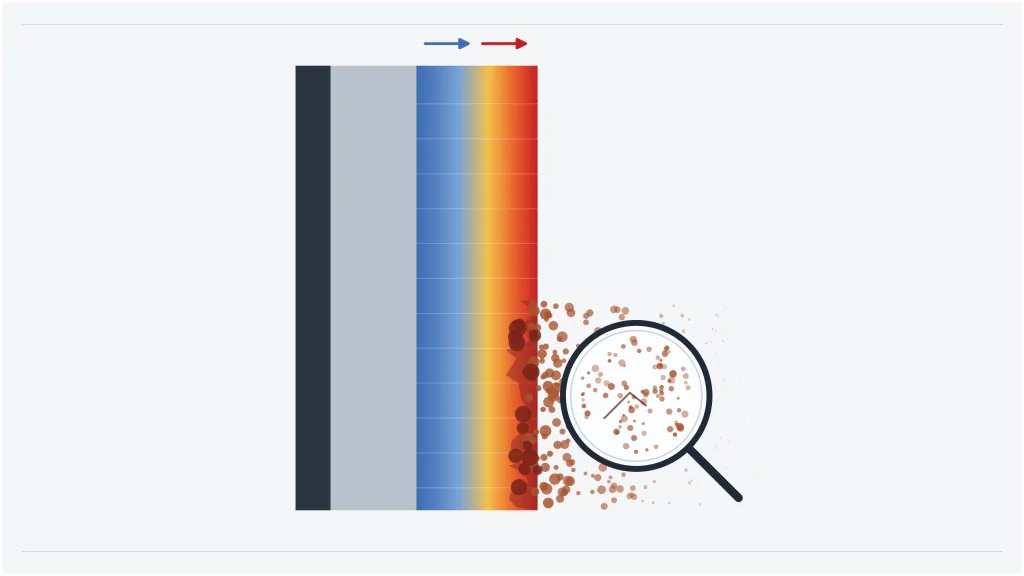
Dusting is the progressive disintegration of a refractory’s hot face into loose, fine particles — typically sub-millimetre to a few millimetres — rather than into cracks, chunks or slabs. The bonding phase that holds aggregate particles together has locally broken down, so the material loses cohesion and sheds itself as powder under normal handling, gas flow or gentle mechanical contact.
Visible Symptoms and Material Loss
The signs are usually indirect before they are direct:
- Fine, light-coloured or dark powder accumulating on ledges, in expansion joints, on the furnace floor or in downstream ductwork and baghouses.
- A hot face that looks intact from a distance but is soft, friable or crumbles under light hand pressure or a scraper.
- Gradual, distributed thickness loss on ultrasonic or physical measurement, without a corresponding pattern of cracks or missing sections.
- A shell temperature trend that creeps upward steadily rather than jumping after an identifiable event.
- Aggregate grains that separate cleanly from the matrix when the powder is examined, rather than fracturing through the grain itself.
Because the loss is gradual and the debris looks unremarkable, dusting is frequently under-reported until a shell hot spot or a refractory thickness survey forces the issue.
Dusting vs Spalling, Erosion and Chemical Attack
Most competitor articles lump every refractory failure mode into one list. In practice, distinguishing dusting from its neighbours early is what determines whether the fix is a material change, an installation correction or an operating change — get this step wrong and a reline can fail again for the same reason within one campaign.
| Failure mode | What is lost | Typical appearance | Usual trigger |
| Dusting | Fine powder, sub-mm to a few mm | Soft, friable hot face; gradual, even thickness loss | Loss of bonding phase — binder, curing, dry-out, material chemistry |
| Spalling | Chunks or slabs | Sharp-edged voids, exposed backup lining | Thermal shock, cyclic stress, mismatched expansion |
| Erosion | Directional wear | Smooth, polished, often grooved surface | High-velocity gas, particle or slag impact |
| Chemical attack | Altered, glassy or bloated layer | Colour change, slag infiltration, bloating | Alkali, sulphur, reducing atmosphere, molten phase attack |
The image below summarises this diagnostic split — it is the first branch point in any refractory failure investigation, and it is where the rest of this article’s root-cause logic starts.
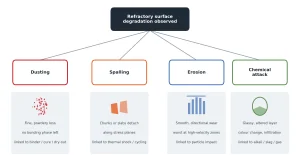
The practical distinction: dusting is a bonding-phase failure, while spalling, erosion and chemical attack are mechanical or reaction failures acting on an otherwise sound matrix. A lining can also show more than one mechanism at once — for example, chemical attack that degrades the bond first, followed by dusting at the reacted layer — so the diagnostic sequence in this guide is built to separate primary cause from secondary consequence.
Map the Operating Conditions Before Looking at the Material
Before pulling samples or blaming a supplier, plot what the lining actually experienced. Dusting is condition-sensitive, and the operating record usually narrows the cause list faster than a lab report does.
Temperature, Atmosphere and Thermal Cycling
- Peak and average hot-face temperature relative to the product’s rated service limit. Even a modest, sustained overheat can push a binder or bond phase past its stable range without ever approaching the classic melting or slagging temperature.
- Atmosphere — oxidising, reducing, or cycling between the two. Reducing conditions are a well-known contributor to bond-phase breakdown in carbon-containing and some oxide refractories.
- Heat-up and cool-down frequency. Frequent start-stop cycling stresses the bond differently than continuous operation, even at the same peak temperature, and can accelerate a dusting mechanism that a steady-state duty would not trigger.
Gas Velocity, Solids Loading and Vibration
- Local gas velocity and solids loading, since these determine whether loosened surface material is removed as fast as it forms (masking early dusting as “erosion”) or accumulates as visible powder deposits.
- Vibration, from adjacent rotating equipment, gas pulsation or structural resonance, which can dislodge material that has already lost cohesion internally — the vibration is not the root cause, but it is often what makes dusting visible.
Material-Related Causes
Wrong Grade, Binder or Aggregate System
Dusting frequently traces back to a mismatch between the specified refractory and the actual service condition:
- A binder system rated for a lower temperature or a different atmosphere than what the zone actually experiences.
- An aggregate–binder combination with poor chemical compatibility at operating temperature — for example, a bond phase that reacts unfavourably with alkalis or sulphur species present in the process.
- A substitution made at procurement or installation stage (same generic type, different supplier formulation) without re-verifying compatibility with the specific duty.
Storage, Shelf Life and Moisture Contamination
Bagged and pre-mixed refractories are chemistry, not just aggregate, and chemistry degrades:
- Cement-bonded castables past shelf life lose reactive capacity, producing a weaker, more porous bond after cure.
- Moisture pickup during storage — from humid site conditions or damaged packaging — can pre-hydrate a bonding phase before it is ever mixed for installation.
- Contamination from dust, oils or incompatible materials on site can interfere with the bond reaction locally, producing patches of weak lining that dust out first.
Installation and Dry-Out Causes
This is the single most common source of dusting in linings under twelve months old, and it is the category most often skipped in a generic RCA because it requires installation records that may not have been kept.
Mixing Water, Compaction and Curing
- Incorrect water addition — too much water increases porosity and weakens the fired bond; too little prevents proper placement and full bond development.
- Inadequate compaction or vibration during installation leaves voids and weak zones that dust out preferentially once in service.
- Curing interrupted or rushed before adequate strength has developed, particularly in cold weather or on a compressed outage schedule.
Heat-Up Rate, Steam Pressure and Incomplete Dry-Out
- Heat-up rate exceeding the manufacturer’s dry-out schedule traps free and chemically bound water, which then generates internal steam pressure as it flashes off.
- Incomplete dry-out, often from a schedule compressed to meet a startup date, leaves residual moisture that continues to affect the bond after the unit is already in service.
- Uneven heating, from burner management or airflow patterns during commissioning, that dries some areas fully while leaving others under-cured — producing dusting that appears in a pattern matching the heat-up airflow rather than the process flow.
Abrasion, Erosion and Chemical Mechanisms That Mimic or Trigger Dusting
Not every dusting case is purely a bond-phase problem from the outset. Some begin as a different mechanism that first weakens the matrix, after which the surface fails by dusting.
Particle Impact and High-Velocity Zones
Repeated low-energy particle impact — from solids entrainment, catalyst fines or ash — can progressively weaken the bond at the surface without removing material fast enough to look like classic erosion. The result reads as dusting at inspection even though the initiating mechanism is mechanical.
Alkali, Sulphur, Reduction and Carbon Deposition
- Alkali vapour attack (potassium, sodium) is a well-documented cause of bond-phase breakdown and volume instability in refractories used in cement, lime and some minerals processing furnaces.
- Sulphur species can react with certain bond phases, particularly in reducing zones, degrading strength before any visible slag layer forms.
- Carbon deposition (Boudouard reaction) in reducing, carbon-monoxide-rich atmospheres can build up within pore structures and physically disrupt the bond matrix from the inside — a mechanism that is easy to miss unless carbon content is specifically checked during sampling.
How to Diagnose the Root Cause
Inspection Pattern and Sample Plan
A defensible diagnosis starts with a pattern, not a sample:
- Map where dusting is occurring against zone, elevation and orientation relative to burners, flow direction and any known hot spots.
- Compare the dusting pattern against the installation record — pour or gunning sequence, batch numbers, weather on the day, and who performed the work — to rule in or out an installation-related cause.
- Take samples from the degraded zone and from an adjacent sound zone of the same material and age, so the lab is comparing like with like rather than testing the failure in isolation.
- Photograph and retain loose powder before it is cleared away — particle size, colour and texture are diagnostic evidence that disappears the moment housekeeping does its job.
Laboratory Tests, Timeline and Operating Data
Useful tests typically include chemical analysis (bulk and, where relevant, layer-by-layer) to check for alkali, sulphur or carbon pickup; phase analysis (XRD) to confirm whether the expected bond phase is present or has converted to something else; porosity and bulk density compared against as-installed specification; and, where installation is suspected, a review of batch certificates against the specification actually required for that zone.
Overlay all of this against the operating timeline — startup date, first dry-out, any trips or upset conditions, maintenance interventions — because the point at which dusting first appeared is usually more diagnostic than the point at which it was finally noticed.
Prevention and Repair Strategy
Material and Detail Changes, Plus Operating Controls
Once the root cause is confirmed, the fix should map directly to it rather than defaulting to “reline with the same material, more carefully”:
- Material mismatch confirmed — re-specify grade, binder system or aggregate chemistry for the actual atmosphere and temperature the zone experiences, not the nameplate duty.
- Installation cause confirmed — tighten water-addition control, compaction method and curing time in the next installation specification, with sign-off points built in rather than left to the crew’s judgement.
- Dry-out cause confirmed — rebuild the heat-up schedule around the manufacturer’s curve for the actual lining thickness installed, not a generic plant standard, and instrument key zones during commissioning.
- Operating condition cause confirmed — address the atmosphere, cycling frequency or velocity driving the mechanism; a better material will still degrade if the underlying operating condition is unchanged.
Repair Boundaries, QA Hold Points and Monitoring
- Define repair boundaries by inspection evidence, not by convenient shutdown boundaries — dusting that has affected the bond phase often extends further than what has visibly lost material.
- Build QA hold points for water addition, compaction and dry-out into the next installation, with records that would let a future investigation actually confirm what was done.
- Establish a monitoring baseline after the repair — thickness survey, shell temperature mapping or acoustic/visual inspection at a set interval — so any recurrence is caught as a trend rather than rediscovered as a failure.
FAQ
What causes refractory dusting?
Dusting results from the breakdown of a refractory’s bonding phase, most often from material or binder mismatch with actual service conditions, installation defects such as incorrect water content or inadequate curing, incomplete dry-out, or chemical attack from alkalis, sulphur or reducing-atmosphere species that degrade the bond before it fails as powder.
How is refractory dusting different from spalling?
Spalling produces chunks or slabs detaching along a stress plane, usually from thermal shock or cyclic stress on an otherwise intact matrix. Dusting produces fine, loose powder from a bond phase that has lost cohesion, with no equivalent stress-driven fracture surface.
Can improper dry-out cause refractory dust?
Yes. Heating a lining faster than its dry-out schedule, or stopping dry-out before it is complete, traps moisture that continues to affect the bond and can produce steam pressure that weakens the matrix internally — a common cause of dusting in linings under a year old.
How do you test a failed refractory lining?
A defensible test programme combines chemical and phase analysis (to identify bond breakdown or contamination), porosity and density comparison against as-installed specification, and a review of installation and operating records against the dusting pattern observed in the field, rather than lab testing in isolation.
If dusting is recurring across relines, or the cause isn’t clear from a visual inspection alone, our root cause failure analysis service can combine site evidence, material testing and simulation to confirm the mechanism before the next reline is specified. For furnaces, kilns and ladles more broadly, our refractory engineering capability covers material selection, lining design and shell-refractory interaction from the outset. To discuss a specific failure, get in touch with our team.
Related reading: Common RCFA Tools: Methods and Techniques Used in Root Cause Failure Analysis · RCA vs RCFA: Key Differences, Applications and When to Use Each Method