Ask two engineers to name a “pressure vessel” and you’ll get two very different pictures in their heads — a horizontal propane tank, a spherical LPG sphere, a tall vertical reactor column, a shell-and-tube heat exchanger. All of them are correct. That’s the point.
A pressure vessel isn’t one design — it’s a category that covers a wide range of shapes, orientations, pressure ranges, and functions, each shaped by the process it serves and the loading it has to survive. Classifying them properly isn’t an academic exercise; it’s the first engineering decision that shapes everything downstream, from code selection to material choice to how the vessel will be analyzed.
This guide walks through how pressure vessels are classified — by function, shape, orientation, and pressure range — the engineering logic behind each category, where they show up across oil & gas, mining, and process industries, and the design challenges that come with each type.
What Is a Pressure Vessel?
A pressure vessel is a sealed container designed to hold a gas or liquid at a pressure substantially different from ambient. That difference in pressure — not the vessel’s size, shape, or contents — is what defines it as a pressure vessel and brings it under codes such as ASME Section VIII. We cover the code side of this in detail in Pressure Vessel Design According to ASME; this article focuses on the types of vessels that code applies to.
Why Pressure Vessel Classification Matters
Classification isn’t just terminology. Each way of categorizing a pressure vessel maps directly to a design decision:
- Function determines internal configuration — baffles, tube bundles, agitators, or simply an empty shell.
- Shape governs how pressure-induced stress distributes across the shell, and therefore how efficiently material is used.
- Orientation affects support design, foundation loading, and how internals settle or drain.
- Pressure range drives material selection, wall thickness, and how much analysis — hand calculation versus FEA — the design actually needs.
Get the classification wrong at concept stage, and it tends to surface later as a design that’s technically compliant but poorly matched to its service — overweight, over-analyzed, or under-engineered for the loading it actually sees.
Types of Pressure Vessels by Function
The most practical starting point is what the vessel actually does in the process. Function shapes internal geometry more than any other classification.
| Type | Primary role | Typical industries |
| Storage vessels | Hold liquids or gases at pressure, with minimal internal process activity | Oil & gas, LPG distribution, chemical storage |
| Heat exchangers | Transfer thermal energy between two fluids across a shell and tube bundle | Refining, power generation, minerals processing |
| Boilers | Generate steam by applying heat to water under pressure | Power generation, industrial utilities |
| Reactors | Contain and control chemical reactions, often under pressure and temperature | Chemical and petrochemical processing |
| Separators | Split multiphase streams into gas, oil, and water components | Oil & gas production, minerals processing |
Storage Vessels
Storage vessels are the simplest functional type — largely a sealed shell with minimal internals, sized to hold a fixed inventory of liquid or gas at pressure. Design attention centres on the shell and heads rather than internal components, though nozzle placement and support design still matter for fatigue and access.
Heat Exchangers
Heat exchangers combine pressure containment with thermal performance, typically as a shell-and-tube arrangement. Two pressure boundaries — shell side and tube side — often operate at different pressures and temperatures simultaneously, which adds thermal stress and differential expansion into the structural picture alongside the usual pressure loading.
Boilers
Boilers are a specialized, heavily regulated subset of pressure vessels, since they combine high-temperature combustion with pressurized water and steam. Cyclic thermal loading from start-up and shutdown makes fatigue a governing design consideration, not an afterthought.
Reactors
Reactors contain a chemical process, which often means internal agitators, catalyst beds, or linings in addition to the pressure boundary. Corrosive or reactive process fluids frequently push material selection toward stainless steel or specialty alloys, covered further below.
Separators
Separators — common in upstream oil & gas — split a multiphase well stream into gas, oil, and water. They’re usually horizontal or vertical cylindrical vessels with internal baffles, mesh pads, or weirs, and their sizing is driven as much by residence time and fluid dynamics as by pressure containment alone.
Types of Pressure Vessels by Shape
Shape is where pressure vessel classification earns its engineering weight. The geometry of a vessel directly determines how uniformly stress distributes across its shell under internal pressure — which is why shape, more than any other factor, drives material efficiency and cost.
| Shape | Stress behaviour | Typical use case |
| Cylindrical | Hoop stress is twice the longitudinal stress — well understood, straightforward to fabricate | The default choice for most storage, reactors, and heat exchangers |
| Spherical | Stress distributes evenly in all directions — the most efficient shape for a given pressure and volume | Large-volume, high-pressure gas storage such as LPG spheres |
| Conical | Stress varies along the taper, concentrating at the shape transition | Transition sections, hoppers, and specialised process vessels |
Cylindrical Pressure Vessels
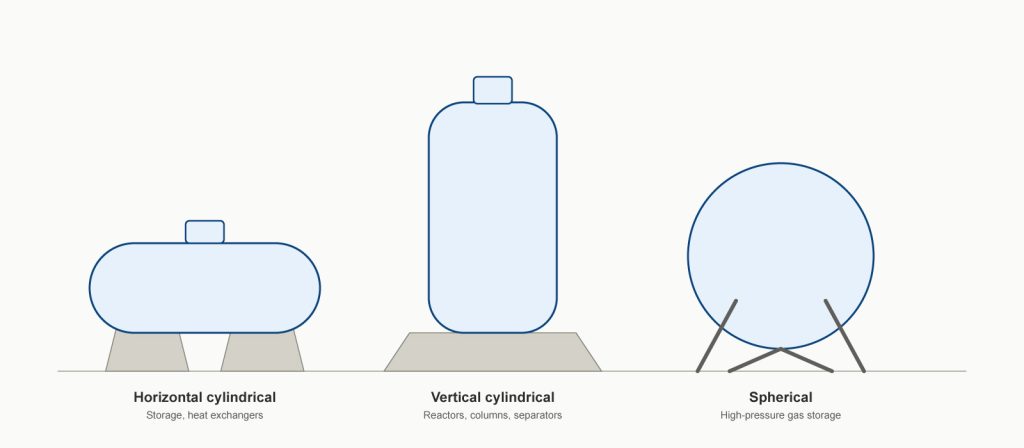
Cylindrical vessels are by far the most common shape in industry, and for good reason: they’re straightforward to fabricate from rolled plate, easy to support, and well understood by fabricators and code writers alike. The trade-off is that a cylinder’s hoop stress runs twice its longitudinal stress under internal pressure, meaning the shell isn’t as material-efficient as a sphere of equivalent volume. A typical horizontal LPG storage tank at a mining or processing site is a cylindrical vessel — the shape that shows up most often across oil & gas, mining, and general process industries.
Spherical Pressure Vessels
A sphere distributes stress evenly across its entire surface, which makes it the most structurally efficient shape for containing pressure — it needs less wall thickness than a cylinder for the same pressure and volume. That efficiency comes at a fabrication cost: spherical shells require more complex forming and welding, and support structures (typically a system of raked legs) are more involved than a simple saddle. Spherical vessels earn that extra cost on large-volume, high-pressure applications — LPG and ammonia storage spheres are the classic example, where the material savings on a very large vessel outweigh the added fabrication complexity.
Conical Pressure Vessels
Pure conical pressure vessels are relatively rare on their own; conical sections more often appear as transition geometry — connecting a cylindrical shell to a smaller-diameter outlet, or forming the base of a vertical vessel that needs to discharge solids or settled liquid. The geometric transition where a cone meets a cylinder is a classic stress concentration zone, and it’s one of the areas most likely to need finite element analysis rather than a purely code-formula approach.
Types of Pressure Vessels by Orientation
| Orientation | Typical applications | Design consideration |
| Horizontal | Storage tanks, heat exchangers, separators | Saddle supports carry bending loads along the shell length |
| Vertical | Reactors, columns, tall separators | Skirt or leg supports carry the full weight and seismic/wind loading in compression |
Horizontal Pressure Vessels
Horizontal vessels sit on two or more saddle supports, which introduce local bending stress at the saddle-to-shell interface — a well-known design check in its own right. They’re a natural fit where floor space allows and where internal arrangement (like a heat exchanger’s tube bundle) favours a horizontal axis. Storage tanks, horizontal separators, and shell-and-tube exchangers are typically horizontal.
Vertical Pressure Vessels
Vertical vessels stand on a skirt or leg support, which carries the vessel’s full weight in compression along with wind and seismic overturning loads — a very different load path from a horizontal saddle. Vertical orientation suits reactors, columns, and tall separators where gravity-driven flow, catalyst beds, or staged internals benefit from height.
Types of Pressure Vessels by Pressure Range
| Range | Typical design approach | Example applications |
| Low-pressure | Simpler prescriptive design, thinner walls, standard materials | Atmospheric-adjacent storage, low-pressure air receivers |
| Medium-pressure | Standard ASME Section VIII Division 1 approach for most projects | Process vessels, standard heat exchangers, general storage |
| High-pressure | Often analysis-based design (Division 2 or 3), stricter material and inspection requirements | High-pressure reactors, gas storage, specialised process equipment |
Low-Pressure Vessels
Low-pressure vessels operate close to atmospheric conditions and generally allow the simplest design approach — thinner walls, standard carbon steel, and prescriptive code formulas without the need for detailed stress analysis.
Medium-Pressure Vessels
The majority of industrial pressure vessels fall into this middle range, where standard ASME Section VIII Division 1 design comfortably applies. This is the pressure band most general storage, process, and heat transfer equipment occupies.
High-Pressure Vessels
High-pressure vessels push toward the limits where prescriptive formulas become overly conservative, which is where ASME Section VIII Division 2 or Division 3 design — backed by detailed engineering analysis — starts to earn its added cost through material and weight savings. These vessels also typically carry stricter inspection and NDE requirements given the higher consequence of failure.
Material Selection for Different Pressure Vessel Types
Shape and pressure define the geometry; the process fluid and operating environment decide the material. Getting this pairing wrong is one of the more expensive mistakes in pressure vessel design — not because the vessel becomes non-compliant, but because it becomes the wrong compliant vessel.
| Material | Best suited to | Watch-out |
| Carbon steel | General storage and process vessels, moderate temperatures, non-corrosive service | Limited corrosion resistance — often needs a lining, coating, or corrosion allowance |
| Stainless steel | Corrosive process fluids, food and pharmaceutical service, cryogenic applications | Higher material cost and longer lead times than carbon steel |
| Alloy materials (e.g. duplex, Inconel, Hastelloy) | High-temperature, high-pressure, or highly corrosive reactors and specialty process equipment | Significant cost premium — justified only when service conditions genuinely demand it |
Carbon Steel
Carbon steel remains the default material for the majority of pressure vessels — storage tanks, general process equipment, and moderate-temperature applications where the process fluid isn’t aggressively corrosive. It’s readily available, well understood by fabricators, and the most cost-effective option when service conditions allow it.
Stainless Steel
Stainless steel earns its higher cost in corrosive or hygiene-sensitive service — chemical processing, food and beverage, pharmaceuticals, and marine environments. Its corrosion resistance can also reduce or eliminate the corrosion allowance that a carbon steel design would otherwise need, which partly offsets the material cost premium over the vessel’s service life.
Alloy Materials
Specialty alloys — duplex stainless, Inconel, Hastelloy, and similar grades — come into play when temperature, pressure, or process chemistry exceed what standard stainless can reliably handle. These materials carry a significant cost premium, so material selection here is a genuine engineering trade-off rather than a default choice: the service conditions need to justify the alloy, not just tolerate it.
Engineering Challenges for Different Pressure Vessel Types
This is where classification stops being a naming exercise and starts driving real engineering work. Different vessel types carry different dominant failure risks, and the analysis effort should follow the risk — not a one-size-fits-all checklist.
Stress Concentrations
Nozzles, shape transitions (like a cone-to-cylinder junction), and support attachments all create local stress concentrations that simple membrane formulas don’t fully capture. This is precisely where finite element analysis earns its place in the design process — identifying whether a locally elevated stress is within acceptable limits or a genuine structural risk. Spherical and conical vessels, and any vessel with multiple nozzle penetrations, tend to need this level of scrutiny more than a simple cylindrical storage tank.
Fatigue Loading
Vessels in cyclic service — boilers, reactors with frequent start-stop cycles, or equipment subject to pressure or thermal cycling — face a very different failure mode than a vessel holding a constant static pressure. A design that passes a static stress check can still develop fatigue cracks after thousands of pressure or thermal cycles. Our guide to High Cycle vs Low Cycle Fatigue covers how these mechanisms differ and when each governs a design.
Thermal Expansion
Heat exchangers, reactors, and any vessel operating at elevated or cycling temperatures have to accommodate thermal expansion — both of the vessel itself and, in multi-boundary equipment like heat exchangers, between components operating at different temperatures. Restrained thermal expansion generates mechanical stress on top of pressure loading, and vessels with significant temperature gradients often need combined thermal-structural simulation to confirm the design is genuinely adequate, not just code-compliant on paper.
Corrosion and Material Degradation
Corrosion is a slow-acting but serious risk, particularly for vessels handling aggressive process fluids, seawater, or cyclic wet-dry conditions. Because it reduces wall thickness over time rather than causing immediate failure, corrosion allowance, inspection intervals, and material selection all need to work together — a generous corrosion allowance on the wrong material is not a substitute for choosing a material actually suited to the service.
Pressure Vessel Type Selection Guide
As a starting point, here’s how the main classification factors typically align:
| If your priority is… | Consider… |
| Lowest fabrication cost and simplest support | Horizontal cylindrical vessel |
| Maximum material efficiency at large volume and high pressure | Spherical vessel |
| Gravity-driven flow, staged internals, or catalyst beds | Vertical cylindrical vessel |
| Corrosive or hygiene-sensitive process fluid | Stainless steel construction |
| Extreme temperature, pressure, or chemical exposure | Specialty alloy construction |
| Cyclic thermal or pressure loading | Design with fatigue analysis, not static checks alone |
How Engineering Analysis Supports Pressure Vessel Design
Classification tells you what kind of vessel you’re dealing with; analysis tells you whether a specific design actually works. As vessels move toward higher pressure, more complex shapes, or cyclic service, the design increasingly leans on engineering simulation — FEA for stress concentrations, thermal-structural coupling for temperature-driven loading, and fatigue evaluation for cyclic equipment — rather than code formulas alone. Independent design verification then confirms that the finished design, materials, and analysis together meet the vessel’s actual service requirements before it goes to fabrication.

Frequently Asked Questions
What are the main types of pressure vessels?
Pressure vessels are typically classified by function (storage, heat exchangers, boilers, reactors, separators), shape (cylindrical, spherical, conical), orientation (horizontal, vertical), and pressure range (low, medium, high).
What is the most common pressure vessel shape?
Cylindrical vessels are the most common, largely because they’re straightforward to fabricate from rolled plate and well understood by both fabricators and design codes.
Why are spherical pressure vessels used for high-pressure applications?
A sphere distributes stress evenly across its entire surface, requiring less wall thickness than a cylinder for the same pressure and volume — making it the most material-efficient shape for large-volume, high-pressure storage.
How are pressure vessels classified?
There’s no single classification system — engineers typically classify vessels by function, shape, orientation, and operating pressure range, since each factor drives a different set of design decisions.
What materials are commonly used for pressure vessels?
Carbon steel is the default for general service, stainless steel for corrosive or hygiene-sensitive applications, and specialty alloys such as duplex stainless, Inconel, or Hastelloy for extreme temperature, pressure, or chemical exposure.
Which pressure vessel type is best for industrial storage?
Horizontal cylindrical vessels are the most common choice for general industrial storage due to their lower fabrication cost and straightforward support requirements; spherical vessels take over at very large volumes and high pressures where material efficiency outweighs the added fabrication complexity.
Conclusion
There’s no single “best” pressure vessel — only the vessel that’s correctly matched to its function, shape, orientation, and pressure range for the service it’s actually going into. Getting that classification right at concept stage sets up every decision that follows: material selection, support design, and how much engineering analysis the project genuinely needs.
Need support with pressure vessel design, verification, or engineering analysis? Our team provides advanced simulation and design services for complex pressure equipment projects. Get in touch to discuss your project.