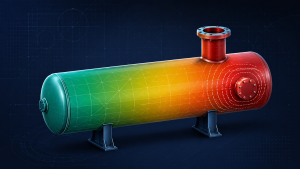
ASME Section VIII Explained: A Decision-Making Guide for Pressure Vessel Engineers
Most engineers already know that ASME Section VIII governs pressure vessel design. What’s harder is applying it — deciding which Division actually fits a project, where the real cost and schedule trade-offs sit, and which mistakes quietly turn a compliant design into a rejected one. If you’re looking for a
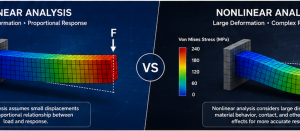
Linear vs Nonlinear Structural Analysis: Key Differences
Structural analysis helps engineers predict how a component or structure will behave under load. It can calculate stress, strain, deformation, reaction forces, buckling risk, contact pressure, and other important responses. However, not every structure behaves in a simple or proportional way. Some structures remain stiff and elastic throughout loading. Others

High Cycle vs Low Cycle Fatigue: Key Differences, Failure Mechanisms, and Analysis Methods
Fatigue is one of the most common causes of failure in engineering components and industrial equipment. A structure may safely support a load once. However, the same structure can fail when that load is repeated thousands or millions of times. This type of failure can occur even when the maximum
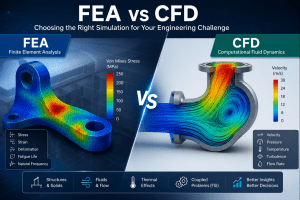
FEA vs CFD: Key Differences, Applications, and How to Choose the Right Simulation Method
Engineering simulation allows engineers to evaluate designs before manufacturing, installation, or construction begins. However, not every simulation method solves the same problem. Two of the most widely used methods are Finite Element Analysis and Computational Fluid Dynamics. These methods are commonly known as FEA and CFD. FEA usually evaluates the

Crack Growth Analysis: Methods, Models and Applications
Cracks are among the most serious defects found in industrial equipment and engineering structures. A small crack may appear harmless during an inspection. However, repeated loading can cause it to grow over time. Eventually, the crack may reach a critical size. At that point, the remaining section may no longer
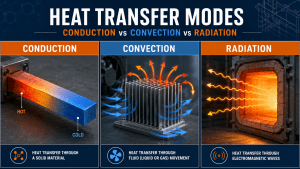
Conduction vs Convection vs Radiation: A Complete Engineering Guide
Heat transfer is one of the most important principles in engineering. Whether engineers are designing a pressure vessel, heat exchanger, industrial furnace, electronic cooling system, HVAC system, pipeline, power plant component, or manufacturing process, they must understand how heat moves from one place to another. In real engineering systems, heat